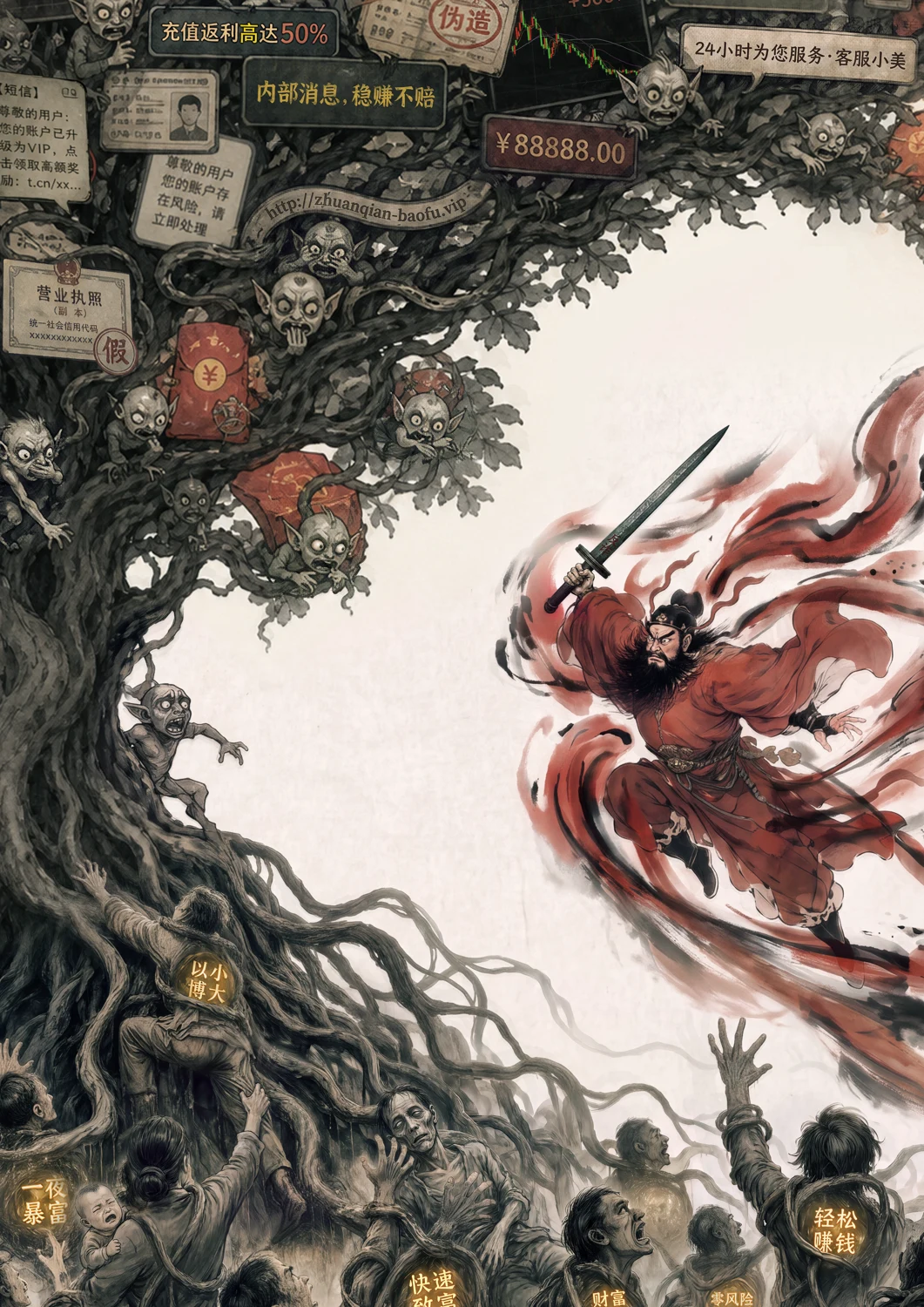
A traditional demon-queller faces digital-age scams that come dressed in human language.
Project Type
Culture & Arts
Client
Self-initiated · VACAT Award entry
Year
2026
Our role
AI poster design & refinement
01 / Background
How a traditional exorcist figure answers today's scams
We created this piece for the VACAT Awards AI Graphic Visual track, where a single image had to connect a traditional figure clearly with a social problem of today. Starting from the idea that “the ancients drove out ghosts; today we drive out fraud,” Anti-Fraud Zhong Kui turns fake customer service, top-up rebates and get-rich-quick promises into a monstrous tree bearing down on the human world, so the scam becomes something viewers recognize at a glance.
The concept also centers on temptation and human judgment. In the crowd below, some people are climbing upward, while others struggle, cry for help or drag their families down with them. What Zhong Kui's sword faces is a scam tangled up with greed. The mythic gesture reflects a very real situation.
02 / Creative Highlights
Making both the scam and the temptation visible
01
Growing modern scams into a tree
In the canopy you can read “Top-up rebates up to 50%,” “Insider tip, guaranteed profit,” forged certificates and fake customer-service messages, with little demons hiding among the branches. From afar it is a grey-black tree looming over the world; up close it is full of familiar scam lines. Either way, the image is about fighting fraud.
02
Red robes and negative space give the counterstrike its force
Zhong Kui sits on the right of the frame. His red robe, the ink-like afterimage behind him and his raised sword carry the eye diagonally upward. The roots on the left and the canopy above are dense, and a band of empty space in the middle separates the two sides. The sword has already swung, but the tree has not yet fallen: the image freezes the instant just before the crisis breaks.
03
Everyone under the tree has their own story
The roots wrap around the elderly, the young and whole families, with words of greed placed beside each figure. A woman holding a baby, a man climbing upward and someone crying out for help all appear at once. Temptation, concern for family and the feeling of being trapped are all in the picture, so the anti-fraud message doesn't rest on an imposing deity alone.
04
Letting the weapon state the theme
The word “Anti-Fraud” is engraved on the sword, directly facing the false promises in the canopy. Zhong Kui's hat, beard and robe keep his traditional, recognizable look, while the modern anti-fraud theme is carried by the words on the blade, the fragments of scam messages and the situations of the crowd.
03 / Final Works
One A3 portrait: the sword has swung, the tree still stands.
Start with the full final artwork, then look closely at the canopy and the people beneath the tree. For how the image took shape over four rounds of composition, see “Case Study.”
01
Anti-Fraud Zhong Kui
New Gods Series · A3 Portrait
Image 01
The Full Final Artwork
On the left, a grey-black monstrous tree presses down on the human world; on the right, Zhong Kui in red robes leaps up and swings his sword, trailing a red-and-black ink afterimage that leads the eye from the lower right to the tip of the blade. A wide band of empty space in the middle separates the two sides; the sword has swung, but the tree has not fallen. The word “Anti-Fraud” is engraved on the sword. A3 portrait, 3508×4961 px.
The Full Final Artwork · Final 1
Image 02
The Canopy: Hung with Lies
The canopy is hung with text messages, forged business licenses and fake links, and you can read “Top-up rebates up to 50%” and “Insider tip, guaranteed profit,” with little demons hiding among the branches. From afar it is a tree; up close it is all familiar scam lines.
The Canopy: Hung with Lies · Final 1
Image 03
Beneath the Tree: Every Person, a Different Plight
Some are still climbing the tree, some have been drained and lie slumped among the roots, and some cry out for help; a mother holding her child reaches out to pull back a man who is climbing. Each person carries a golden bubble reading “Overnight riches,” “Small stake, big win” or “Easy money.”
Beneath the Tree: Every Person, a Different Plight · Final 1
04 / Results
An anti-fraud visual in the New Gods series
Completed the A3 portrait Anti-Fraud Zhong Kui artwork at 3508×4961 px and 300 dpi, submitted to the AI Graphic Visual track in the image category of the VACAT Awards.
Case Study
The ancients drove out ghosts; today we drive out fraud. Zhong Kui's sword strikes at a “scam tree”
Zhong Kui has been catching ghosts for more than a thousand years.
Today's ghosts no longer have green faces and fangs. They go by names like “guaranteed profit,” “insider tip” and “customer service rep Xiaomei.”
This is “Anti-Fraud Zhong Kui,” an original work Liandan AI Studio created for the AI Graphic Visual track in the image category of the VACAT Awards.
One A3 portrait, and four rounds of composition.
Nature of Work
Original work; entry in the AI Graphic Visual track, image category, VACAT Awards
Project Type
AI graphic visual · Anti-fraud illustration
Timeline
Aug 2026
Specs
A3 portrait, 3508×4961 px, 300 dpi
Release
Submitted to the VACAT Awards and published online with text and images
Series
New Gods Series
Produced by
Shenzhen Alchemy Technology Co., Ltd. (Liandan AI Studio)
01
Zhong Kui keeps his old look; everything modern goes to the scam
In the same series, the God of Wealth has his body replaced with graphics cards and circuit boards. For Zhong Kui we did the opposite: the old god keeps his old look and simply takes on a new job.
His hat, beard and red robe are all drawn the traditional way, so he is instantly recognizable as Zhong Kui. Everything modern is placed on his opponent.
Before starting, we boiled the brief down to one line: ghosts ride in on greed; fraud slips in wearing human words. The scam comes from outside, but what lets it in is often a little greed in people's hearts.
So the image needed three things at once: the scam itself, the people being deceived, and Zhong Kui with his sword.
Detail of the final artwork: text messages, forged licenses, fake links and “guaranteed profit” hang from the canopy
02
One tree: split it down the middle, or strike from the side?
The first round tested the action: Zhong Kui in red robes crouches low and slashes sideways at scam messages scattering like shreds of paper. The pose looked great, but the image only showed “fighting.” You couldn't tell where the scam came from or who it was targeting.
The second round drew the scam as a tree: the canopy hung with signs like “high returns” and “insider tips,” the roots wrapping around a row of people below, and Zhong Kui bursting out of the middle of the trunk with a sword in one hand and a mirror in the other. The problem was obvious: stuck in the middle of the tree, he looked trapped inside it.
In the third round we moved him out to the right, in midair, facing the big tree on the left head-on. The mirror was dropped and only the sword kept. A wide band of empty space opened up in the middle, dense on one side and open on the other, which made the direction of the strike even clearer.
Round 1: slashing through scattered scam messagesRound 2: Zhong Kui bursting out of the trunkRound 3: Zhong Kui leaps outside the tree, tree on the left, god on the right
Once the composition was settled, we removed the large title from the image and gave the whole frame to the content: the scam messages at the top became more specific, with forged certificates and red envelopes clearly visible. The fourth round focused on refining this single image. First we added a red-and-black ink afterimage behind Zhong Kui, tried several densities, and chose the one that leads the eye from the lower right to the tip of the sword.
After removing the title: no afterimage behind Zhong Kui yetWith the red-and-black ink afterimage, the direction of the strike is clearer
03
The people under the tree were harder to draw than the god
At first, the crowd was just a row of silhouettes looking up and crying for help.
But in reality, many people are deceived not because they don't know better, but because of greed: even when someone warns them, they keep believing and keep climbing.
So we broke the crowd apart: some still climbing the tree, some drained and slumped among the roots, some crying out for help. Each person carries a golden bubble reading “Overnight riches,” “Small stake, big win” or “Easy money.” In the final version we added a family tug-of-war: a mother holding her child reaches out to pull back a man who is climbing.
Before refinement: most people under the tree look up and cry for helpAfter refinement: climbing, collapsing, crying for help — each in a different plight
From a distance, viewers see a monstrous tree bearing down on the world; up close, they can find people from their own lives beneath it.
Detail of the final artwork: climbing, collapsing, crying for help, and a family pulling at one another
04
What this work achieves
The hardest part of anti-fraud messaging is that everyone has heard the advice, yet it's hard to make an image that makes people stop and look.
This image turns abstract warnings into things you can point to: the lies are written on the tree, the greed is written on the people, and Zhong Kui's sword points at the space between them.
In terms of process, we first wrote the brief clearly before generating images. Once the direction was set, we kept refining that one image instead of branching out. The final output is A3 at 3508×4961 px, ready for print display.
The final “Anti-Fraud Zhong Kui”
The same approach works for government and public-interest campaigns: pair a social issue with a familiar traditional figure, then write the specific risks into the image.
FAQ
FAQ
Can AI be used for anti-fraud and public-interest posters? How do you make the theme clear at a glance?
Yes. “Anti-Fraud Zhong Kui” paints real, common scam lines such as “Top-up rebates up to 50%” and “Insider tip, guaranteed profit,” along with forged licenses, directly into the canopy, so viewers recognize them up close. The people under the tree carry words like “Overnight riches” and “Easy money,” tying the scam to greed.
When using AI to draw traditional figures like Zhong Kui, how do you keep them recognizable?
We changed none of the traditional features: the official's hat, thick beard, glaring eyes, red robe and sword all follow the folk image. Modern elements are placed only on the scam and the crowd, so Zhong Kui is instantly recognizable while the theme belongs to today.
Can AI graphic work be output at print size?
Yes. This final artwork was output as an A3 portrait at 3508×4961 px and 300 dpi, and the canvas size was checked before delivery.
How long did a poster like this take?
We started the brief in mid-to-late August, first writing the requirements and text plan, then went through four rounds of composition and refinement. The final artwork came together within a few days, and the A3 entry was submitted at the end of August.
Approach
From concept mapping to a portrait composition
During ideation, we first worked out how the deity, the scam, inner temptation and the people being protected relate to one another, then translated that into a portrait composition: Zhong Kui leaps and swings his sword on the right, facing the monstrous tree on the left, with a wide band of empty space in between so the action stands out.
Everything in the image serves one question: can people understand the theme? The scam content at the top is spelled out clearly and specifically, while the people below, young and old, are shown in different states: still climbing, already trapped, or being pulled back by family. In this way, the abstract ideas of scams and greed become concrete words and relationships in the picture.