Grains are scaled up and farmers scaled down, creating a harvest world you can “walk into” to answer the question of what the five grains are.
Project Type
Culture & Arts
Client
CCTV Video (Yangshipin)
Year
2024
Our role
All AI visuals (stills & motion shots)
Original format
1080 × 1920 · 01:10
Film01:10 · Film
01 / Background
Making Familiar Grains Clear and Fun
Yangshipin's explainer short on the “five grains” had to match the five characters for rice, broomcorn millet, foxtail millet, wheat and soybeans to actual grains. Some of these characters are familiar to viewers and some aren't; the visuals had to keep people watching while making each grain clearly recognizable and understood, one by one.
The miniature world gave the knowledge an easy way in: farmers shrunk, grains enlarged, and a tractor carrying viewers through one field after another. But the miniatures couldn't get in the way of recognizing the grains. So each section shows the field, what the crop looks like, its name and what food it becomes at the same time, and these cues tell apart grains that are almost all the same golden color.
02 / Creative Highlights
From a Single Grain to a Meal
01
Using Contrast in Scale to Bring Viewers Up Close to Grain
Farmers stand among giant rice ears, grain piles and food, turning everyday staples into places you can walk into. The tiny figures' work keeps the bond between people and grain; the fun lies in the change of scale, which also ties into the harvest theme.
02
Connecting Grain Names to Everyday Life
Rice, broomcorn millet, foxtail millet, wheat and soybeans each get scenes of their fields, crops and work; the broomcorn millet section leads to wine, the wheat section to a bowl of noodles, and the soybean section to soy products. Name, appearance and use complement one another within the same section, so even unfamiliar characters connect to the dinner table viewers know.
03
The Same Harvest Light Links Different Fields
Terraced fields, wheat fields and grains all share warm golden light and shallow depth of field. The surroundings change from region to region, but the film stays bright throughout, linking several explainer sections into one complete farming world.
04
Bringing the Five Grains Together in a Split Screen
The final part first spreads the different fields and grains out horizontally, then combines them into a split-screen image, ending with “a bumper harvest of the five grains.” The one-by-one introductions come together here: viewers see each of the five grains again and see that together they make a harvest.
03 / Scene Breakdown
Following a tractor through fields of five grains.
Film · 00:00–00:09
Opening: Driving a Tractor in Search of the Five Grains
The title “What Are the Five Grains?” first appears in a field at harvest, then a tractor drives across colorful fields and is swept into the world of the five grains by a whirlpool of grain.
Clip · 00:00–00:05
Harvest Season Is Here Again
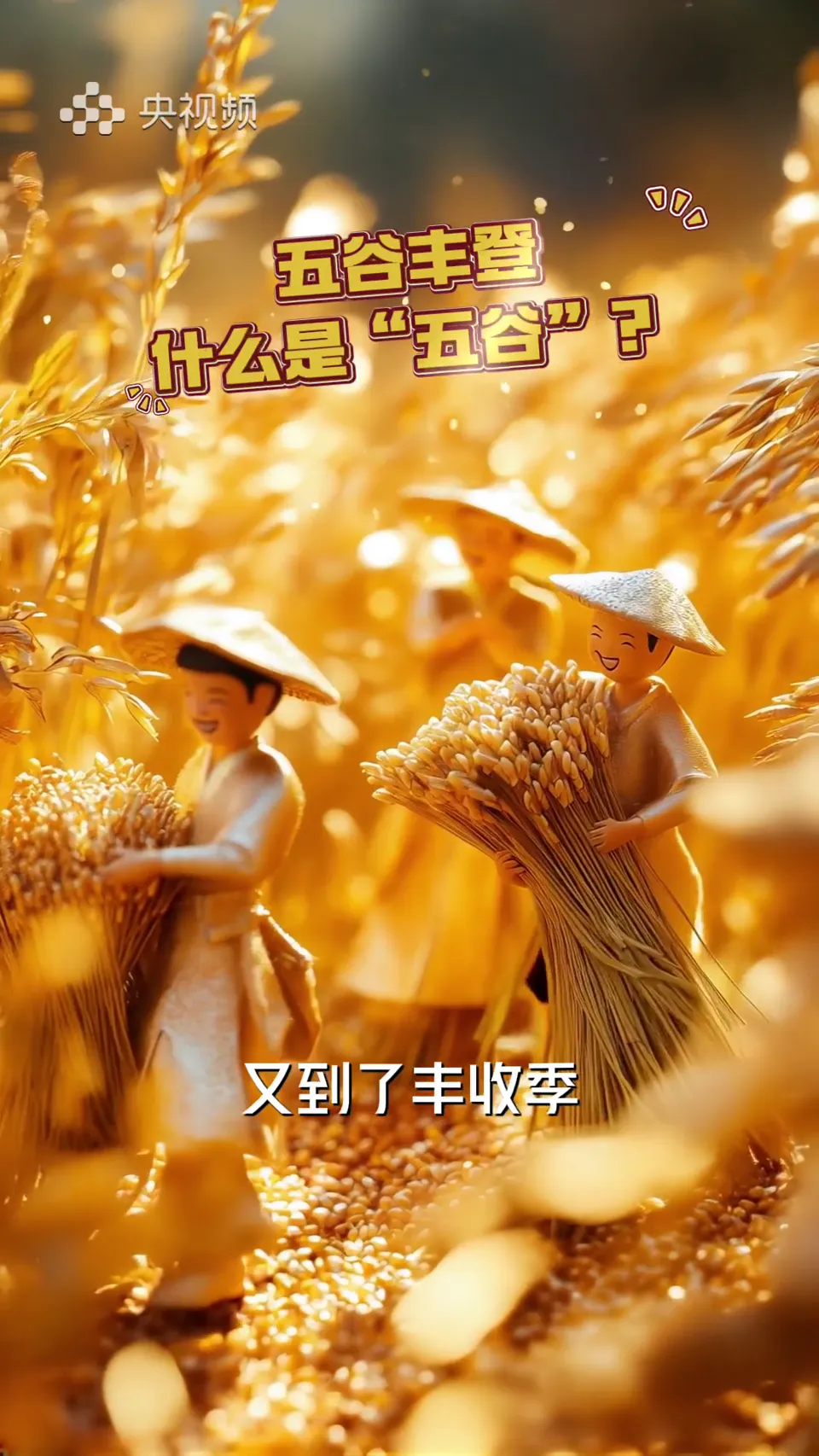
Miniature farmers in bamboo hats hold sheaves of rice among rice ears taller than they are, followed by a threshing ground piled with straw, with the title set over the golden scene.
Clip · 00:05–00:09
A Tractor Swept Into a Tunnel of Grain
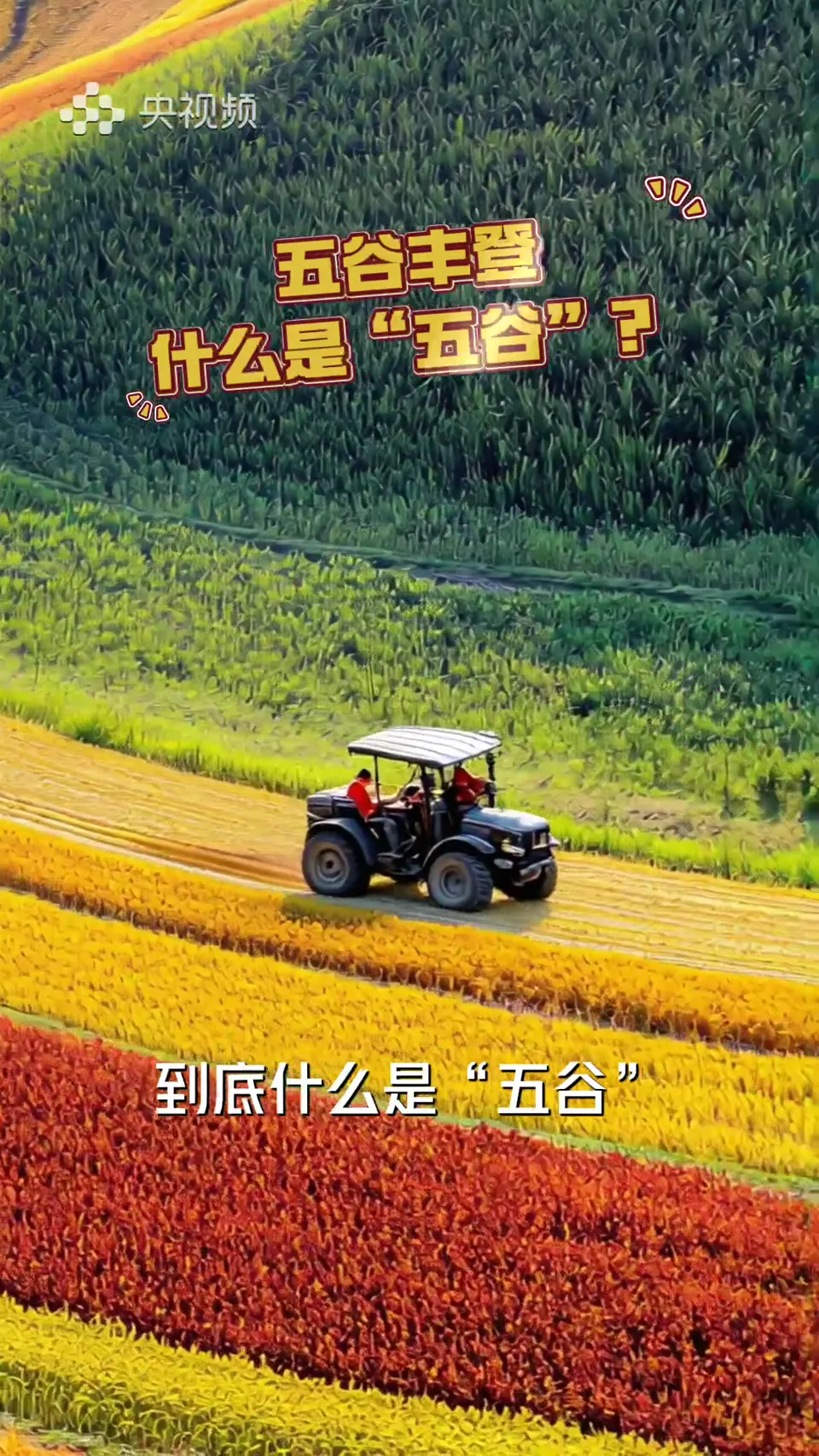
A tractor drives across fields striped red, yellow and green, gets swept up by a whirlpool of grain, then bursts out of a tunnel mouth ringed with red and black beans into a vortex of five-colored grains.
Film · 00:09–00:27
Rice and Broomcorn Millet: Jiangnan Water Towns and Shanxi Cave Dwellings
The tractor first reaches the terraced rice paddies of Jiangnan, then a cave-dwelling village in Shanxi. At each stop, the matching character appears in the upper right, and the images show the field, the grain heads and the food they become.
Clip · 00:09–00:13
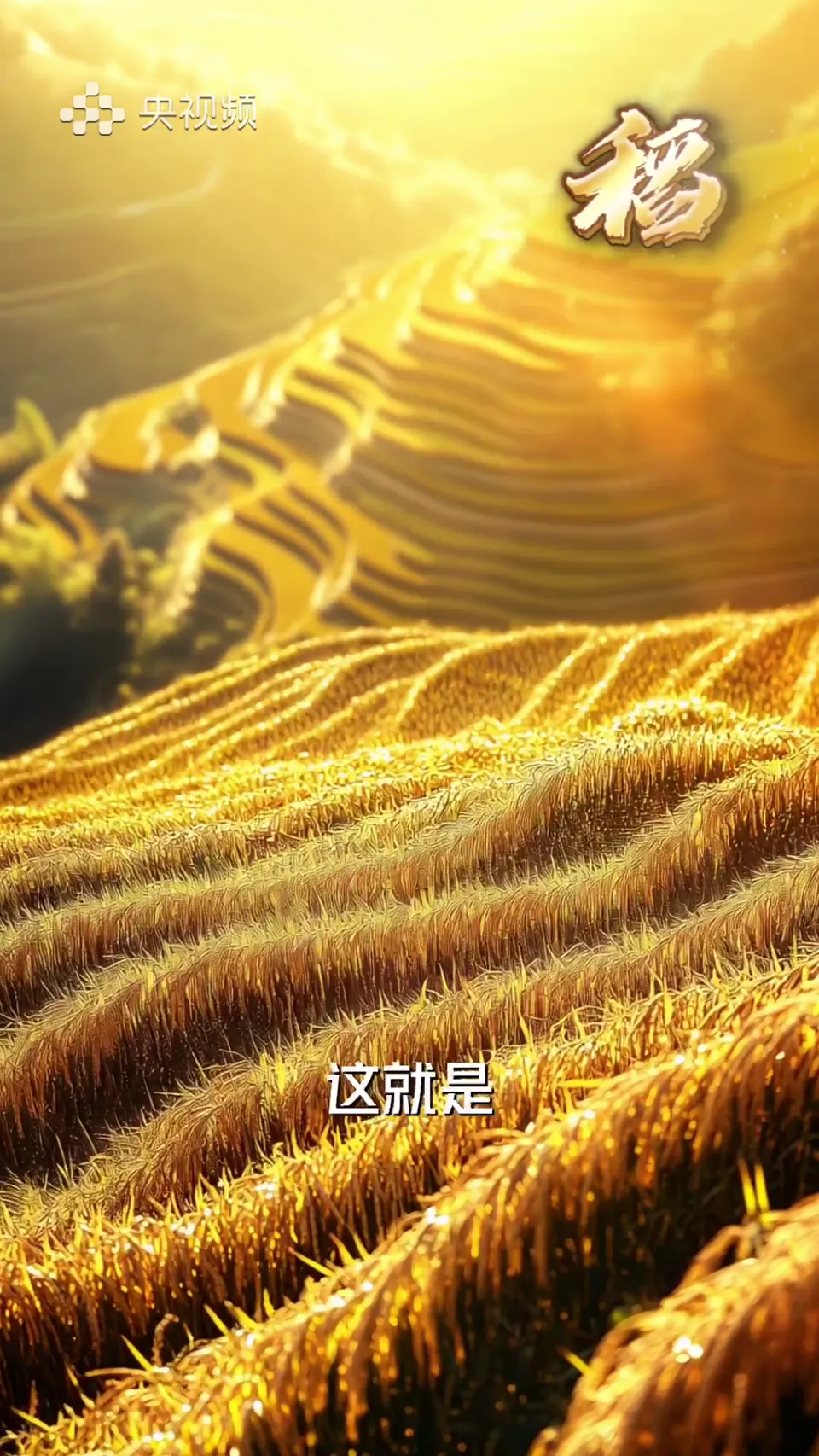
“Rice” in the Terraced Paddies
Sunlight falls on waves of rice like terraces as the character for rice appears; the shot cuts to a field ridge where two farmers swing tools to thresh the grain.
Clip · 00:13–00:16
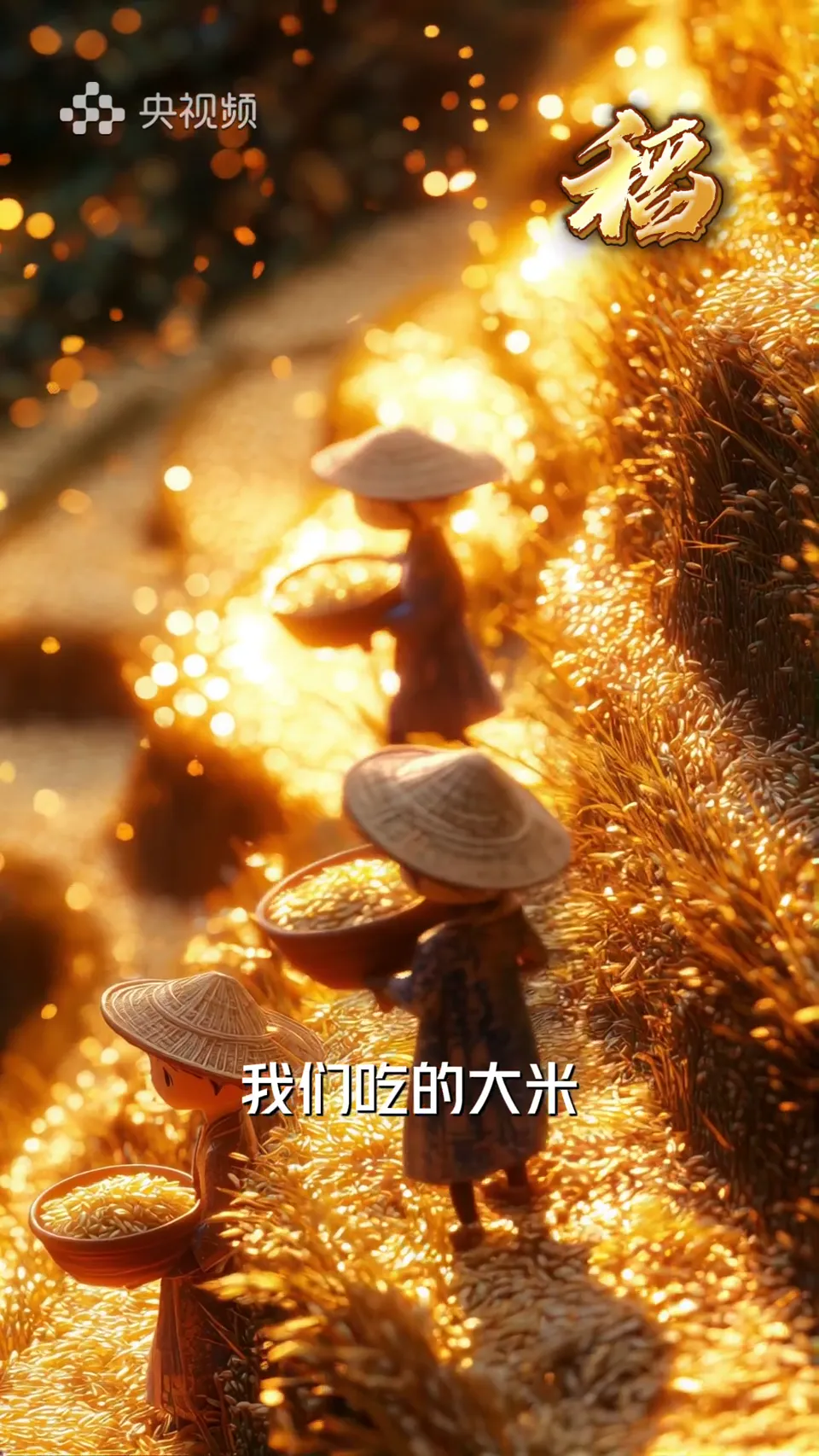
Carrying Rice, Exchanging a Smile
A farmer walks past carrying a winnowing basket full of rice, and two people look up and smile at each other in a pile of rice as the narration says, “People in Jiangnan can't do without it.”
Clip · 00:16–00:21
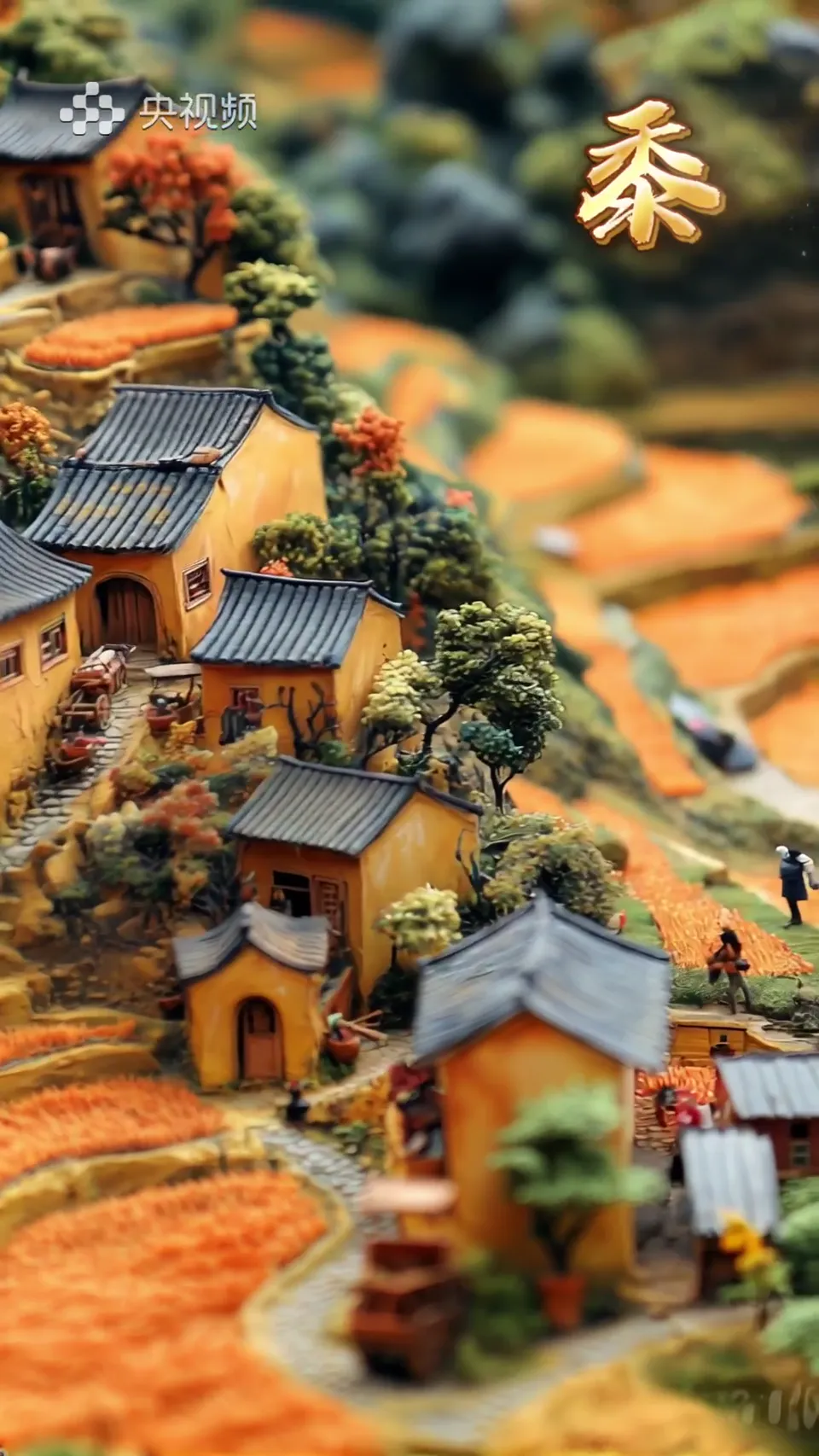
Cave-Dwelling Village and Broomcorn Millet Heads
Cave-dwelling courtyards and terraced fields on a loess slope appear as the character for broomcorn millet drops in; next comes a broomcorn millet head bent under its own weight, with a farmer below no bigger than a single grain.
Clip · 00:21–00:27
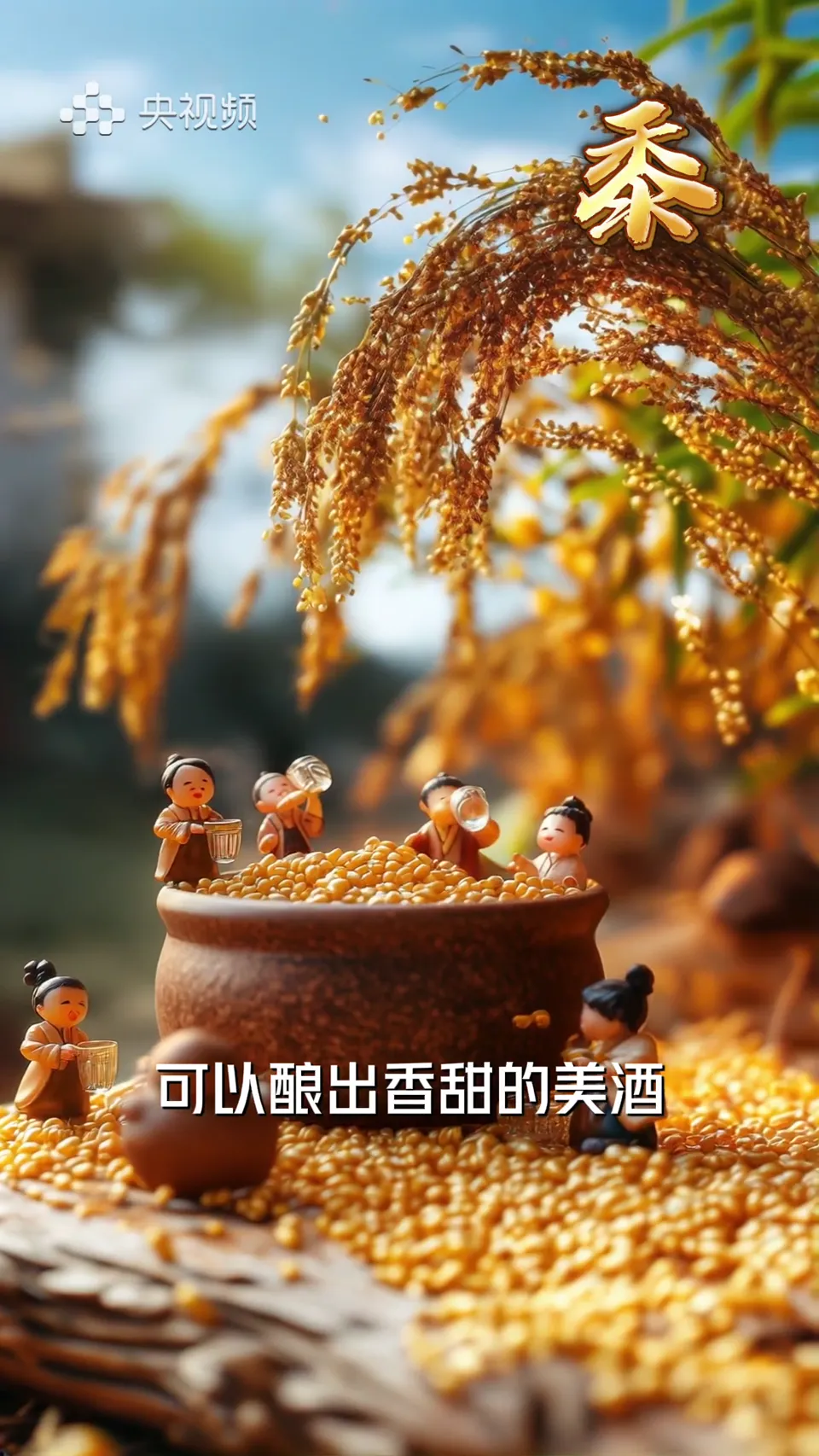
Broomcorn Millet Brewed Into Wine
Tiny figures gather around a clay vat full of broomcorn millet as the narration says it “can be brewed into sweet, fragrant wine”; then two farmers under the millet heads call out, “Come on, let's celebrate this year's good harvest!”
Film · 00:27–00:48
Foxtail Millet and Wheat: The Loess Plateau and the Wheat Fields of the Central Plains
The foxtail millet section has tiny figures climbing grain heads and dancing on a grain pile to tell how it “nourished the lands of the Qin and Han”; the wheat section runs from grain trucks and wheat kernels all the way to a bowl of noodles.
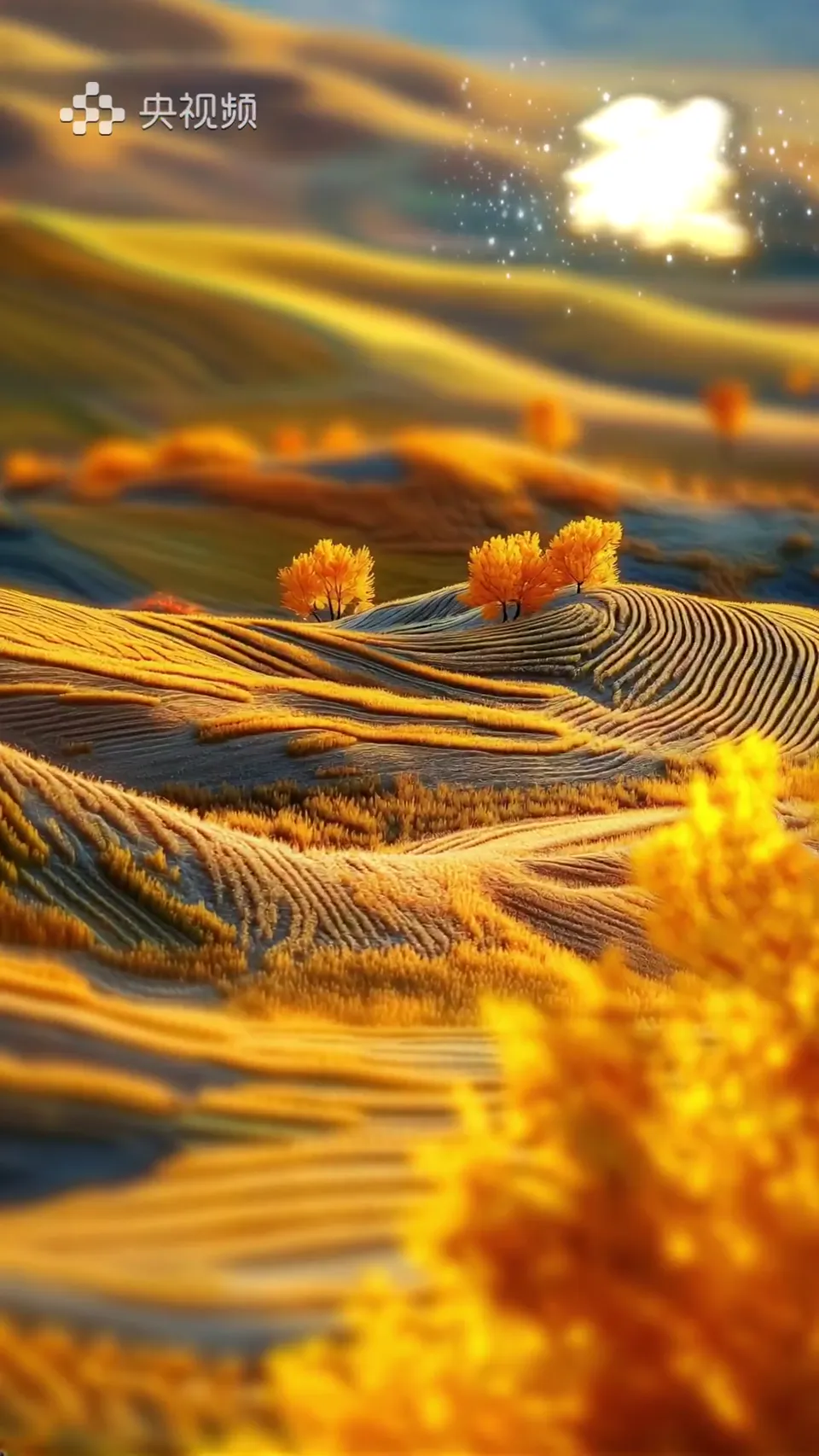
Clip · 00:27–00:33
Farmers Climbing the Grain Heads
A golden field of grain rolls like waves as the character for foxtail millet appears; farmers clamber over grain heads many times their size, and the subtitle explains that this is millet.
Clip · 00:33–00:37
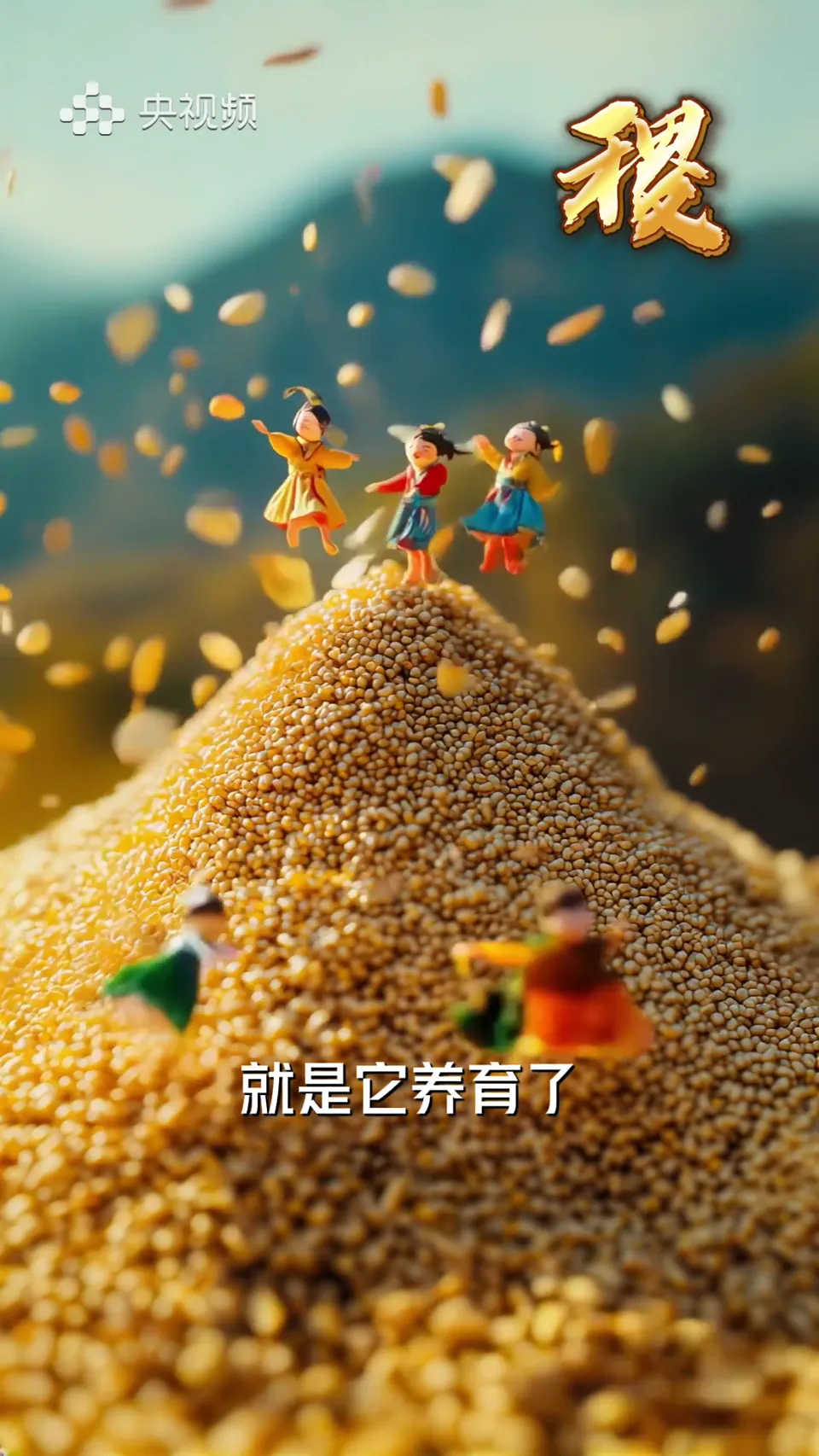
Celebrating on the Grain Pile
A small mountain of foxtail millet, with tiny figures in colorful clothes dancing on top and grains drifting through the air, matching the narration “it nourished all the lands of the Qin and Han.”
Clip · 00:37–00:41
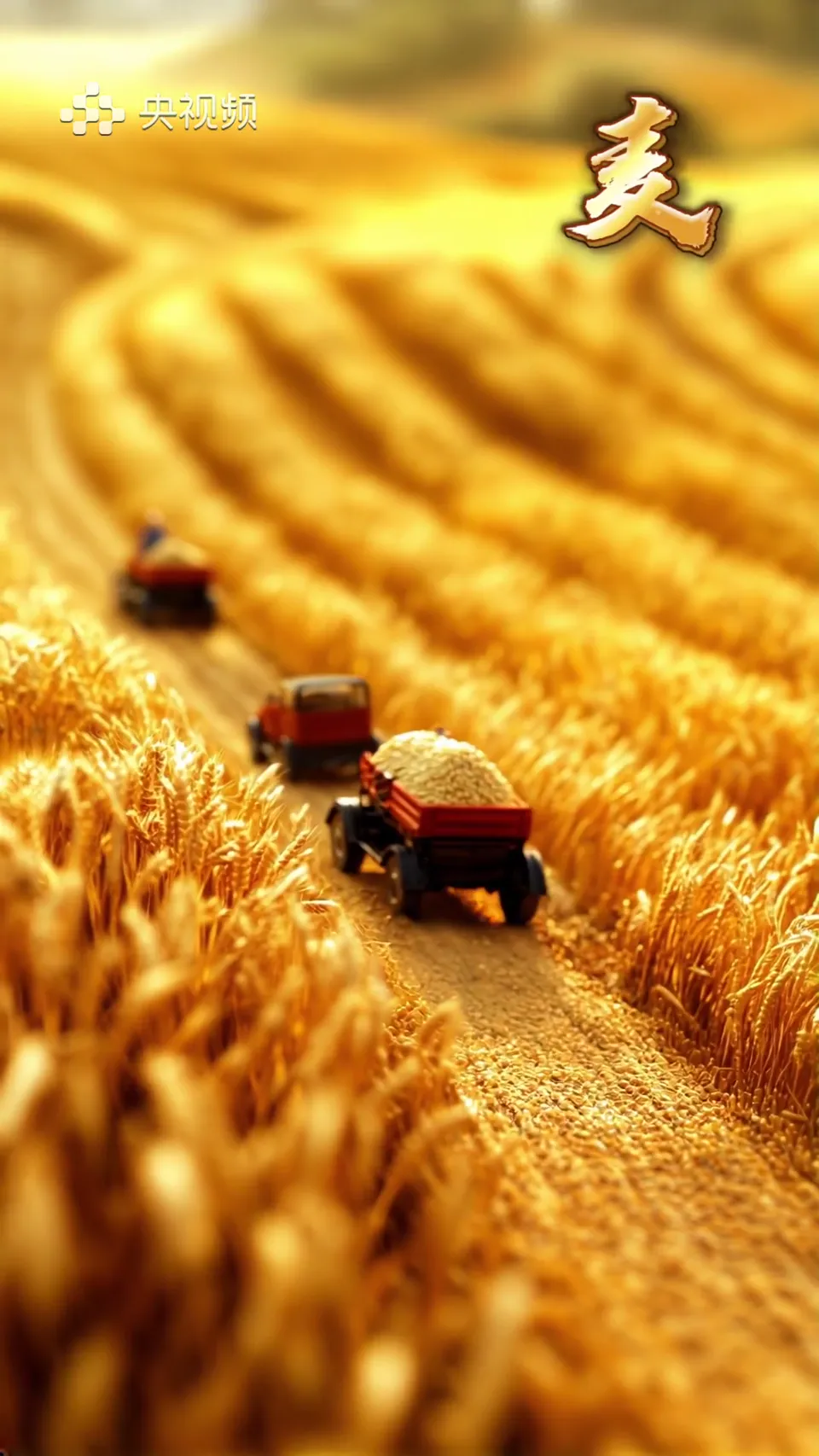
Grain Trucks in the Wheat Field
Three small grain trucks drive along the wheat rows as the character for wheat drops in; next come farmers harvesting in a wheat pile, with kernels flying in the backlight.
Clip · 00:41–00:48
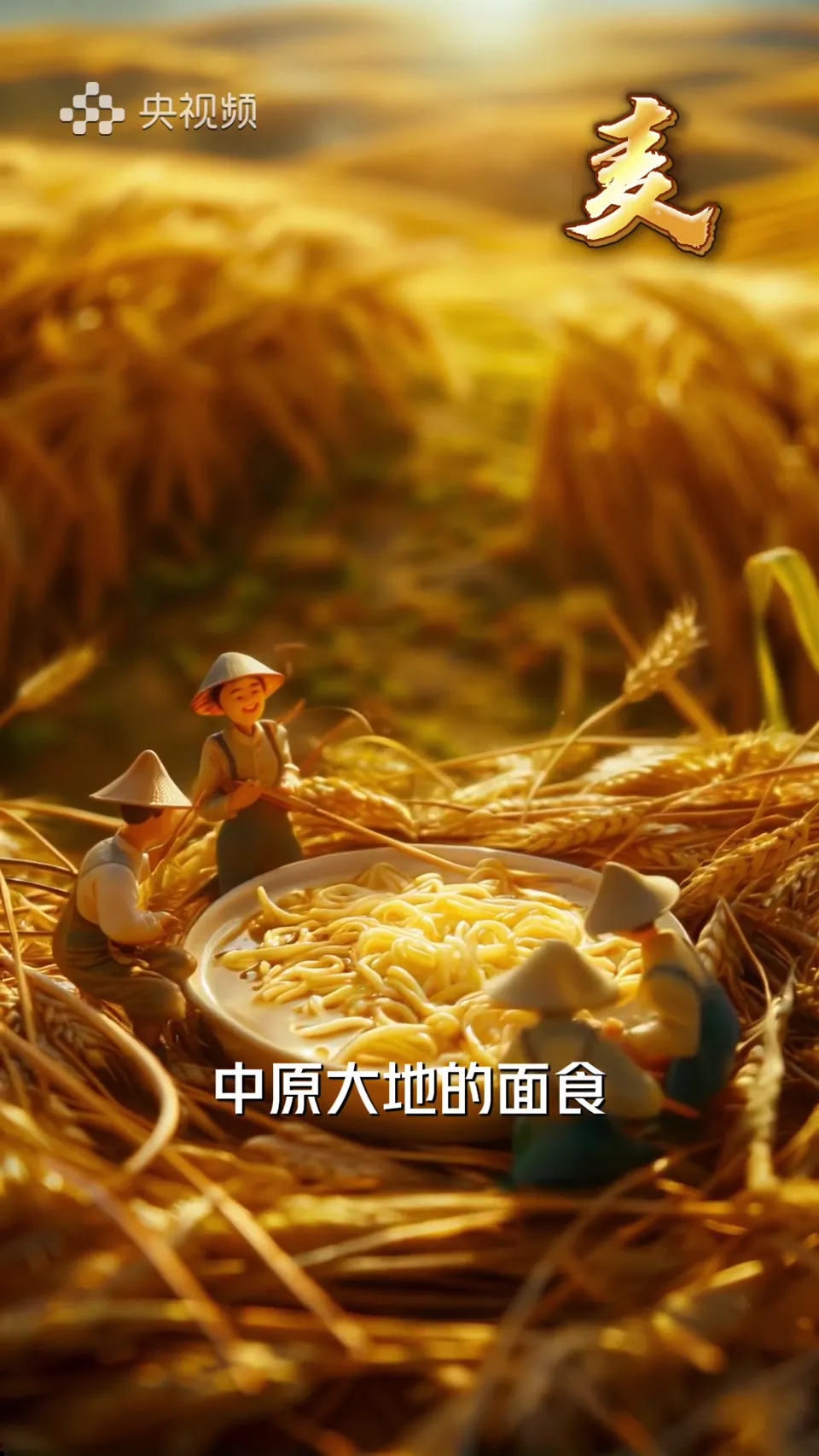
A Bowl of Noodles and “Time to Eat!”
A big bowl of noodles sits in a pile of wheat straw with tiny figures gathered around it; in the next shot, farmers wave and shout “Time to eat!”, linking wheat to the noodle dishes of the Central Plains.
Film · 00:48–00:57
Soybeans: The Black Soil of Heilongjiang
A tractor and bean fields on black soil, soybeans falling from the sky into a bowl of soy milk, and finally farmers holding their bowls and laughing heartily.
Clip · 00:48–00:52
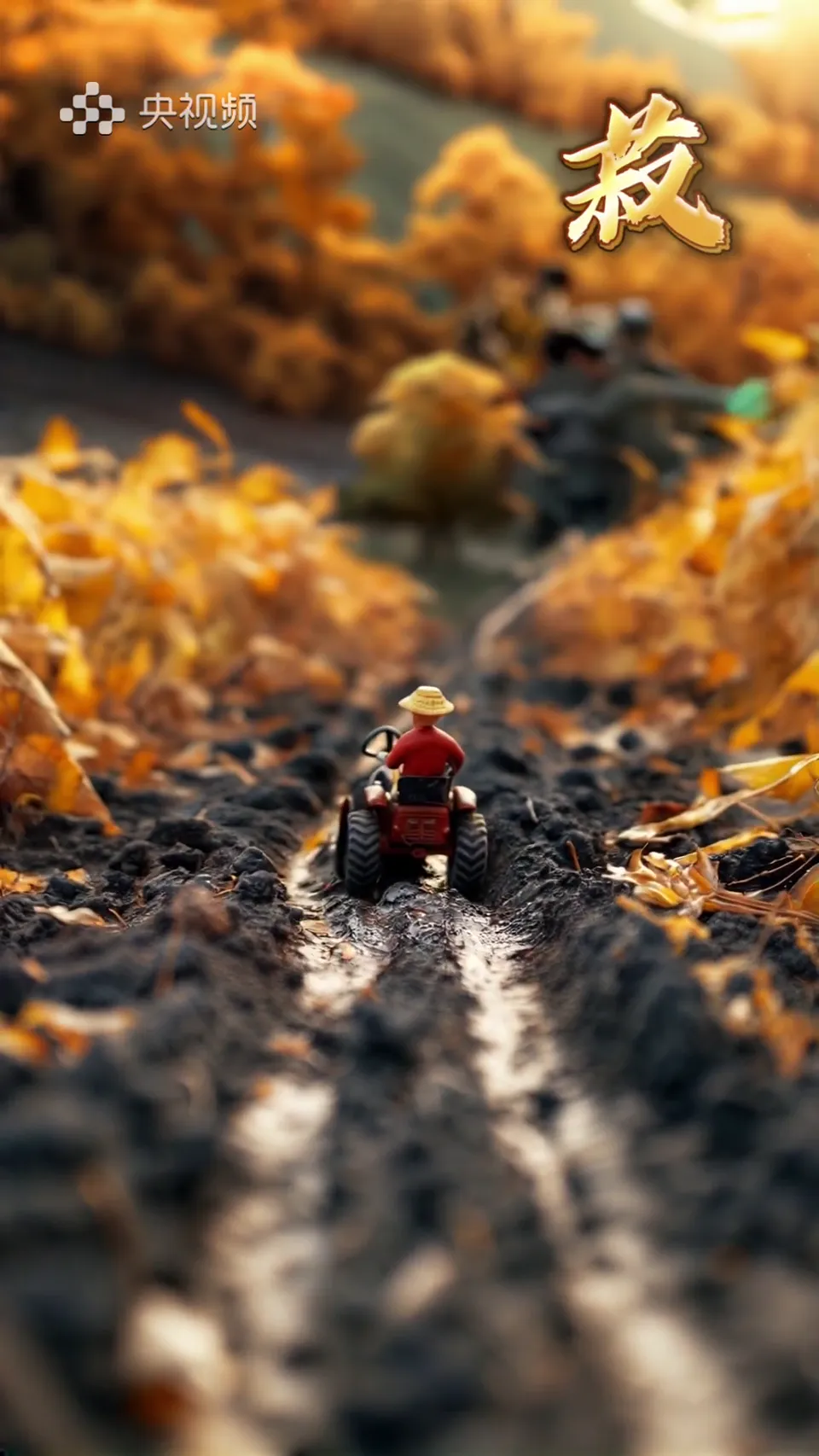
Bean Fields on Black Soil
A red tractor drives between black furrows as the character for soybeans appears; the shot cuts to golden bean fields on both sides, with the subtitle explaining that this grain is in fact the soybean.
Clip · 00:52–00:57
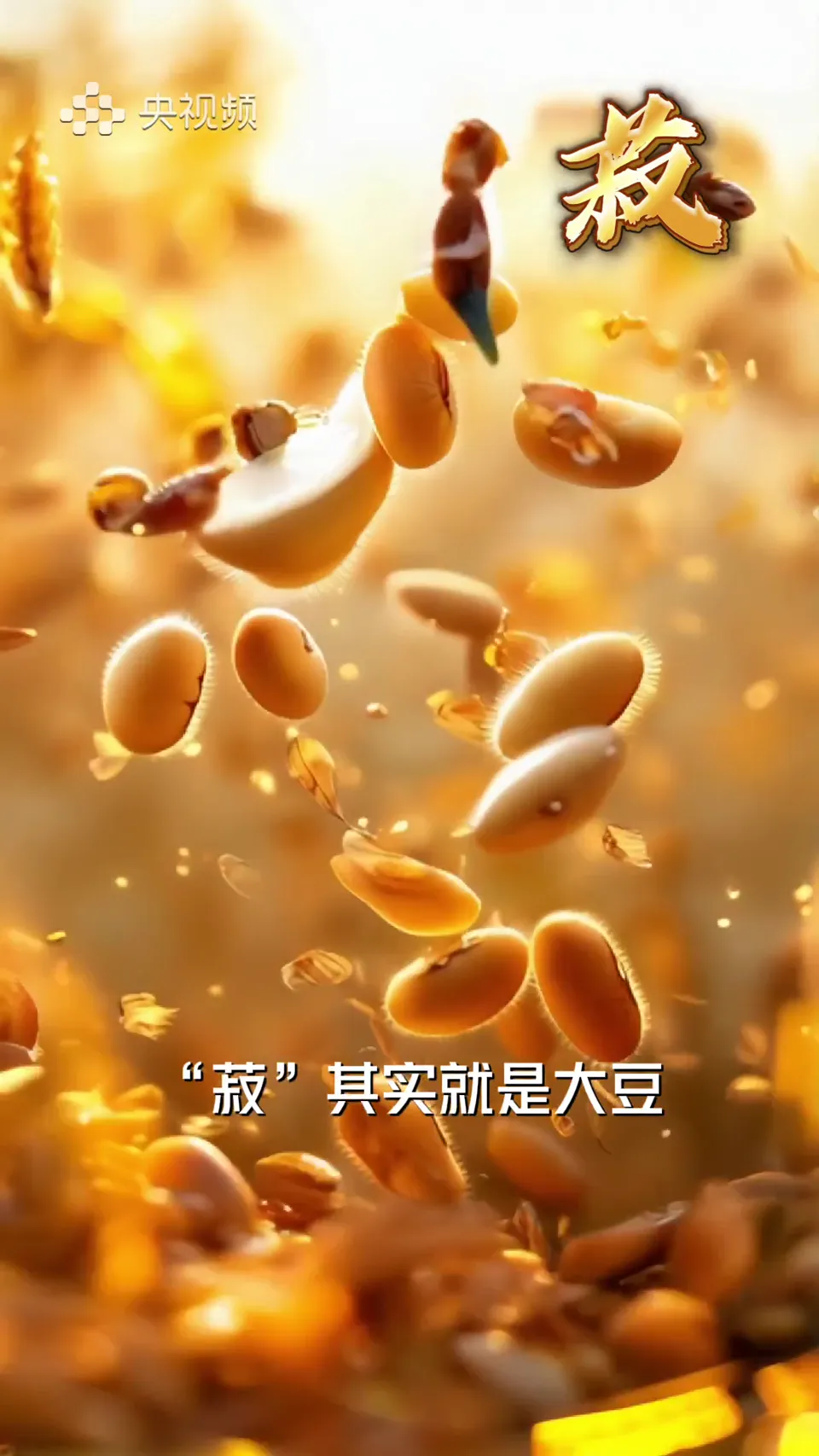
Soybeans Fall Into a Bowl
Soybeans fall one by one from the air, and the next shot becomes a bowl of soy milk with tiny figures gathered around it; three farmers hold their bowls and burst out laughing, “Ha ha ha.”
Film · 00:57–01:09
Finale: The Five Grains Come Together
The fields and grains visited in the five earlier sections are stacked into one vertical frame at the end, then combined into a big harvest group shot, landing on “a bumper harvest of the five grains.”
Clip · 00:57–01:00
Five Fields Stacked on One Screen
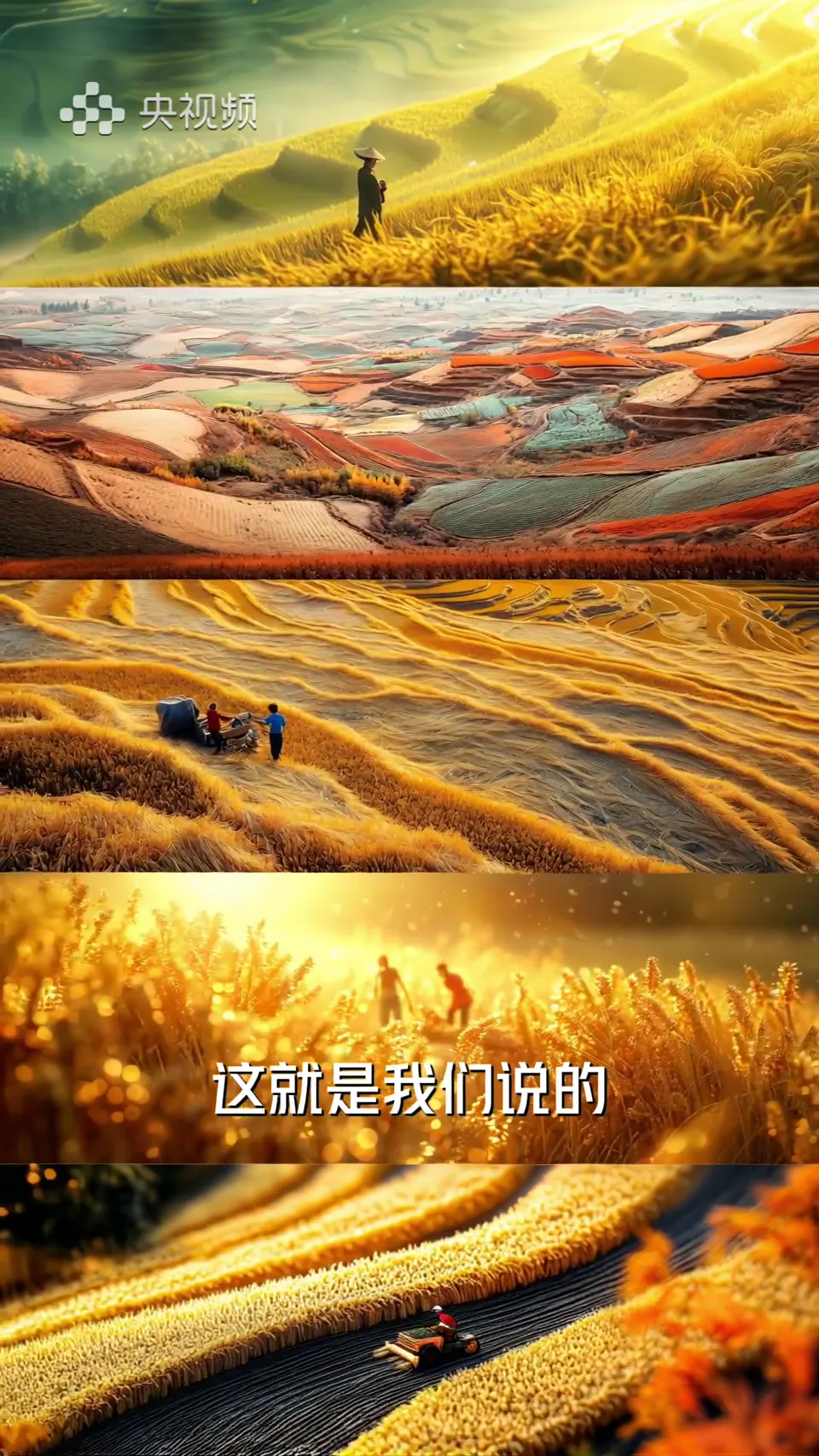
Five horizontal strips of terraced fields, colorful slopes, a grain field, a wheat field and black soil are stacked top to bottom, with the subtitle saying, “These are what we call the five grains.”
Clip · 01:00–01:04
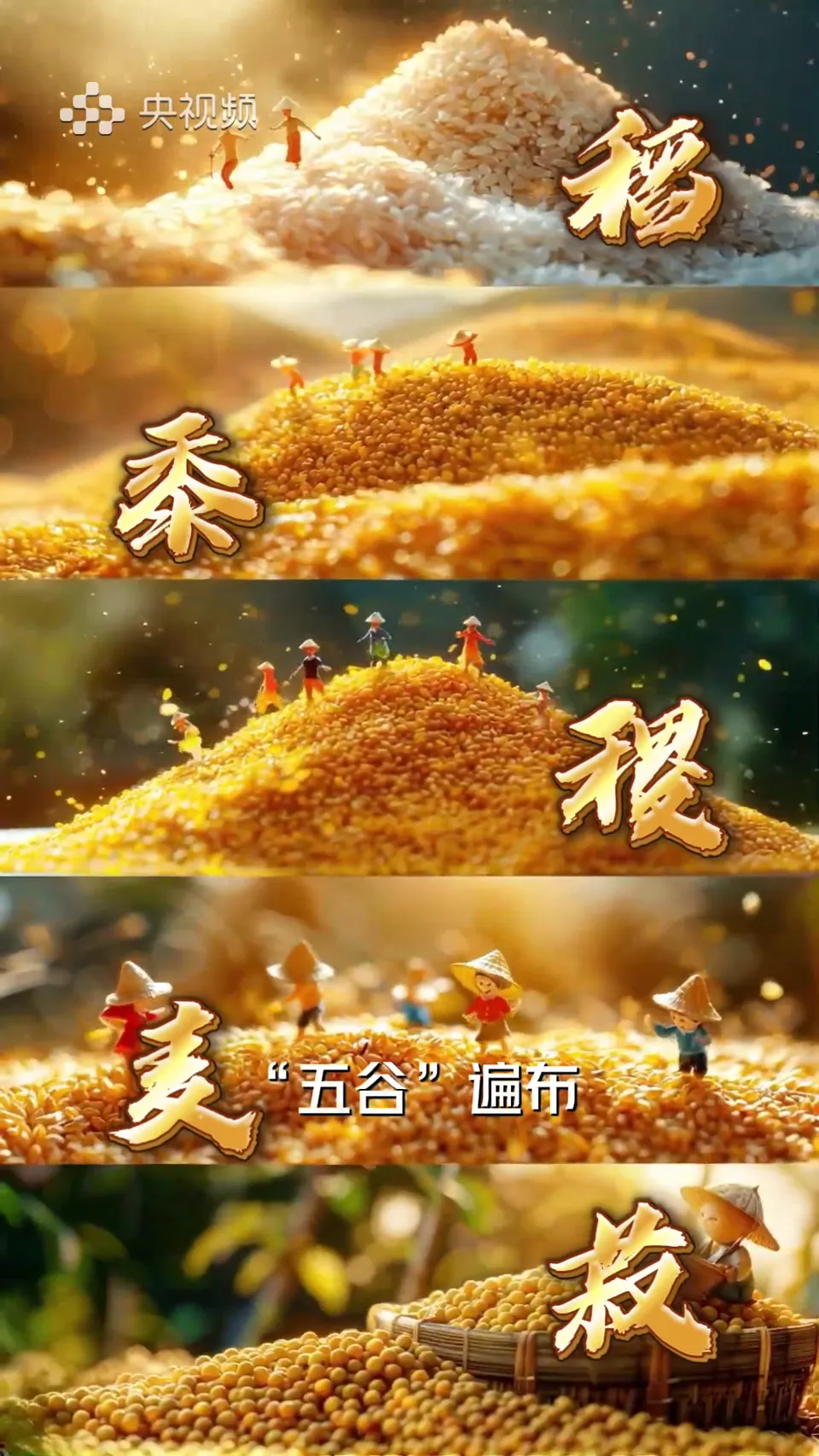
Five Piles of Grain in a Column
White rice, broomcorn millet, foxtail millet, wheat and soybeans are each heaped into small mountains, each strip labeled with its character, so the five grains can be compared side by side.
Clip · 01:04–01:09
A Bumper Harvest of the Five Grains
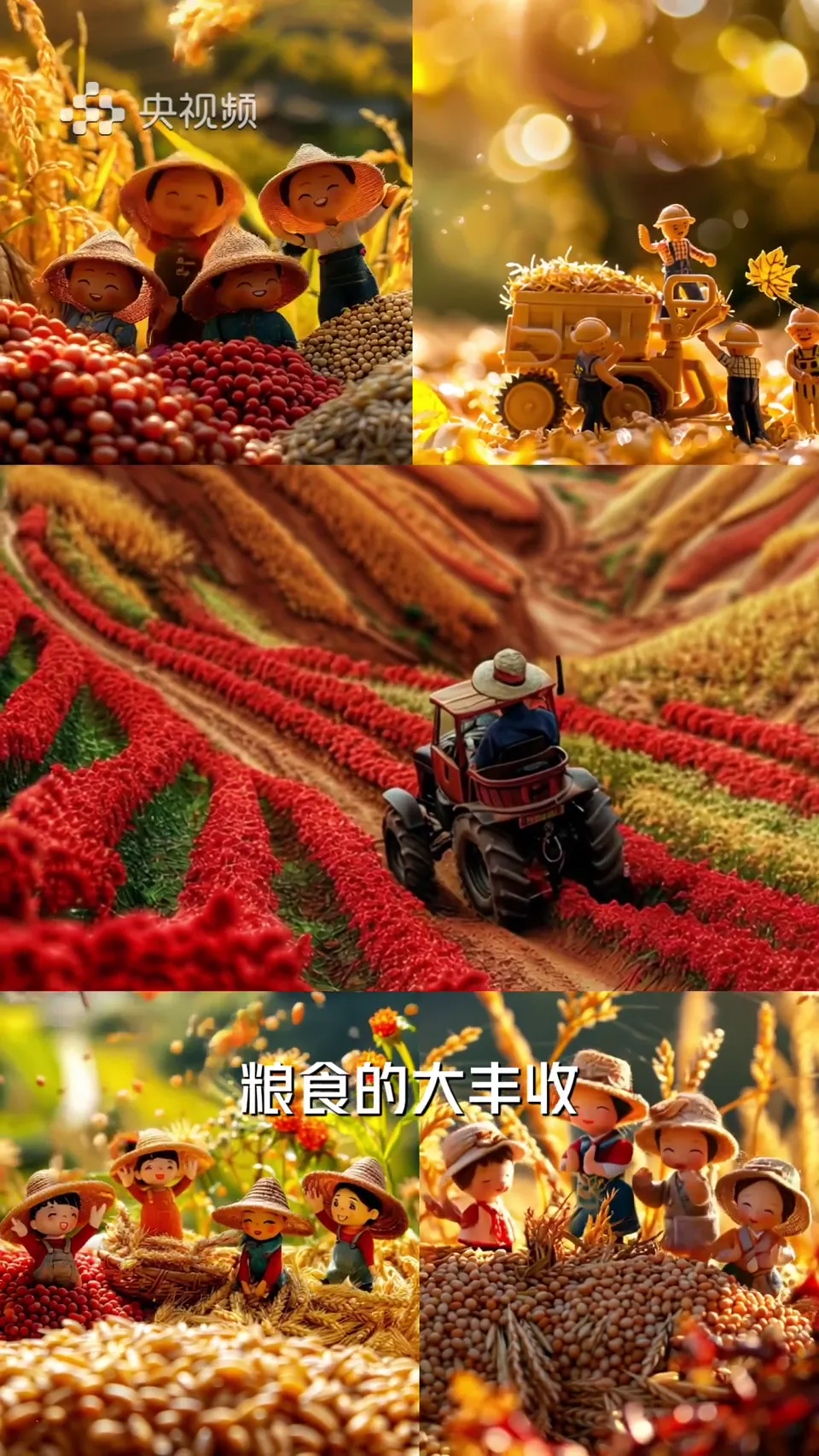
Farmers beside a pile of red beans, a tractor on a red slope and a crowd beside a wheat pile are combined on one screen as the golden words “a bumper harvest of the five grains” drop in.
04 / Storyboards & Final Frames
The final frame of every shot.
Arranged in the order of the final film: each shot first describes what it shows, followed by the final still used in the film (from which the motion shots were generated). Stills for a few shots, such as the opening threshing ground and the five piles of grain at the end, weren't in the compiled documents and are not included.
01
Opening: Driving a Tractor in Search of the Five Grains
In the film · 00:00–00:09
Shot 1.1
Farmers Holding Sheaves of Rice
The first shot as the title appears: several miniature farmers in bamboo hats hold sheaves of rice, standing among rice ears taller than they are.
Farmers Holding Sheaves of Rice · Final 1
Shot 1.2
A Tractor Crossing Colorful Fields
The farmer driving the tractor is the film's guide; he drives across colorful fields laid out in red, yellow and green strips, and the five sections that follow all trail behind him.
A Tractor Crossing Colorful Fields · Final 1
Shot 1.3
Swept Into a Whirlpool of Grain
Golden grains swirl into a whirlpool that lifts the tractor, marking the start of the “journey.”
Swept Into a Whirlpool of Grain · Final 1
Shot 1.4
Through a Tunnel of Five-Colored Grains
Red beans, black beans and rice ring a tunnel mouth that the tractor bursts out of; a vortex of five-colored grains follows as a transition.
Through a Tunnel of Five-Colored Grains · Final 1Through a Tunnel of Five-Colored Grains · Final 2
02
Rice · Jiangnan Water Towns
In the film · 00:09–00:17
Shot 2.1
Terraced Rice Paddies
Backlit waves of rice like terraces, with the character for rice set over this shot.
Terraced Rice Paddies · Final 1
Shot 2.2
Threshing on the Field Ridge
Two farmers thresh grain on a ridge beside the rice paddy, with a golden tree arching over the top of the frame.
Threshing on the Field Ridge · Final 1
Shot 2.3
Carrying Rice Past
A farmer walks past carrying a winnowing basket full of rice, with the grains around him glowing in the backlight.
Carrying Rice Past · Final 1
Shot 2.4
Exchanging a Smile
Matching the script's “farmers nearby exchange a smile as they work”: two farmers look at each other in a pile of rice.
Exchanging a Smile · Final 1
03
Broomcorn Millet · Shanxi Cave Dwellings
In the film · 00:17–00:27
Shot 3.1
Cave-Dwelling Village
Cave-dwelling courtyards and tiers of fields on a loess slope tell viewers they've arrived in Shanxi.
Cave-Dwelling Village · Final 1
Shot 3.2
Farmers Under Broomcorn Millet Heads
The broomcorn millet heads are drawn round and plump to set them apart from foxtail millet, with farmers tucked beneath them.
Farmers Under Broomcorn Millet Heads · Final 1
Shot 3.3
A Vat of Broomcorn Millet Brewed Into Wine
Tiny figures gather around a clay vat full of broomcorn millet, matching the narration that it “can be brewed into sweet, fragrant wine.”
A Vat of Broomcorn Millet Brewed Into Wine · Final 1
Shot 3.4
Celebrating This Year's Good Harvest
Two farmers stand under tall broomcorn millet heads; the final film adds the text “Come on, let's celebrate this year's good harvest!” here.
Celebrating This Year's Good Harvest · Final 1
04
Foxtail Millet · The Loess Plateau
In the film · 00:27–00:37
Shot 4.1
Golden Grain Field
The rolling grain field looks like golden waves, and the character for foxtail millet lands on this shot.
Golden Grain Field · Final 1
Shot 4.2
Climbing the Grain Heads
Farmers clamber over grain heads many times their size, each grain clearly visible, so viewers can recognize it as millet.
Climbing the Grain Heads · Final 1
Shot 4.3
Celebrating on the Grain Pile
Matching the script's “scattering grain across the sky”: tiny figures dance on a small mountain of foxtail millet as grains drift through the air.
Celebrating on the Grain Pile · Final 1
05
Wheat · Henan
In the film · 00:37–00:48
Shot 5.1
Grain Trucks in the Wheat Field
A line of small grain trucks drives along the wheat rows, establishing the boundless wheat fields of the Central Plains.
Grain Trucks in the Wheat Field · Final 1
Shot 5.2
Farmers Harvesting Wheat
Farmers harvest in a wheat pile, with kernels flying up in the backlight.
Farmers Harvesting Wheat · Final 1
Shot 5.3
A Bowl of Noodles Beside the Wheat Ears
A big bowl of noodles sits in a pile of wheat straw with tiny figures gathered around it, bringing wheat to the dinner table.
A Bowl of Noodles Beside the Wheat Ears · Final 1
Shot 5.4
Time to Eat!
A crowd of farmers waves in greeting, and the final film adds “Time to eat!” here.
Time to Eat! · Final 1
06
Soybeans · The Black Soil of Heilongjiang
In the film · 00:48–00:57
Shot 6.1
A Tractor on Black Soil
A red tractor drives between black furrows, instantly recognizable as the black soil of Northeast China.
A Tractor on Black Soil · Final 1
Shot 6.2
Harvesting the Bean Fields
Ripe bean fields on both sides, with a harvester and farmers at work in the middle.
Harvesting the Bean Fields · Final 1
Shot 6.3
Soybeans Become Soy Milk
Soybeans fall one by one from the air, cutting to a bowl of soy milk with tiny figures gathered around it.
Soybeans Become Soy Milk · Final 1Soybeans Become Soy Milk · Final 2
Shot 6.4
Laughing Over Soy Milk
Matching the script's “takes a bowl of soy milk, drains it in one go and laughs heartily.”
Laughing Over Soy Milk · Final 1
07
Finale: The Five Grains Come Together
In the film · 00:57–01:09
Shot 7.1
Five Fields Stacked on One Screen
Five ultra-wide 45:16 horizontal images stacked top to bottom in a 9:16 vertical frame: terraced fields, colorful slopes, a grain field, a wheat field and black soil each take one strip.
Five Fields Stacked on One Screen · Final 1Five Fields Stacked on One Screen · Final 2Five Fields Stacked on One Screen · Final 3Five Fields Stacked on One Screen · Final 4Five Fields Stacked on One Screen · Final 5
Shot 7.2
A Big Group Shot of the Five-Grain Harvest
Farmers beside a pile of red beans, a tractor on a red slope and a crowd waving beside a wheat pile are combined into the final screen.
A Big Group Shot of the Five-Grain Harvest · Final 1A Big Group Shot of the Five-Grain Harvest · Final 2A Big Group Shot of the Five-Grain Harvest · Final 3
05 / Results
AI Visuals for a Five Grains Explainer Short
Produced all the AI visuals for a roughly 70-second vertical explainer short on the five grains for World Food Day 2024, taking about a week from briefing to delivery; it was released on WeChat Channels on World Food Day, October 16.
Case Study
Liandan AI Studio × Yangshipin | Shrinking the Farmers, Enlarging the Grains, Explaining “What Are the Five Grains?” in One Minute
Everyone knows the phrase “a bumper harvest of the five grains,” yet ask which five grains dao, shu, ji, mai and shu actually are, and many people can't answer.
For World Food Day 2024 (October 16), Yangshipin wanted to release an explainer short called “What Are the Five Grains?”
We were responsible for all the AI visuals in the film: a miniature farmer driving a tractor takes viewers from the rice paddies of Jiangnan all the way to the black soil of the Northeast, getting to know the grains one by one.
Client
CCTV Video (Yangshipin)
Project Type
World Food Day five grains explainer short · AI visual production
Timeline
October 2024, released on World Food Day, October 16
Runtime & Specs
About 70 seconds, 9:16 vertical, 1080×1920
Distribution
WeChat Channels
Division of Work
Yangshipin provided the script and handled voiceover, music and final editing; Liandan AI Studio produced all the AI visuals (stills from Midjourney, motion shots generated with Kling AI)
Produced by
Shenzhen Alchemy Technology Co., Ltd. (Liandan AI Studio)
01
One Explainer Short, Five Look-Alike Grains to Explain
Yangshipin's script was very specific: an ordinary farmer climbs aboard a four-wheeled tractor that can “travel through space” and heads from south to north to five growing regions.
Rice in the water towns of Jiangnan, broomcorn millet in the cave dwellings of Shanxi, foxtail millet on the Loess Plateau, wheat in Henan, and soybeans on the black soil of Heilongjiang. At each stop, the matching character appears on screen, followed by what food it becomes.
That's also where the difficulty lay: most of the five grains are golden and all have small kernels. The images had to look good enough to keep people watching to the end, and above all let viewers tell at a glance which grain is which.
Time was tight too: about a week from briefing to delivery, with delivery on October 15 and release on World Food Day, October 16. Yangshipin set the format as 9:16 vertical.
Opening: A Tractor Crossing Colorful Fields
02
Shrinking the People, Enlarging the Grain
We continued the miniature style from our earlier Harvest Festival content for Yangshipin: farmers no bigger than a grain of rice, grain heads like trees, grain piles like mountains.
The vertical format posed a challenge for the miniature style: the frame is narrow, the surroundings don't fit, and giant things look less giant.
The solution was to make grains, leaves and whole grain heads bigger than the people. With the figures shrunk so small their expressions can't be read, they become even cuter; the grain fills the frame, so viewers' attention naturally lands on the grain.
Foxtail millet: farmers clamber over grain heads many times their sizeOpening: miniature farmers holding sheaves of rice
The tiny figures aren't just standing there as a scale reference either. They thresh, carry winnowing baskets, climb grain heads and dance on grain piles, and in every shot they're doing something tied to that grain.
03
All Golden: How Do Viewers Tell Them Apart?
Broomcorn millet and foxtail millet, rice and unhusked millet looked very alike in the first version. Yangshipin wrote revision notes shot by shot in the final-review document, and we added images item by item.
The method had three steps: first, look up what a single kernel of each grain looks like (broomcorn millet, for example, is spherical and slightly larger than foxtail millet) and write those traits into the prompts; next, find real photos of each grain, put them in the document for comparison, and use good photos as image references to regenerate; finally, standardize the names: ji was always labeled foxtail millet (xiaomi), never guzi, a word easily confused with unhusked rice.
Broomcorn millet: the redone millet heads, with rounder, plumper kernelsFoxtail millet: a rolling field of millet
The client also wanted the place name marked at each stop. In the final film, settings such as fields, cave dwellings and black soil, along with the character in the upper right and the subtitles, form several cues that together help viewers recognize each grain.
The opening shot followed the same idea: an early version was a field of golden wheat; the final version switched to colorful fields laid out in red, yellow and green strips, with the tractor driving through the middle. Before the five grains even appear, viewers can already see that more than one crop grows on this land.
Early version: a field of golden wheatFinal: colorful fields, with the tractor driving through the middle
04
A Single Grain Falling Into a Bowl
Each section of the script has a line about “becoming”: rice becomes cooked rice, broomcorn millet becomes wine, wheat becomes noodles, soybeans become soy milk.
We did this with first and last frames: first an image of “grain falling from the sky,” then one of “the finished dish in a bowl,” letting Kling AI fill in the transformation between them. What viewers see is grain falling straight onto the dinner table.
Clip · 00:52–00:57
Soybeans Become Soy Milk
Soybeans fall from the air into a bowl of soy milk, and a farmer holds up the bowl and laughs heartily.
The wheat section works the same way: a farmer harvesting wheat in the field is, in the next shot, standing beside a big bowl of noodles. From raw ingredient to food, no explanation is needed; the cut makes it clear.
05
Five Fields Combined in One Vertical Frame
The ending had to bring the five grains together. The team proposed combining the harvest scenes of all five grains on a single screen.
We made five horizontal images in an ultra-wide 45:16 ratio that stack exactly into a 9:16 vertical frame. The problem: video tools don't support generating images that wide directly.
The final solution was to combine the five images into one vertical image first, then generate video from the whole thing. The five panels each moved on their own without blending together. Between a “scene version” and a “grain close-up version,” the client chose the close-up version, and the final film uses both: first the five fields, then the five piles of grain labeled with their five characters.
Clip · 00:57–01:04
The Five Grains on One Screen
Five fields stack into one screen, then switch to five piles of grain, each labeled with its character.
06
What this project achieved
Explainer shorts fear two things most: images that look good but don't explain, or explanations that are clear but nobody wants to watch.
This film solves “wanting to watch” with a miniature perspective: a tiny figure driving a tractor takes viewers through five fields. It solves “explaining clearly” with the grains' own appearance, where they grow and the dishes they become: every grain can be matched up.
For the client, the script, voiceover and editing stayed in their hands while the visuals were left to us, and within a week they had a complete set of AI visuals ready for release on World Food Day.
FAQ
FAQ
In an AI-made science short, how do you make sure viewers can recognize each grain?
In this film, we first looked up the shape, color and size of a single kernel of each grain and wrote them into the prompts; then we compared against real photos of the grains and used good photos as image references to regenerate; the images also show where each grain grows (Jiangnan water towns, Shanxi cave dwellings, the black soil of the Northeast and so on) and what food it becomes, along with the matching character.
How long does a vertical AI explainer short like this take from brief to delivery?
“What Are the Five Grains?” took about a week from briefing to delivery: we received the script in early October, delivered the first version on October 13, revised it according to client feedback through delivery on the 15th, and it was released on World Food Day, the 16th.
If a client already has a script and voiceover, can Liandan AI Studio handle just the visuals?
Yes. In this project, Yangshipin provided the script and handled voiceover, music and final editing, while Liandan AI Studio produced all the AI visuals in the film: creating stills shot by shot, generating motion shots, and adding and revising images according to the client's shot-by-shot notes in the document.
What if AI video tools don't support an ultra-wide split-screen image?
The five-field split screen at the end uses 45:16 horizontal images, a ratio video tools can't generate directly. We first combined the five images into a single 9:16 vertical image, then generated video from the whole thing; the five panels each moved independently without bleeding into one another.
Approach
Miniature Storyboarding: A Lead Character and Recognizable Grains
Building on the script from Yangshipin, the storyboard laid out the growing region, crop, farmers' actions and food transformation item by item. The opening highlights the lead character driving the tractor, so viewers first recognize the farmer guiding them before following the whirlpool of grain into the different fields.
Every image centered on “recognizing the grain”: broomcorn millet, foxtail millet and wheat had to look distinct, grain-head shapes and kernels were drawn with reference to real grain, and the working figures had to be clear too. Varieties are told apart by the grains' own features and growing environments, not just by names and the same golden color.
The sections about grains and food all keep miniature figures as a scale reference. A farmer among wheat kernels cuts to a noodle bowl beside the wheat ears, and the shots on both sides share warm golden light and a working setting, so the link from raw ingredient to food is clear from the cut alone. All visuals in the film were made with AI by Liandan AI Studio (with technical support from Kuaishou Kling AI); the script, voiceover, music and final editing were done by Yangshipin.