Exploring China Through Idioms: Zheng He's Voyages to the Western Seas
From the treasure ships setting sail to a giraffe coming ashore, the maritime exchange has both sweeping spectacle and memorable details.
Project Type
Culture & Arts
Client
CMG program “Chengyu Tan Huaxia”
Year
2025
Our role
AI visuals for the program’s idiom dramas
Original format
3456 × 2160 · 00:45
Question 1: “Hutong Youwu” (Trading What Each Has) | Program Segment00:45 · FilmQuestion 2: “The Heavenly Qilin” | Standalone Final Cut00:23 · Video
01 / Background
How do you capture both the scale of the fleet and the details of exchange on a single voyage?
“Zheng He's Voyages to the Western Seas” is our AI visual work for CCTV's “Exploring China Through Idioms,” split into two question videos: “Hutong Youwu” (Trading What Each Has) and “The Heavenly Qilin.” The first covers the voyages and the exchange of goods; the second uses a giraffe coming ashore to lead into an idiom. The two had to feel like the same chapter of history in the same visual style, while each having its own highlights.
The image script divides the port, the fleet, work on deck, the cargo and the markets into shots at different distances. The fleet shots are expansive, while the deck and the sails each get their own shots; the second question sets the giraffe against the watching crowd to contrast their size.
02 / Creative Highlights
From the scale of the fleet to a single moment of wonder.
01
Changing camera positions to show the fleet's scale
From an overhead view of the port and the fleet in formation at sea to a head-on view of a treasure ship and a view between the sails, every new shot shows something new. The fleet has an overall grandeur, while the bows, masts and sails can be seen clearly too.
02
From sweeping voyage scenes to specific work
Men working on deck are followed by sailors climbing the masts; people, ropes and sails turn the voyage into visible action. The camera opens out over the sea first, then moves in close to the people, giving the historical question details of daily life.
03
Telling the exchange through specific goods
Loading cargo, close-ups of porcelain, townspeople and a hold full of medicinal herbs appear one after another. Ships, ports, people and goods together make clear what was exchanged, and bright, warm light ties the two questions together into a whole.
04
Making the giraffe the memorable hook of the question
The second question contrasts the giraffe's size with the harbor buildings and the onlookers; as the giraffe turns its neck, the townspeople's eyes follow it. An animal no one has seen before arrives in a familiar port, and that sense of wonder plants the clue for the idiom question that follows.
03 / Scene Breakdown
One fleet, two questions: first where it went and what it carried, then a single giraffe.
Film · 00:01–00:10
Question 1: Setting Sail by Imperial Order
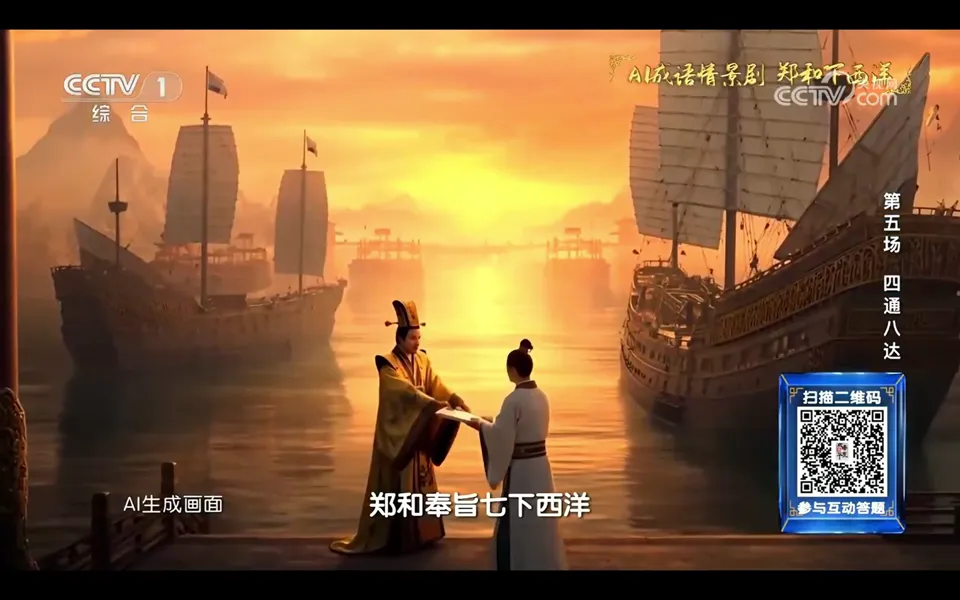
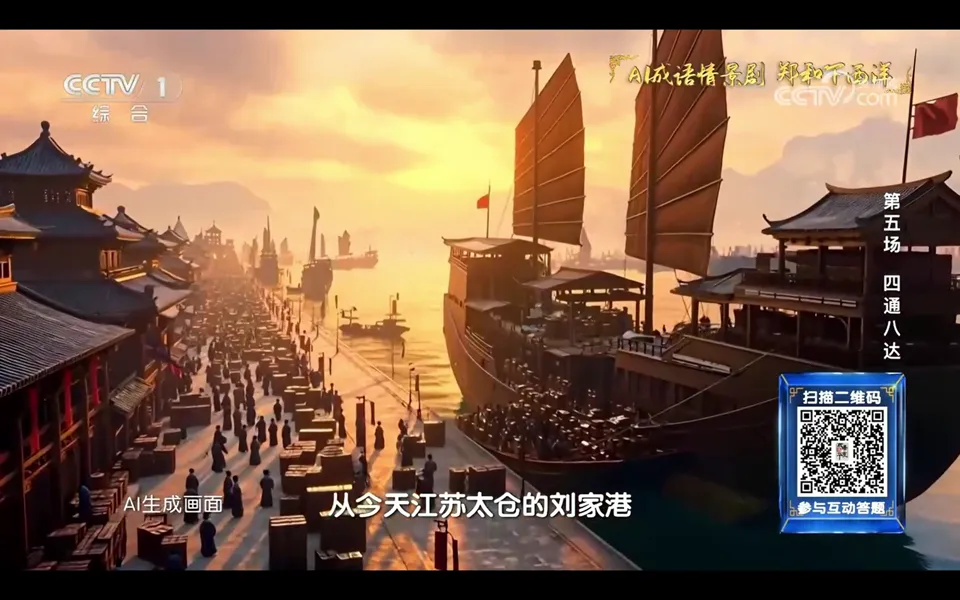
Zheng He receives the imperial edict at the port, the camera pulls back to a panorama of Liujiagang, the great ships are moored at the shore, the fleet sails out of the harbor, and seagulls skim the sea.
Clip · 00:01–00:05
Receiving the Edict, Then Liujiagang
At sunset, Zheng He bows to receive the edict, a great ship moored behind him; the next shot rises high above the harbor, where sails stretch layer upon layer.
Clip · 00:05–00:10
Setting Sail
The great ship at the shore prepares to set sail; the camera stands on the bow looking at the fleet ahead, then follows two seagulls out over the sea, matching the line “crossing the East China Sea and the South China Sea.”
Film · 00:10–00:21
Question 1: Visiting More Than 30 Countries
The fleet crosses the sea and calls at port after port: a bay in Southeast Asia, a city in West Asia, a beach in East Africa, followed by a whole fleet and dolphins leaping from the water.
Clip · 00:11–00:15
One Foreign Port After Another
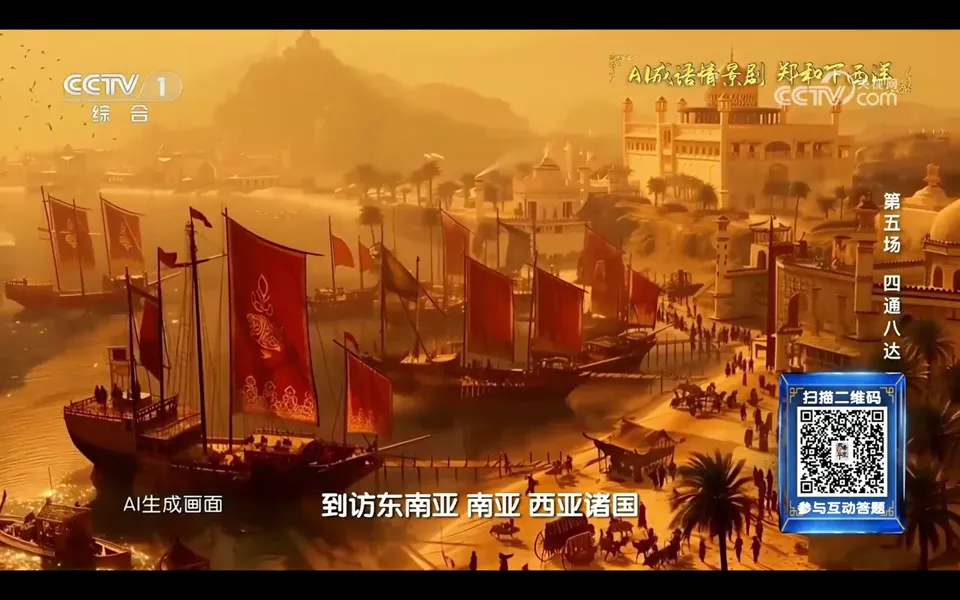
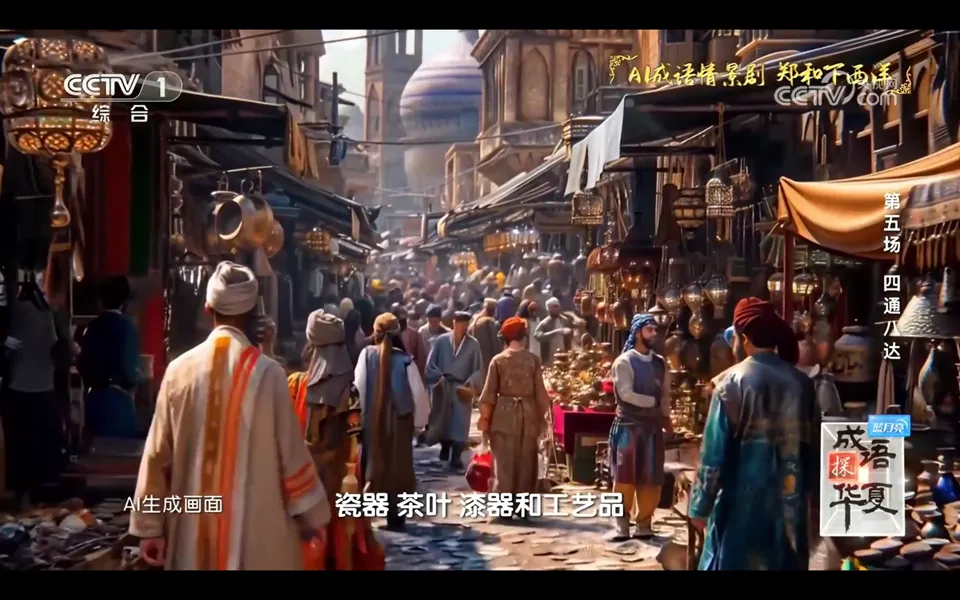
Red-sailed boats fill a harbor, with domed buildings on shore; the camera turns to a beach crowded with people under palm trees, a great ship anchored close by.
Clip · 00:15–00:17
The East African Coast
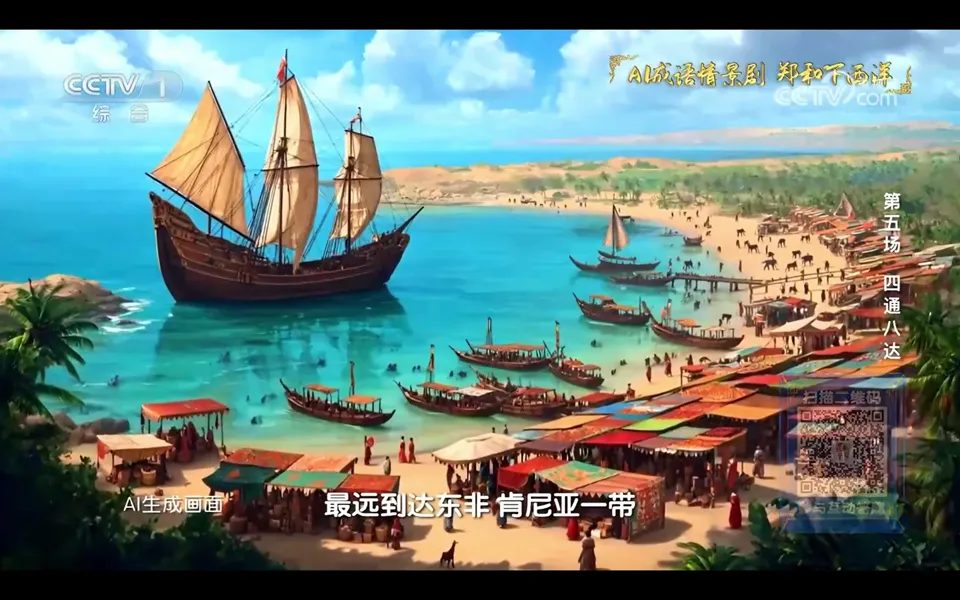
A row of market stalls lines a turquoise bay, followed by a man carrying a large bundle of goods across the docks, matching the line “reaching as far as present-day Kenya in East Africa.”
Clip · 00:17–00:21
More Than 30 Countries
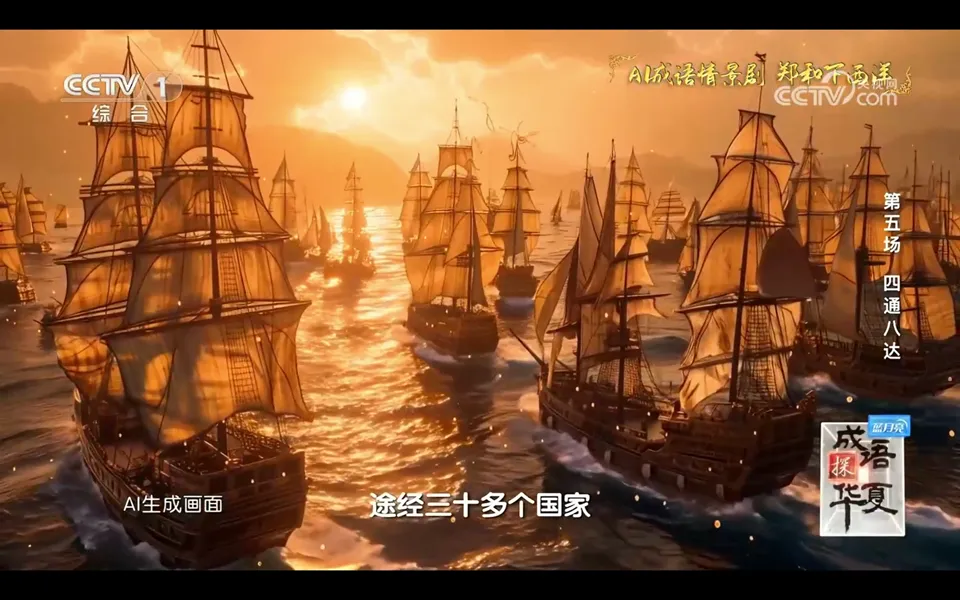
A vast fleet of sailing ships fills the sea at sunset, then two dolphins leap from the waves. The number of ships and the life on the sea convey the long voyage.
Film · 00:21–00:31
Question 1: The Largest Fleet of All
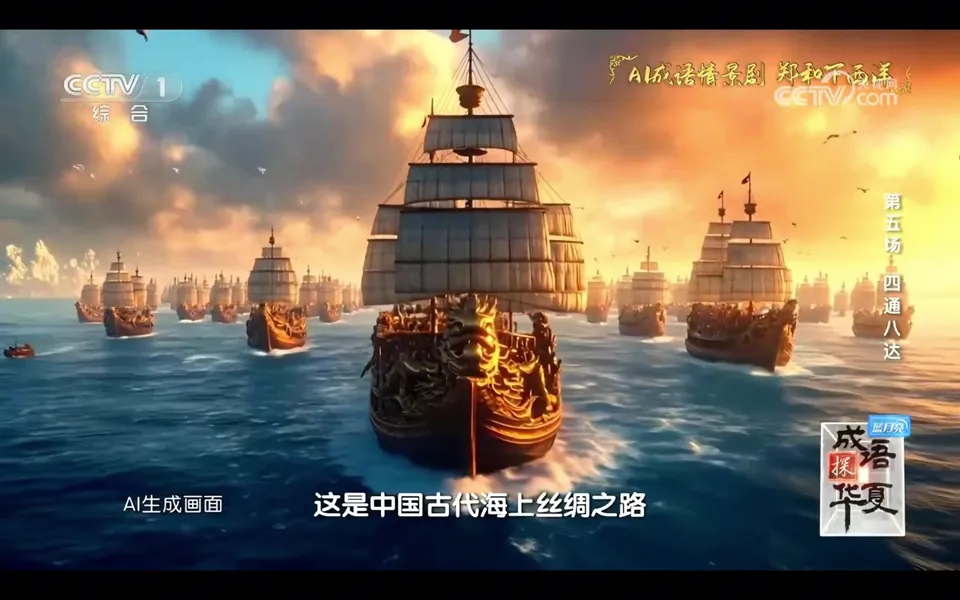
First a head-on view of a treasure ship, then up onto the deck to watch sailors working and climbing the masts, through a forest of sails, and finally a pull-back to hundreds of ships advancing together.
Clip · 00:21–00:25
The Treasure Ship at Center, Sailors on Deck
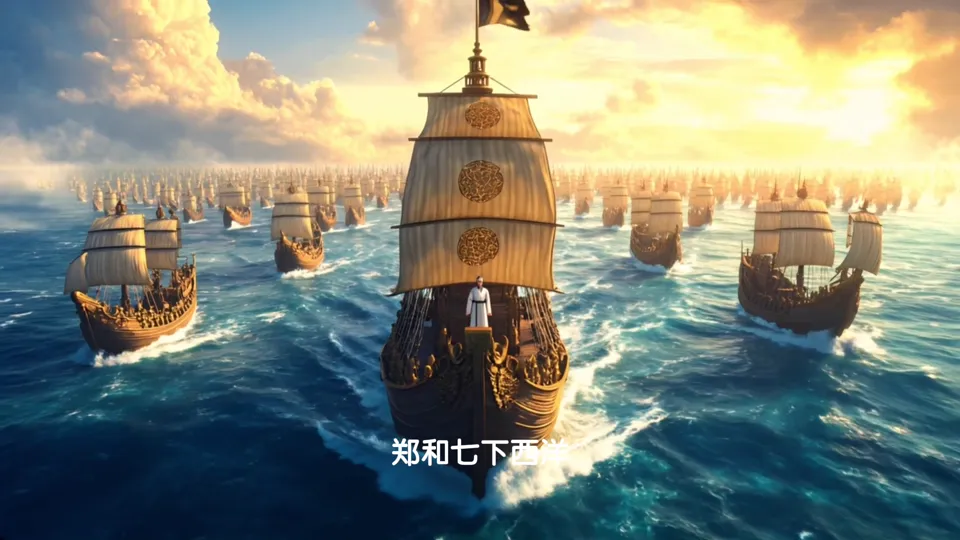
A treasure ship sails toward the center of the frame, a line of sails behind it; the next shot is on deck, where backlit sailors haul ropes and move cargo.
Clip · 00:25–00:31
Climbing the Mast, Through the Sails
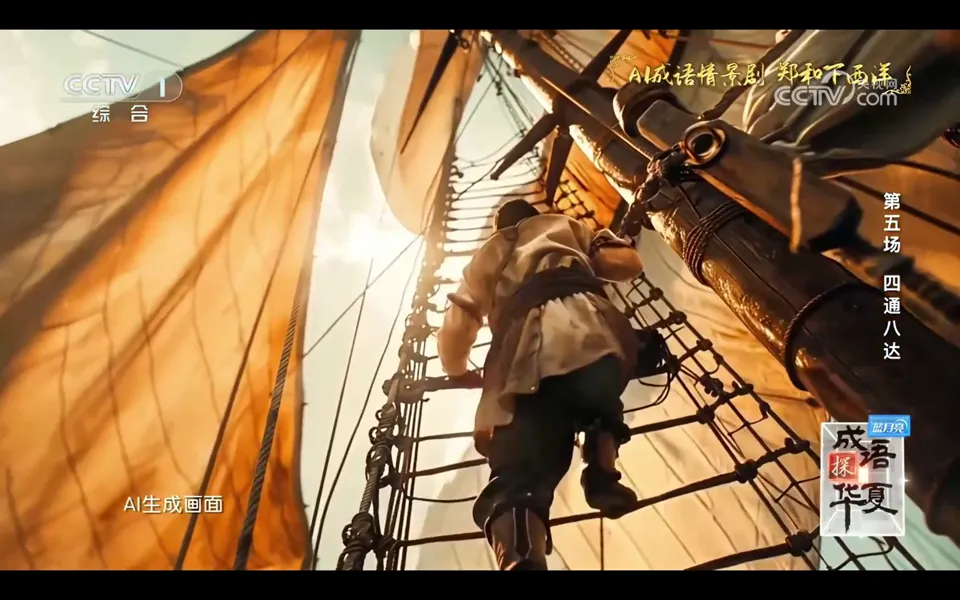
A low-angle shot of a sailor climbing a rope ladder, then the camera passes between billowing sails before rising high to reveal the whole fleet riding the wind and waves.
Film · 00:31–00:43
Question 1: What They Took, What They Brought Back
A hold full of silk, bolts of silk on display in a foreign market, a hand lifting a blue-and-white teapot to pour tea; on the return voyage, the deck is piled with jewels and spices.
Clip · 00:31–00:35
Silk, Porcelain and Tea
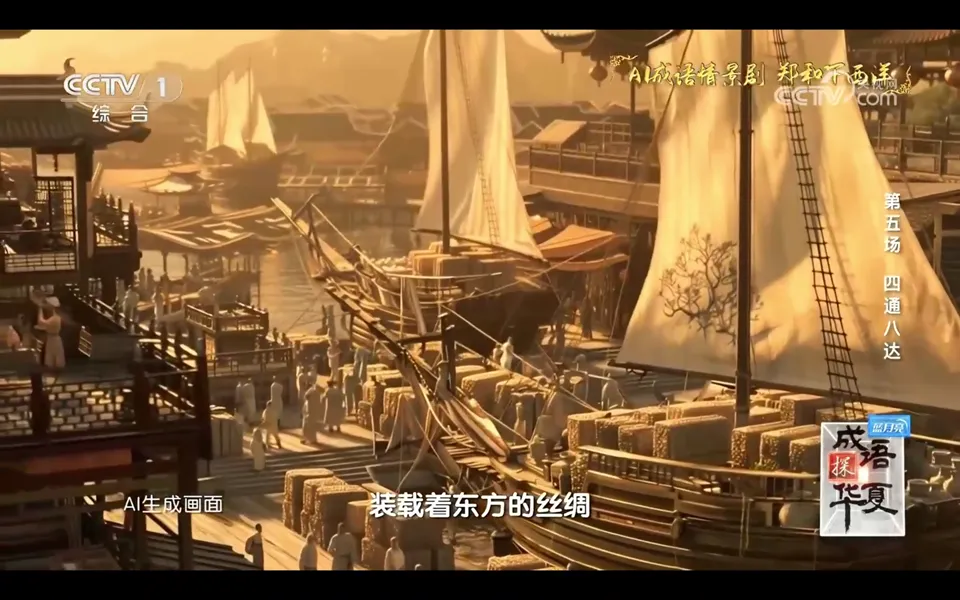
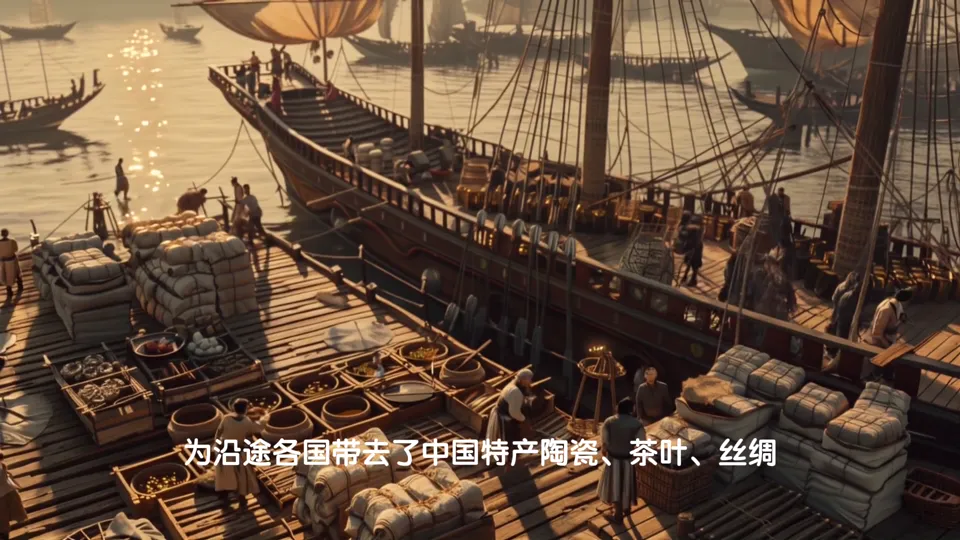
Cargo crates are stacked high by the ships at the dock, followed by a silk stall in a foreign market, then a close-up: tea poured from a blue-and-white teapot into a cup.
Clip · 00:35–00:39
Foreign Streets, Setting Sail Again
People in all kinds of dress pass through a busy street market; the camera returns to the turquoise sea as the fleet sets sail once again.
Clip · 00:39–00:43
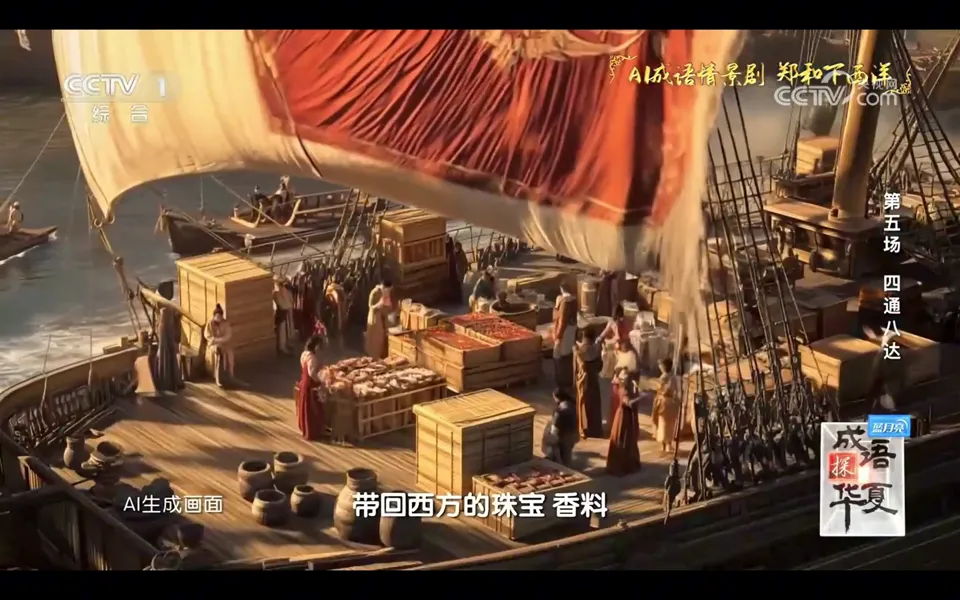
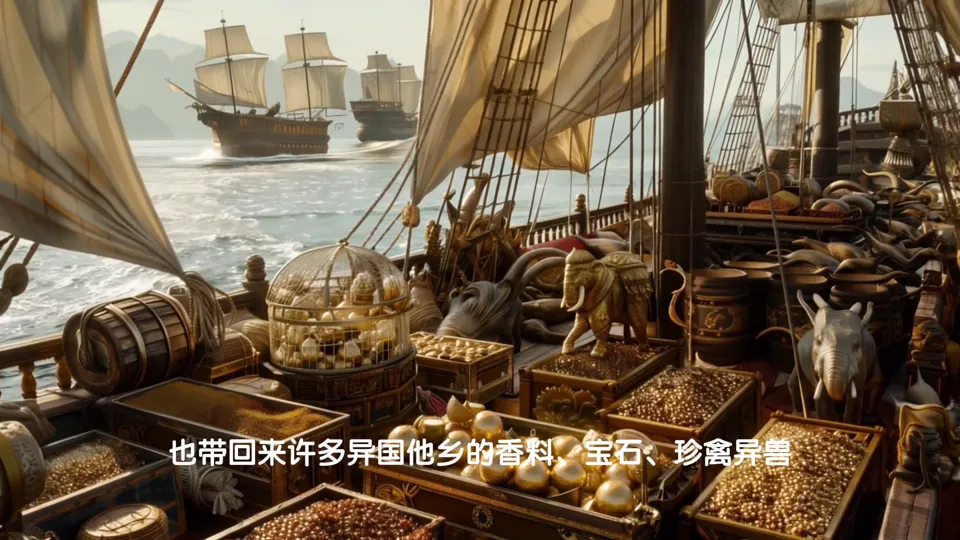
Bringing Back Jewels and Spices
On the return voyage, the deck is lined with wooden crates, compartments of spices and treasures gleaming in the sun, matching the narration “bringing back jewels and spices from the West.”
Film · 00:00–00:09
Question 2: What They Took and What They Brought Back
The second question first sets the scene in about ten seconds: the same fleet, the carved hull of a treasure ship, cargo being loaded at the dock, a foreign market, and pearls and spices on deck on the return voyage.
Clip · 00:00–00:04
The Treasure Ship and Its Carved Hull
A treasure ship leads the fleet straight toward the camera, then the camera moves in close to the hull to show layer upon layer of carved wood, matching the line “bringing Chinese specialties such as ceramics, tea and silk to the countries along the way.”
Clip · 00:04–00:09
Docks, Markets and Cargo for the Return
People at the dock are busy carrying crates, a foreign street market is full of goods, and new crates pile up on the deck of the great ship for the return voyage.
Film · 00:09–00:23
Question 2: A Giraffe Comes Ashore
A giraffe stands on a ship as townspeople crowd the harbor to see it; it walks off the ship, the crowd turns to follow it, and finally the narration poses the question: which mythical creature did people associate it with?
Clip · 00:09–00:14
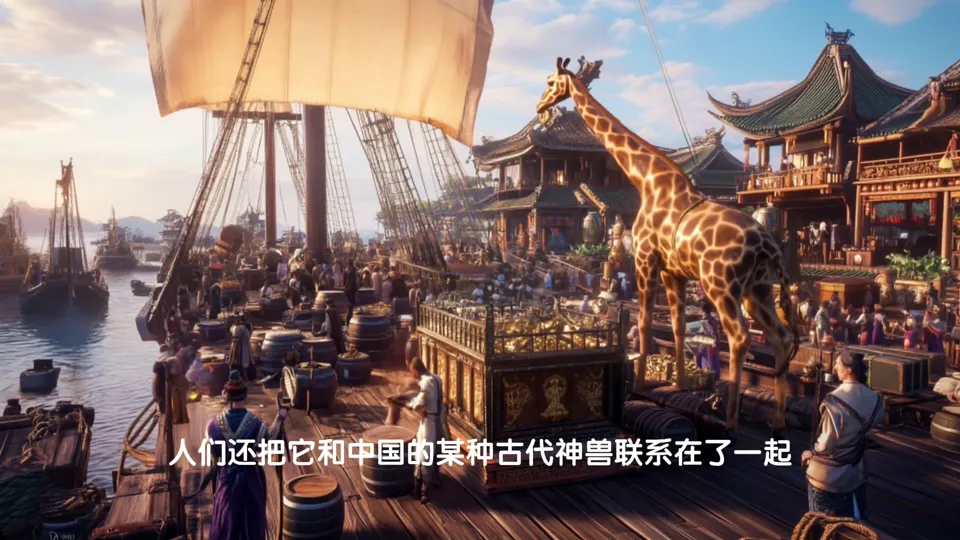
The Giraffe on Deck
First the pearls and spices piled on deck, then a cut to a giraffe standing at the ship's side, craning its neck toward the dense crowd on shore.
Clip · 00:14–00:19
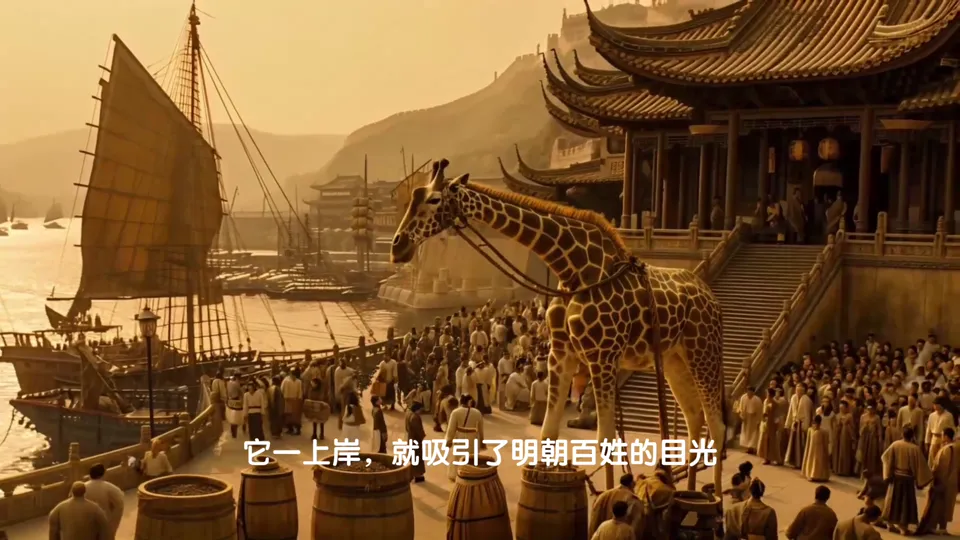
The Moment It Comes Ashore, Every Eye Turns
The giraffe walks along the dock, taller than the surrounding eaves, as the townspeople look up at it; the camera pulls back, and everyone in the harbor is looking in the same direction.
Clip · 00:19–00:23
Posing the Question
The giraffe stands beside the cargo crates and turns to look around as the narration says “people also associated it with a certain mythical creature of ancient China,” putting the question to the contestants.
04 / Storyboards & Final Frames
Every shot from both questions, in broadcast order.
Arranged in the order they appear in the films, Question 1 first, then Question 2: each shot notes what it shows, paired with the final image used in the film. The studio footage, channel logo and QR code were not made by us and are not included.
01
Question 1: Setting Sail by Imperial Order
Question 1 00:01–00:10
Shot 1.1
Receiving the Edict
At a harbor at sunset, Zheng He bows to receive the edict, with great ships ready to sail behind him.
Receiving the Edict · Final 1
Shot 1.2
Panorama of Liujiagang
An overhead view of the harbor, ships moored in rows along both sides of the channel, ready to head out to sea.
Panorama of Liujiagang · Final 1
Shot 1.3
A Great Ship at the Shore
Crowds bustle along the shore as a great ship lies moored beside the dock.
A Great Ship at the Shore · Final 1
Shot 1.4
Standing on the Bow
First-person view from the deck looking ahead, as the fleet sails out to sea together.
Standing on the Bow · Final 1
Shot 1.5
Seagulls
Two seagulls skim the sea, flying toward the distant sunset.
Seagulls · Final 1
02
Question 1: Visiting More Than 30 Countries
Question 1 00:10–00:21
Shot 2.1
The Fleet Crosses the Sea
The fleet sails in a line across the turquoise sea.
The Fleet Crosses the Sea · Final 1
Shot 2.2
A Foreign Harbor
Red-sailed boats fill a harbor, with domed buildings on shore.
A Foreign Harbor · Final 1
Shot 2.3
Palm-Lined Coast
A beach under palm trees is crowded with people, sailing ships anchored offshore.
Palm-Lined Coast · Final 1
Shot 2.4
A Great Ship Near the Beach
People on the beach gather around cargo, with a great ship anchored not far off.
A Great Ship Near the Beach · Final 1
Shot 2.5
An East African Bay
A row of colorful market stalls lines a turquoise bay.
An East African Bay · Final 1
Shot 2.6
A Man Carrying Goods
Close-up: a man carries a large bundle of goods along a shore crowded with ships.
A Man Carrying Goods · Final 1
Shot 2.7
More Than 30 Countries
A vast fleet of sailing ships fills the sea at sunset.
More Than 30 Countries · Final 1
Shot 2.8
Dolphins
Two dolphins leap out of the shimmering sea.
Dolphins · Final 1
03
Question 1: The Largest Fleet of All
Question 1 00:21–00:32
Shot 3.1
Treasure Ship Head-On
A treasure ship sails toward the center of the frame, its fleet's sails lined up behind it.
Treasure Ship Head-On · Final 1
Shot 3.2
Sailors on Deck
Close-up: on a backlit deck, sailors are busy at work as the sails cast shadows.
Sailors on Deck · Final 1
Shot 3.3
Climbing the Mast
Low-angle shot: a sailor climbs a rope ladder up the mast.
Climbing the Mast · Final 1
Shot 3.4
Through the Sails
The camera passes through a forest of billowing sails.
Through the Sails · Final 1
Shot 3.5
Two Hundred Ships
The fleet rides the wind and waves, ships stretching layer upon layer into the distance.
Two Hundred Ships · Final 1
04
Question 1: What They Took, What They Brought Back
Question 1 00:32–00:43
Shot 4.1
Docks Stacked With Cargo
Cargo crates are stacked in rows beside the ships, waiting to be loaded.
Docks Stacked With Cargo · Final 1
Shot 4.2
A Foreign Silk Stall
In a foreign market, people browse bolts of silk.
A Foreign Silk Stall · Final 1
Shot 4.3
Pouring Tea
Close-up: a hand lifts a blue-and-white teapot and pours tea into a cup. Porcelain and tea in the same frame, understood at a glance.
Pouring Tea · Final 1
Shot 4.4
A Foreign Street Market
People come and go in the street market, figures in all kinds of dress passing the stalls.
A Foreign Street Market · Final 1
Shot 4.5
Setting Sail on a Long Voyage
On the turquoise sea, the fleet sets sail.
Setting Sail on a Long Voyage · Final 1
Shot 4.6
The Deck on the Return Voyage
The deck is piled with wooden crates as sailors move between them.
The Deck on the Return Voyage · Final 1
Shot 4.7
Jewels and Spices
Compartments of spices and treasures laid out on the ship gleam in the sunlight.
Jewels and Spices · Final 1
05
Question 2: What They Took and What They Brought Back
Question 2 00:00–00:09
Shot 5.1
The Treasure Ship Sails Toward Us
A treasure ship leads the fleet straight toward the camera, waves breaking against its bow.
The Treasure Ship Sails Toward Us · Final 1
Shot 5.2
The Carved Hull
Seen up close along the hull, carved wood patterns unfold layer upon layer.
The Carved Hull · Final 1
Shot 5.3
Loading at the Dock
People at the dock are busy carrying cargo crates onto a great ship.
Loading at the Dock · Final 1
Shot 5.4
A Foreign Market
A market beneath domed buildings is full of goods and bustling with people.
A Foreign Market · Final 1
06
Question 2: A Giraffe Comes Ashore
Question 2 00:09–00:23
Shot 6.1
Treasures on Deck
Pearls, spices and cargo crates are piled on deck on the return voyage.
Treasures on Deck · Final 1
Shot 6.2
A Giraffe on the Ship
A giraffe stands at the ship's side, with a dense crowd on shore.
A Giraffe on the Ship · Final 1
Shot 6.3
Walking Onto the Dock
The giraffe walks along the dock, taller than the eaves, as the townspeople look up at it.
Walking Onto the Dock · Final 1
Shot 6.4
A Harbor Full of Onlookers
Pulling back, everyone in the harbor is looking in the same direction.
A Harbor Full of Onlookers · Final 1
Shot 6.5
Looking Around Beside the Crates
The giraffe stands beside the cargo crates and turns to look around as the narration poses the question.
Looking Around Beside the Crates · Final 1
05 / Script Excerpts
Beyond the picture.
Voice-over
Loaded with silk, porcelain, tea, lacquerware and handicrafts from the East.Question 1 Script
Voice-over
Among them was a giraffe, which caught the eye of the Ming townspeople the moment it came ashore.Question 2 Script
06 / Results
Turning long voyages and exchange into a knowledge short rich in detail.
Together, the two questions show the full scope of this project: the roughly 46-second program segment is “Hutong Youwu,” and the roughly 23-second standalone final cut is the giraffe sequence from “The Heavenly Qilin.” The AI visuals capture the fleet's scale, work on deck, details of the goods and people's reactions, giving the knowledge the program wanted to convey something to look at.
Case Study
Liandan AI Studio × CCTV “Exploring China Through Idioms” | Seven Voyages Split Into Two Questions: One About the Fleet, One About a Single Giraffe
Two hundred ships, more than 30 countries; silk, porcelain and tea carried out, jewels, spices and rare birds and beasts brought back.
The story of Zheng He's voyages is vast, but Episode 5 of “Exploring China Through Idioms,” titled “Connected in All Directions,” gave it two questions and a little over a minute of footage in total.
The first question tests the idiom “hutong youwu” (trading what each has for what each lacks) and has to make clear where the fleet went and what was exchanged; the second is only about a single giraffe and the Ming townspeople who saw it.
This is one of the nine AI idiom story films we made for the program. The two questions share the same fleet and the same warm golden sea, while each tells its own key point.
Client
China Media Group's “Exploring China Through Idioms”
Project Type
AI visual support: AI idiom story films (two questions)
Timeline
January 2025
Runtime & Specs
Question 1: about 46-second program segment (3456×2160); Question 2: about 23 seconds (1920×1080); both with narration and subtitles
Distribution
Question 1 aired in Episode 5, “Connected in All Directions,” of “Exploring China Through Idioms” on CCTV-1
Series Results
“Exploring China Through Idioms”: 200M+ views across platforms
Produced by
Shenzhen Alchemy Technology Co., Ltd. (Liandan AI Studio)
01
One Story, Two Questions, Two Ways of Telling It
In the production team's script, Zheng He's voyages corresponded to two questions. We made them into two separate short films, one for each question.
The first question had to cover a very long voyage: where it set out from, which seas it crossed, which countries it reached, what it took and what it brought back. So it has many shots and a fast pace, with one to three shots per line of narration.
The second question runs just over twenty seconds and tells only one thing: a giraffe came ashore, and the Ming townspeople all came to see it. There are fewer shots, and each one lingers longer so viewers can see how tall the giraffe is and how packed the crowd is.
Both films use the same treasure ships and the same warm gold of the setting sun, so even when played separately, they clearly belong to the same chapter of history.
02
Wherever the Narration Goes, the Picture Follows
The narration for the first question reads like a nautical chart: Liujiagang, the East China Sea, the South China Sea, Southeast Asia, South Asia, West Asia, and as far as East Africa. Viewers have no map in hand, so they can only tell from the picture that “we've reached another new place.”
In the image script, we wrote out the picture for every line of narration: the departure is an overhead view of Liujiagang; “crossing the East China Sea and the South China Sea” is a view forward from the bow, then following seagulls over the sea; Southeast Asia is palm trees and beaches, West Asia is domed buildings, and East Africa is a turquoise bay and a man carrying goods.
Departure: Liujiagang, with ships lined up along the channelThe farthest point: an East African bay and the market on its shore
The script also included several versions of an ancient map with the route marked in red. In the end, the film didn't use a map; instead, viewers follow the fleet from one port to the next.
03
“The Largest Fleet”: Pull Back First, Then Step Onto the Deck
“This was the largest fleet in the history of the Maritime Silk Road”: a single wide shot can't carry that line on its own.
We broke it into five shots: a treasure ship sails toward the center of the frame; backlit sailors work on deck; a low-angle shot of a sailor climbing the mast; the camera passes between the sails; and finally a pull-back to a high view of hundreds of ships riding the wind and waves together. Wide shots show the scale, while close shots show that there are people on board, at work.
A big scene should feel majestic, not messy. Images that looked cluttered or not expansive enough were regenerated; the fleet shots that made the final cut all put the treasure ship at the center, with the other ships lined up layer by layer into the distance.
Clip · 00:25–00:31
Climbing the Mast, Through the Sails
A sailor climbs a rope ladder, the camera passes through the sails, and finally pulls back to reveal the whole fleet.
04
Silk, Porcelain and Tea, Brought Down to a Single Hand
“Loaded with silk, porcelain, tea, lacquerware and handicrafts from the East”: if this line showed only a shipload of crates, viewers wouldn't remember it.
In the image script, we tried a large scene: in a distant city, several noblewomen take afternoon tea from Chinese porcelain on a terrace. The finished film swapped it for a more direct close-up: a hand lifts a blue-and-white teapot and pours tea into a cup. Porcelain and tea in the same frame, understood at a glance.
Concept draft: afternoon tea from Chinese porcelain on a terraceFinished film: close-up of tea poured from a blue-and-white teapot
Silk follows the same idea: instead of crates, the film shows people in a foreign market gathered around bolts of silk. In the return-voyage section, the camera rests on compartments of spices and treasures on deck, matching the narration “bringing back jewels and spices from the West.”
05
Question 2: One Giraffe, a Harbor Full of People
The answer to the second question lies in the townspeople's reaction: they associated this unfamiliar animal with a mythical creature of ancient China. So the visuals had to show not only the giraffe but also the people looking at it.
One concept put the giraffe in an ornate iron cage on the ship. In the final version, it stands right at the ship's side, craning its neck toward the crowd on shore; once on the dock, it is taller than the eaves, and the townspeople around it all look up.
Concept draft: the giraffe in an iron cage on the shipFinal: the giraffe at the ship's side, with crowds packing the shore
Clip · 00:14–00:19
The Moment It Comes Ashore, Every Eye Turns
The giraffe walks along the dock, taller than the surrounding eaves; pulling back, everyone in the harbor is looking toward it.
06
How to Make a Historical Story Easy to Follow
Zheng He's voyages span a long stretch of history, and the program gave them only a little over a minute. Our approach: first see what the question is testing, then decide what the visuals should and shouldn't cover.
The first question is about exchange, so every line of narration lands on a specific port, specific goods and specific hands; the second is about wonder, so the shots are given to the giraffe and the crowd watching it.
The same approach works for city promotional films and brand history films: however much content there is, first find the few things viewers must remember, then give them enough shots.
FAQ
FAQ
How do you help viewers follow the story in a historical AI short?
Write out the picture for every line of narration first, then generate images line by line. In Question 1 of this project, the narration mentions Liujiagang, the East and South China Seas, Southeast Asia, West Asia and East Africa, so the visuals show, in turn, a harbor panorama, a view from the bow with seagulls, a palm-lined coast, domed buildings and an East African bay, and viewers can tell from the picture where the ships are.
When one story is split into two shorts, how do you keep the visuals consistent?
Both films use the same treasure ship design and the same warm gold light of the setting sun, with consistent styles for the ports, sailing ships and cargo crates. Question 2 also opens with the treasure ship and its carved hull to connect with the first film before moving into the giraffe sequence.
Can AI handle large scenes like hundreds of ships or a harbor packed with people?
Yes. The key is a composition with a clear hierarchy. In this project, every fleet shot puts the treasure ship at the center, with the other ships lined up layer by layer into the distance; images that looked cluttered or not expansive enough were regenerated. For the crowd shots, the height contrast between the giraffe and the townspeople gives each frame an obvious focal point.
What videos were delivered for this project?
Two AI idiom story films: Question 1, “Hutong Youwu,” about 46 seconds (program segment, 3456×2160), and Question 2, about 23 seconds (1920×1080), both with narration and subtitles. Question 1 aired in Episode 5 of “Exploring China Through Idioms” on CCTV-1.
Approach
From sweeping sea views to the deck and the cargo hold.
First we separated what each question needed to cover: the first moves through departure, the voyage, work on board and the exchange of goods; the second moves through the goods brought back, the giraffe and the crowd of onlookers. Both use the same sailing ships, ports and warm light, so even viewed separately they feel like one world.
Shot sizes are arranged around two poles: the overall scale of the fleet at one end, and people's specific actions at the other. The deck, ropes, sails, porcelain and cargo each convey one thing; when choosing images, we looked at spatial proportions, character details and whether the color matched the shots before and after.
For the motion pass, each kind of movement (ships advancing, waves, sails, carrying cargo, the animal looking around) was written out separately, then paced to the question's narration. Wide shots provide the sense of scale, close shots of people and goods show the details, and the second question uses the watching crowd to highlight the clue to the idiom.