Exploring China Through Idioms: The Foolish Old Man Moves the Mountains
From persistence one hammer and chisel at a time to the transformation of mountains and rivers, cinematic scenes bring a familiar idiom to life.
Project Type
Culture & Arts
Client
CMG program “Chengyu Tan Huaxia”
Year
2024—2025
Our role
AI visuals for the program’s idiom dramas
Original format
3456 × 2160 · 01:41
Film01:41 · Video
01 / Background
Everyone knows this idiom. How do you make viewers feel “persistence” all over again?
For CCTV's “Exploring China Through Idioms,” we provided AI visuals that turn the fable of the Foolish Old Man into a chain of actions you can see: mountains blocking the way, a family discussion, labor on the mountain, an answer to a doubter, and finally the gods carrying the mountains away as the story turns.
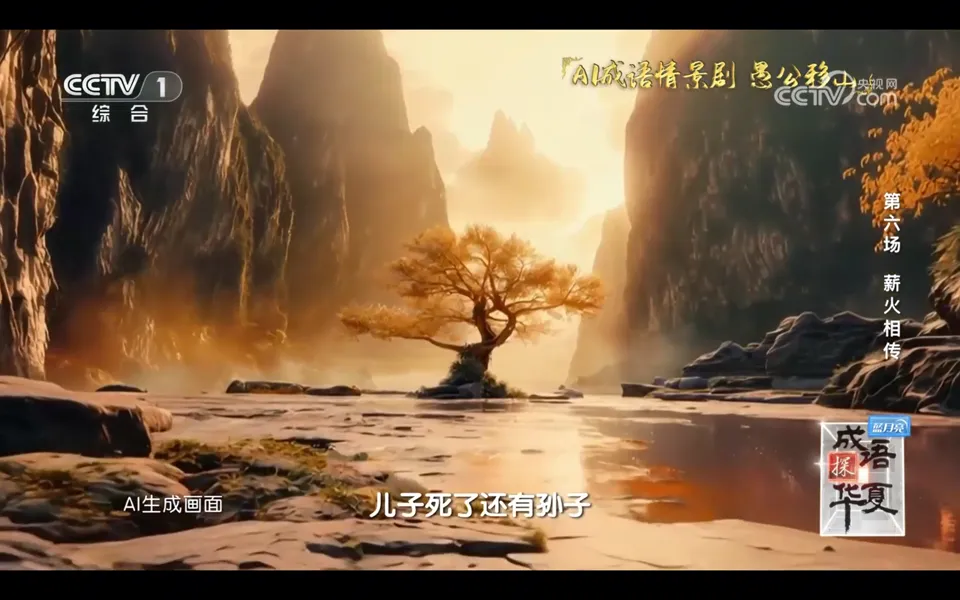
The work had to balance two things: ordinary people's clothes, tools and expressions had to feel familiar and believable, while the mountains and divine giants had to feel towering and majestic. The team tied wide shots and details together with one warm-gold valley setting, and used a tree slowly growing to show one generation after another, giving “persistence” a concrete time and place.
02 / Creative Highlights
The scale of the mountains sets off human effort.
01
A pile of stones makes the plan clear
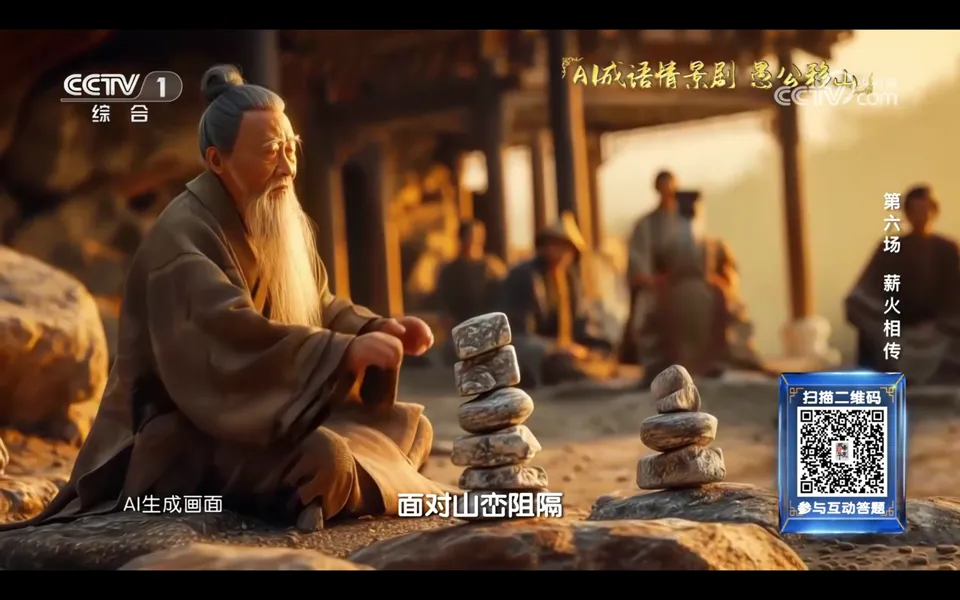
The family discussion cuts from a group shot in the courtyard to a close-up of stones and a walking stick on the ground, where two small piles stand for the Taihang and Wangwu mountains. With this small prop, a plan as huge as moving mountains becomes something concrete a family can gather around and discuss.
02
Chiseling stone and carrying loads, with even a child pitching in
Straw sandals, striking tools and flying stone chips lead into a child and people carrying loads on shoulder poles. Close-ups of the action show the effort, group shots show everyone joining in, and the family's determination comes through in this chain of movements.
03
A growing tree shows the generations carrying on
After the Foolish Old Man answers the Wise Old Man, a tree in the valley grows from small to large. The setting and colors barely change, so viewers know it is the same place, and “sons and grandsons without end” becomes the passage of time you can see at a glance.
04
From feet on the ground to mountains on the back
The opening uses a vast contrast, tiny people against huge mountains, to set up the challenge; the ending shows strength through hands, the full figures of the divine giants and the mountains on their backs. The mountains are there from start to finish, and the ending, with gods carrying them away, answers ordinary people's labor one hammer and chisel at a time.
03 / Scene Breakdown
In a hundred seconds, the Foolish Old Man's family goes from planning to dig to watching the gods carry the mountains away.
Film · 00:01–00:16
Two Great Mountains, One Old Man
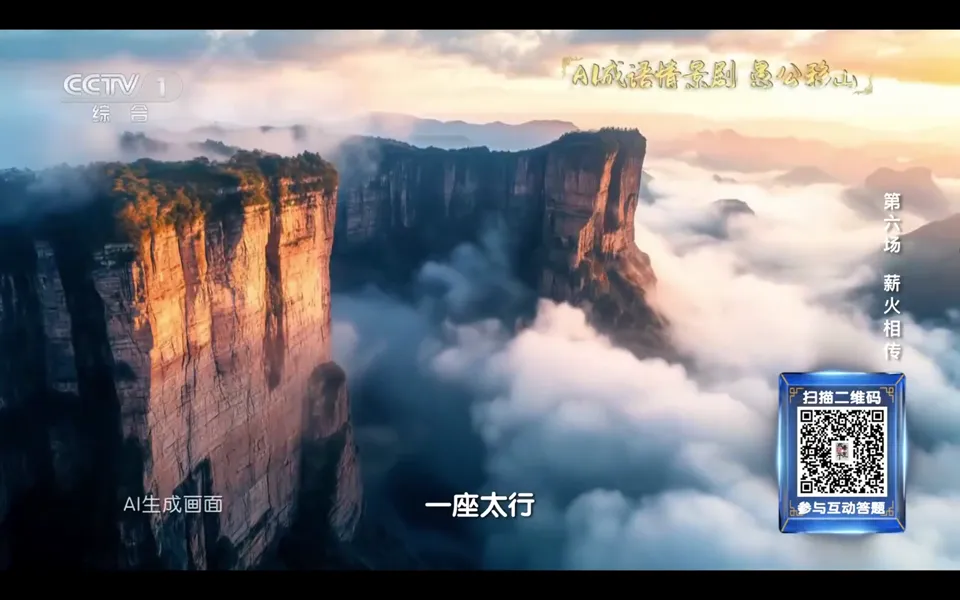
Cliffs rising from a sea of clouds, an ape gazing out from a ledge, a white-bearded old man leaning on a walking stick, then a set of peaks only birds can fly over. Viewers see how big the mountains are first, and only then does the Foolish Old Man appear.
Clip · 00:01–00:07
One Called Taihang, One Called Wangwu
Reddish-brown cliffs rise out of a sea of clouds as the camera slowly pushes in and the narration names the two mountains.
Clip · 00:07–00:11
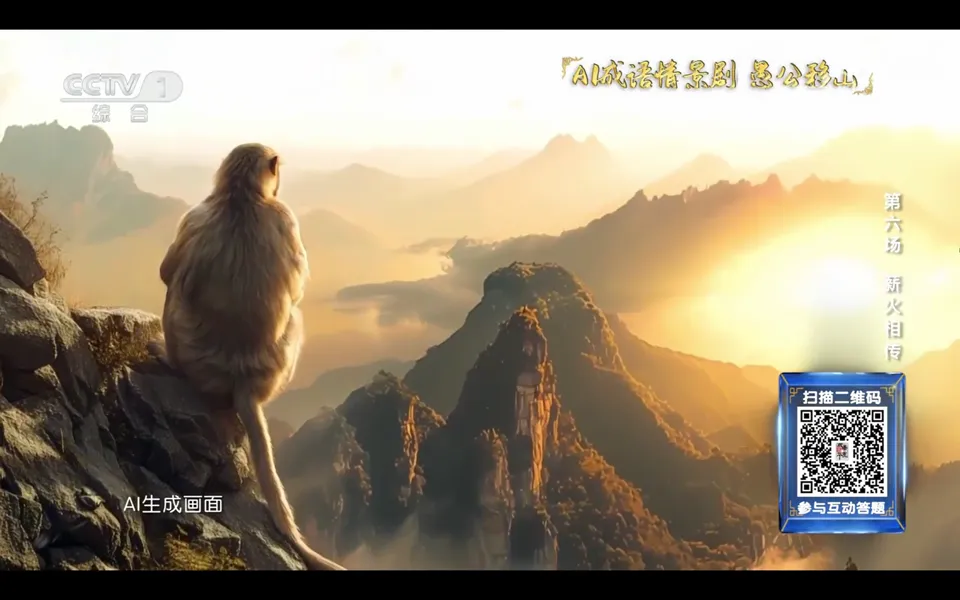
An Ape on the Cliff
An ape crouches at the edge of a cliff, looking out over the endless ranges as the setting sun shines from behind them. Even the ape can only look at the mountains, which leads into the line “at the foot of the mountains lived a man of nearly ninety.”
Clip · 00:11–00:16
The Foolish Old Man Appears
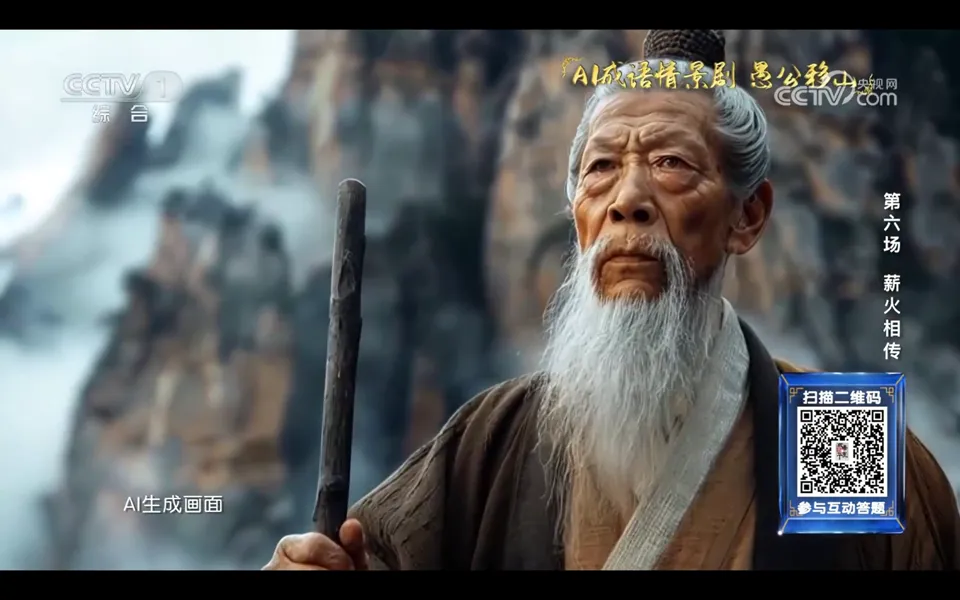
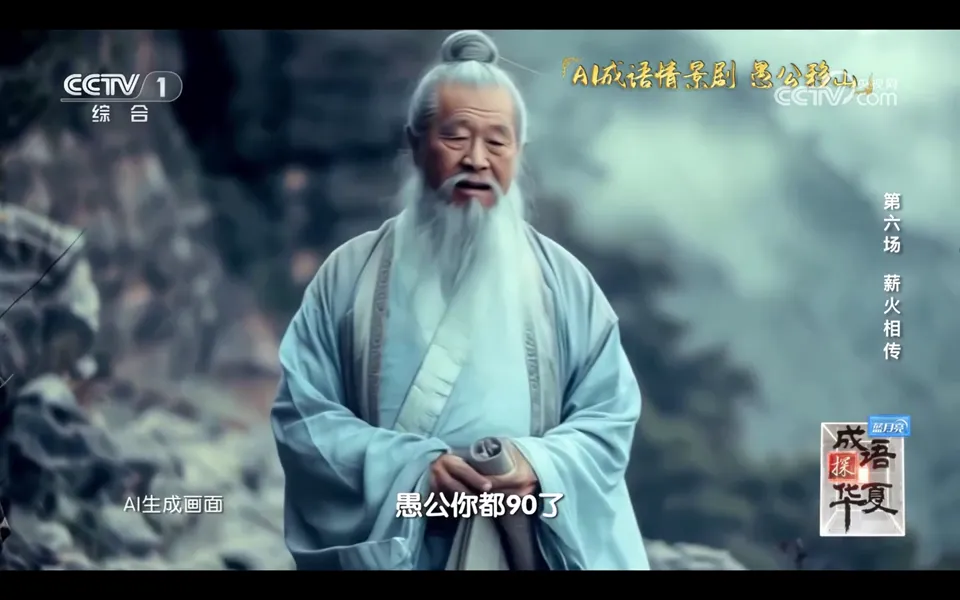
A white-bearded old man stands before the mountains, leaning on his walking stick, with misty cliffs behind him; in the next shot, a few birds skim past peaks in the sea of clouds.
Film · 00:16–00:32
A Family Discussion
The Foolish Old Man stacks stones one by one, then sits with his family in the courtyard to talk it over; his wife raises a question: where will the dug-out earth and rock go? He points into the distance in answer.
Clip · 00:16–00:22
Stacking Stones, Holding a Family Meeting
Sitting in front of the house, the old man stacks stones into two small piles, as if setting out the two mountains; then the whole family sits around the courtyard and hears him say he wants to dig the mountains away.
Clip · 00:22–00:28
A Great Road, and His Wife's Question
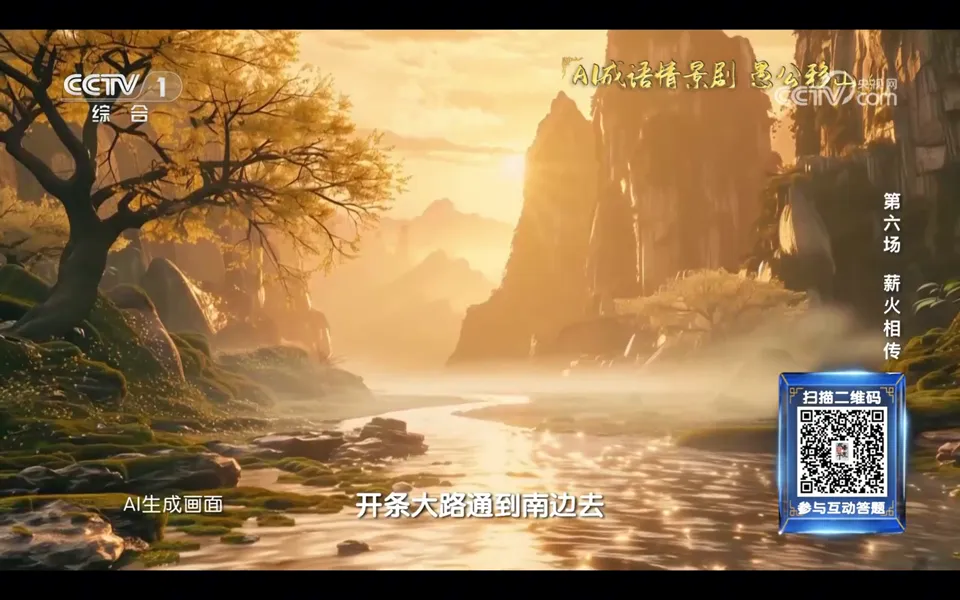
A river runs through a golden valley into the distance, matching “open a great road to the south”; then his wife, seated in front of the house, frowns and asks him: with strength like yours, you think you can shake a mountain?
Clip · 00:28–00:32
Where Will the Earth and Rock Go?
Stones big and small lie scattered on the ground as the wind lifts the dust; in the next shot, the Foolish Old Man raises his hand and points into the distance: carry it to the shores of the Bohai Sea.
Film · 00:32–00:51
Up the Mountain to Dig
The Foolish Old Man leads his sons and grandsons up the mountain, straw sandals crunching over gravel and hammers striking the rock face again and again, and the neighbor's child comes to help too; in winter they brave wind and snow, in summer they carry loads through the sunset.
Clip · 00:32–00:37
Up the Mountain, Gravel Underfoot
The family walks away from the camera onto a mountain path in the mist, followed by a close-up of straw sandals on gravel.
Clip · 00:41–00:45
The Hammer Falls, and a Child Arrives
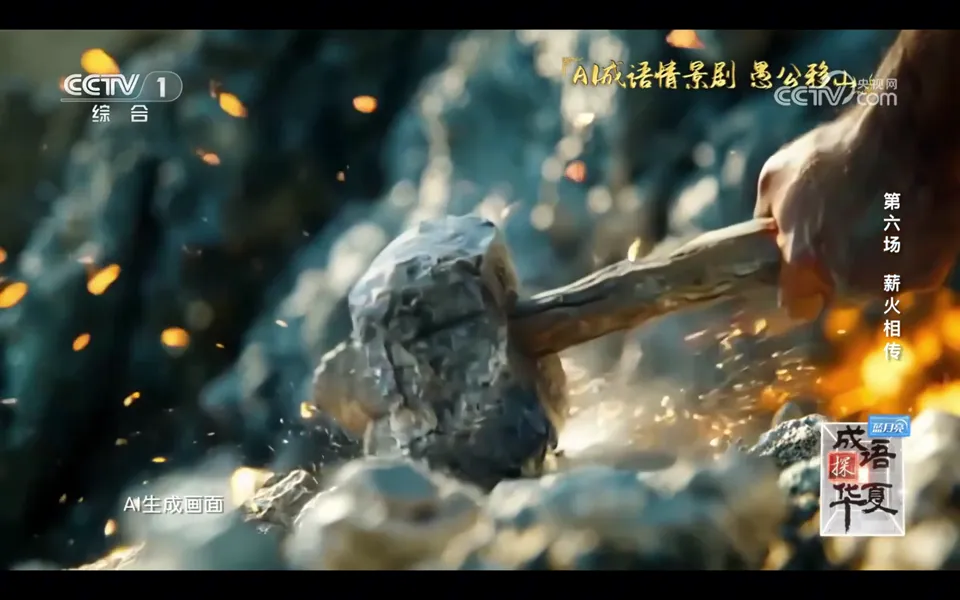
A hammer strikes the rock, sending stone chips and sparks flying; in the next shot, a child of seven or eight crouches among the stones, smiling as he lifts one up.
Clip · 00:45–00:51
Winter Into Summer, Day After Day
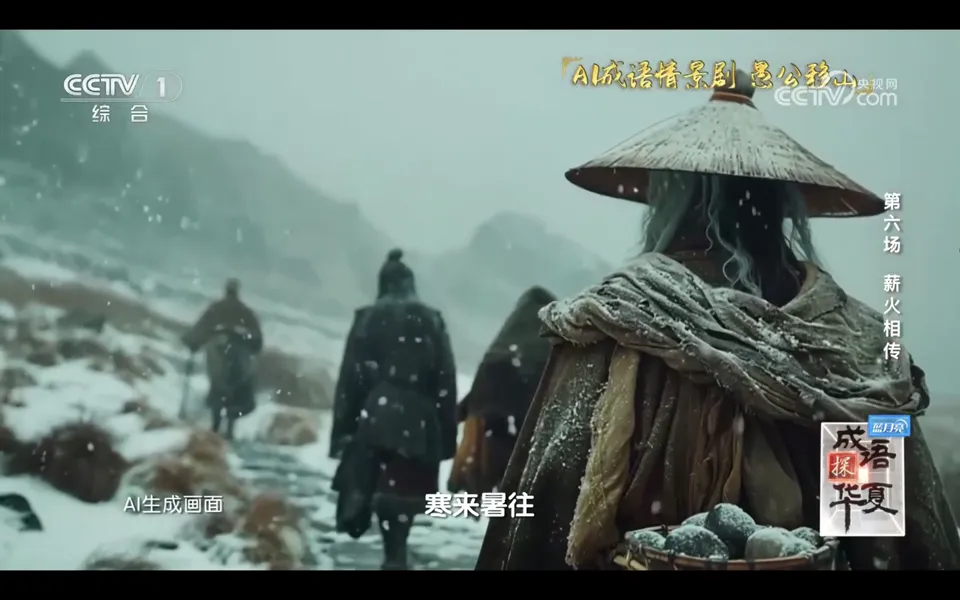
A man in a bamboo hat carries stones on his back through wind and snow, then others carry loads on shoulder poles past the water at sunset; finally a single drop of water falls onto a stone ledge, spreading out ring after ring.
Film · 00:51–01:15
The Wise Old Man Objects, the Foolish Old Man Replies
An old man in white comes along the mountain path and urges the Foolish Old Man to stop wasting his effort; wearing a bamboo hat and carrying stones on a shoulder pole, the Foolish Old Man answers: when I die, my sons will carry on, and when my sons die, my grandsons will.
Clip · 00:55–01:00
The Wise Old Man Tries to Dissuade Him
Dressed in white, with a white beard, the Wise Old Man stands on the mountain path, shaking his head: at your age, how many more stones can you possibly dig?
Clip · 01:01–01:06
A Sapling Grows Into a Great Tree
A sapling by the water in the valley grows, in the same spot, into a tree with a thick trunk and sturdy branches. As the narration reaches “when my sons die, my grandsons will carry on” and “sons and grandsons without end,” time passes on this one tree.
Clip · 01:06–01:12
Generation After Generation Keeps Digging
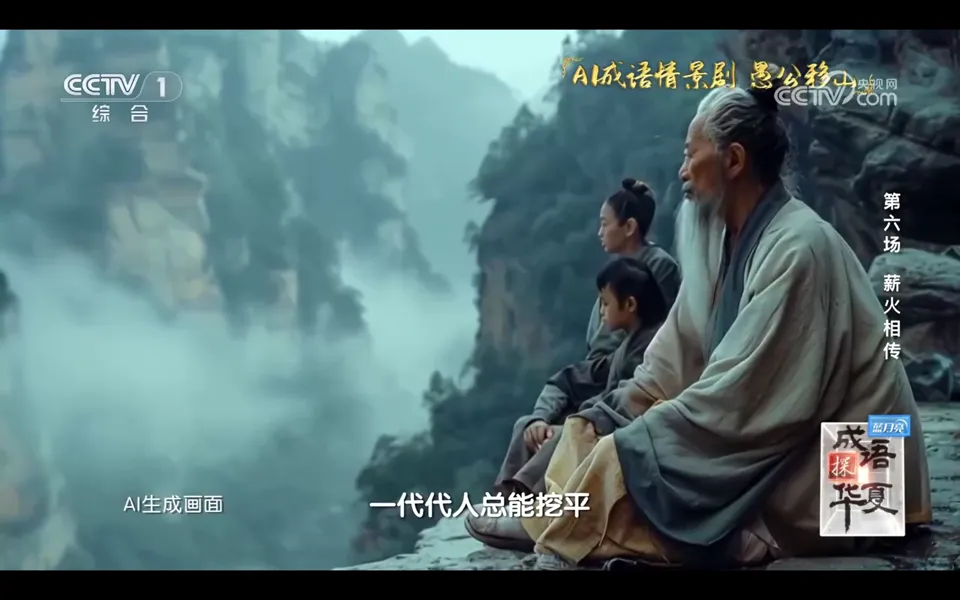
The Foolish Old Man sits at the edge of a cliff with children nestled beside him; then a group of bare-chested young men carry stones forward, as more and more people join the work.
Film · 01:15–01:39
The Mountain Spirit, the Emperor of Heaven and the Giants
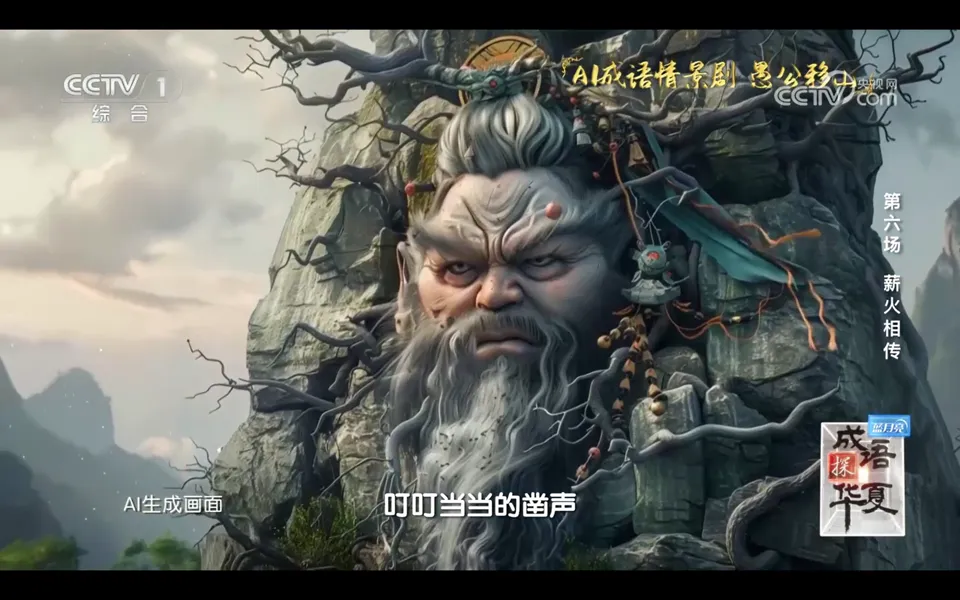
The apes in the mountains are startled, the mountain spirit's angry face emerges from the rock, and he reports to Heaven; golden light descends, the giant god's sons carry the two mountains away on their backs, and the gorge becomes an open road.
Clip · 01:17–01:25
The Mountain Spirit Complains
The frowning face of the mountain spirit surfaces in the rock; then, leaning on a branch staff and covered in vines, he goes to Heaven to report.
Clip · 01:25–01:31
Golden Light From Heaven, Giants Carry the Mountains
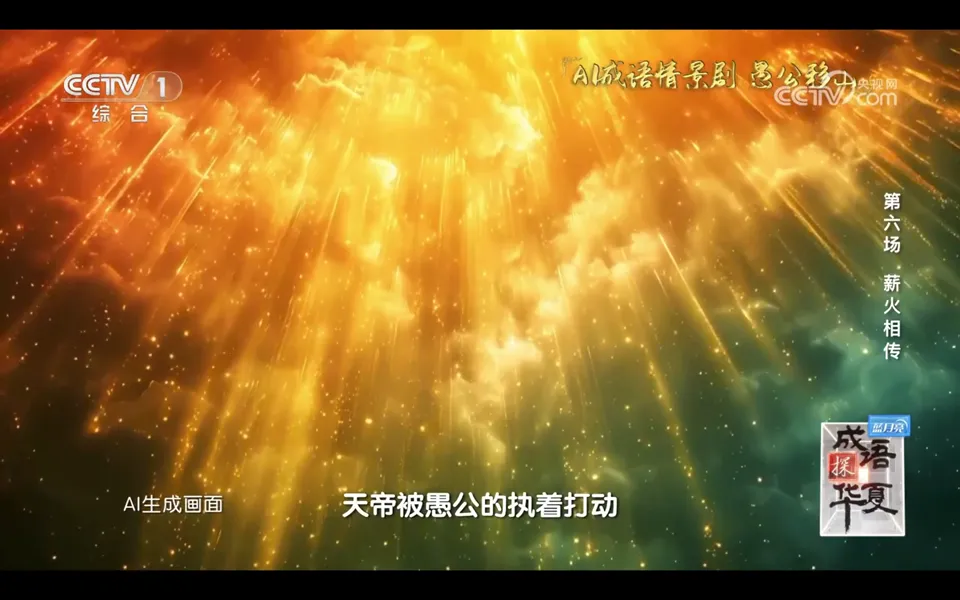
Golden light pours from the clouds and fills the screen, showing that the Emperor of Heaven has been moved; a giant hand presses down on the rock, and then two giants carry the mountains through the clouds.
Clip · 01:33–01:39
The Gorge Becomes an Open Road
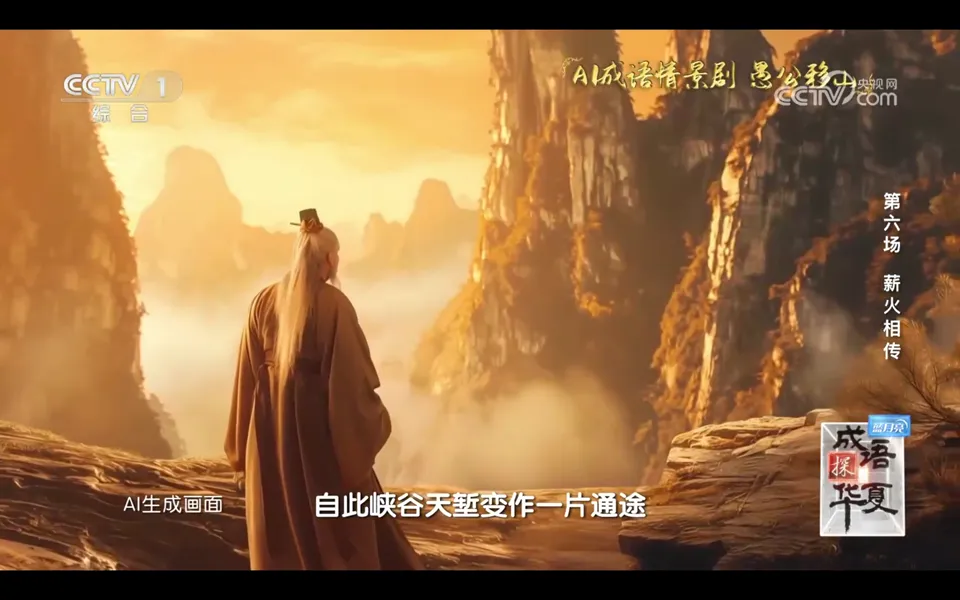
The old man stands at the mouth of the gorge as rock crumbles and shifts away in the dust; finally comes a wide view of open mountains and a winding road, mirroring the cliffs that blocked the way at the start.
04 / Storyboards & Final Frames
Twenty-one final shots, laid out in the order of the film.
Shown in the order of the final film. Shots such as the water drop and the sapling growing into a tree aren't included here; you can see them in the clip breakdown. The studio footage, channel logo and QR code weren't made by us and aren't included.
01
The Mountains and the Foolish Old Man
In the film · 00:01–00:16
Shot 1.1
One Called Taihang, One Called Wangwu
Wide shot: reddish-brown cliffs rise out of a sea of clouds, stressing how the two mountains stand between heaven and earth.
One Called Taihang, One Called Wangwu · Final 1
Shot 1.2
The Foolish Old Man
A white-bearded old man stands before the mountains, leaning on his walking stick, weathered but resolute.
The Foolish Old Man · Final 1
Shot 1.3
Only Birds Can Cross
Wide shot: a few birds skim past peaks in the sea of clouds; only birds can fly over them.
Only Birds Can Cross · Final 1
02
A Family Discussion
In the film · 00:16–00:33
Shot 2.1
A Family Meeting in the Courtyard
The Foolish Old Man and his family sit together in front of the house, discussing digging the mountains away.
A Family Meeting in the Courtyard · Final 1
Shot 2.2
His Wife's Question
Close shot: his wife sits in front of the house, frowning at the Foolish Old Man.
His Wife's Question · Final 1
Shot 2.3
To the Shores of the Bohai Sea
Backlit medium shot: the Foolish Old Man raises his hand and points into the distance, his expression firm.
To the Shores of the Bohai Sea · Final 1
03
Up the Mountain to Dig
In the film · 00:33–00:52
Shot 3.1
Up the Mountain
Seen from behind, the Foolish Old Man leads his sons and grandsons resolutely onto a misty mountain path.
Up the Mountain · Final 1
Shot 3.2
Straw Sandals
Close-up: feet in straw sandals step onto rough, uneven gravel.
Straw Sandals · Final 1
Shot 3.3
Chiseling Stone
Close-up: a hammer strikes the rock, sending stone chips flying.
Chiseling Stone · Final 1
Shot 3.4
The Neighbor's Child
A child of seven or eight crouches among the stones, smiling as he carries one.
The Neighbor's Child · Final 1
Shot 3.5
Winter
In wind and snow, a man in a bamboo hat carries stones on his back.
Winter · Final 1
Shot 3.6
Summer
By the water at sunset, several people walk past carrying loads on shoulder poles.
Summer · Final 1
Shot 3.7
Day After Day
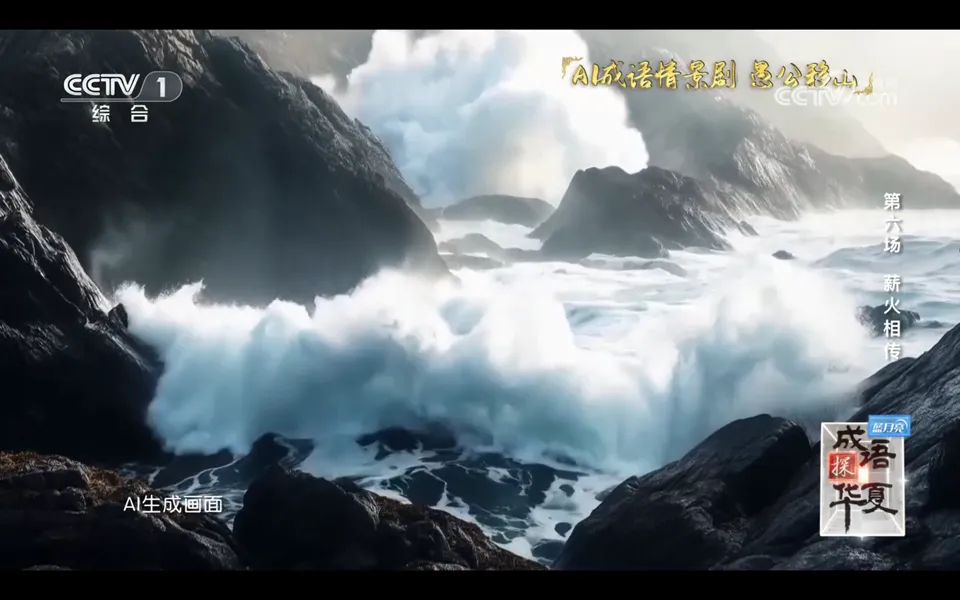
A sea of clouds churns through the gorge as the daylight slowly changes.
Day After Day · Final 1
04
The Wise Old Man Objects, the Foolish Old Man Replies
In the film · 01:00–01:16
Shot 4.1
The Foolish Old Man Carrying Stones
Close shot: the Foolish Old Man, in a bamboo hat, carries baskets full of stones on a shoulder pole.
The Foolish Old Man Carrying Stones · Final 1
Shot 4.2
Grandfather and Grandchildren
The Foolish Old Man sits at the edge of a cliff, children nestled beside him.
Grandfather and Grandchildren · Final 1
Shot 4.3
Generation After Generation Keeps Digging
Bare-chested young men carry baskets of stones forward on shoulder poles.
Generation After Generation Keeps Digging · Final 1
Shot 4.4
The Foolish Old Man in Firelight
Close-up: firelight illuminates the Foolish Old Man's face, a symbol of the torch passed from generation to generation.
The Foolish Old Man in Firelight · Final 1
05
The Mountain Spirit, the Emperor of Heaven and the Giants
In the film · 01:15–01:39
Shot 5.1
A Startled Ape
An ape in the forest looks up and around; even the creatures of the mountains have sensed something.
A Startled Ape · Final 1
Shot 5.2
Golden Light From Heaven
Golden light pours from the clouds and fills the screen, standing in for the Emperor of Heaven.
Golden Light From Heaven · Final 1
Shot 5.3
The Giants Carry the Mountains
Two giants carry the mountains on their backs as they make their way through the clouds.
The Giants Carry the Mountains · Final 1
Shot 5.4
An Open Road
Wide shot: a road winds between the mountains under open skies.
An Open Road · Final 1
05 / Script Excerpts
Beyond the picture.
The Foolish Old Man
Let us dig away these two mountains and open a great road to the south.Program Script
The Foolish Old Man
When I die, my sons will carry on; when my sons die, my grandsons will. Sons and grandsons without end, generation after generation, we will level them in the end.Program Script
Voice-over
From then on, the impassable gorge became an open road.Program Script
06 / Results
Giving the persistence in the fable concrete images.
The final film is a program segment of about 1 minute 41 seconds, running from the family discussion and the labor on the mountain all the way to the gods moving the mountains. Our AI visuals covered the characters, the valley setting, the details of the labor and the mythical scenes.
Case Study
Liandan AI Studio × CCTV “Exploring China Through Idioms” | A Fable Everyone Knows by Heart, Filmed as One Family's Hundred Seconds of Digging
The Taihang and Wangwu mountains spread over seven hundred li and rose seven or eight thousand zhang high. At their foot lived a man of nearly ninety, and he decided to dig them away.
Almost everyone knows this story by heart. That familiarity is exactly what makes it harder to film: viewers already know the ending, so keeping them watching depends on the family's actions, expressions and the passage of time.
Episode 6 of “Exploring China Through Idioms,” “Passing the Torch,” built a scenario question around it. We made nine AI idiom story films for the program; this one runs about 1 minute 40 seconds.
Client
China Media Group's “Exploring China Through Idioms”
Project Type
AI visual support: AI idiom story film (single episode)
Timeline
Characters designed in Nov 2024, finalized in Jan 2025
Runtime & Specs
Program segment of about 1 min 41 s, 3456×2160, with narration, dialogue and subtitles
Distribution
“Exploring China Through Idioms” Episode 6, “Passing the Torch,” on CCTV-1
Series Results
“Exploring China Through Idioms”: 200M+ views across platforms
Produced by
Shenzhen Alchemy Technology Co., Ltd. (Liandan AI Studio)
01
A Textbook Fable, Broken Into Thirteen Scenes
The original text in “Liezi: Questions of Tang” is a narrative: who, where, and what they did. Put pictures straight to it and you easily end up with a series of illustrations.
We first rewrote it as thirteen scenes: the mountains block the way, the Foolish Old Man makes up his mind, the family meeting, his wife's doubts, his answer, the digging begins, the neighbors help, the work goes on and on, the Wise Old Man's doubts, the Foolish Old Man's persistence, the villagers are inspired, the mountain spirit complains, and the Emperor of Heaven is moved.
Each scene spelled out how many images it needed, and the shot size, lighting and color of each one. “The obstacle of the mountains,” for example, read: wide shot, mountains wreathed in cloud and mist, blotting out the sky; plus another image of birds flying over the peaks, since only birds can cross.
The mountains block the way: cliffs rising out of a sea of cloudsPeaks only birds can fly over
The characters speak, too. The Foolish Old Man says, “Let us dig away these two mountains and open a great road to the south,” and his wife asks, “And where will you put the earth and rock you dig out?” With this back-and-forth, the family becomes more than names in a textbook.
02
“Digging the Mountain” Has to Show Feet and Hands
“Chiseling stone and digging earth” is a phrase that's easy to skim past. In the script we added several close-ups specifically for it: feet in straw sandals stepping on gravel; a hammer driving into rock, sending chips flying; bare-chested men carrying baskets of stones forward on shoulder poles.
Added shot: straw sandals on rough, uneven gravelAdded shot: a hammer drives into the rock, sending chips flying
Even a single line like “the neighbor's seven- or eight-year-old came to help” got its own shot: a child crouching among the stones, smiling as he lifts one up. Digging the mountains grows from one old man's resolve into the strength of a whole group.
Clip · 00:41–00:45
The Hammer Falls, and a Child Arrives
A hammer strikes the rock, sending sparks and stone chips flying; in the next shot, the neighbor's child smiles as he lifts a stone.
03
Winter and Summer, a Drop of Water and a Growing Tree: Filming “Generation After Generation”
What's truly hard to film in this story is time. “Only one round trip between winter and summer” and “sons and grandsons without end” aren't single moments.
For the seasons, we set two images side by side: a man carrying stones on his back through wind and snow, and people carrying loads on shoulder poles at sunset. For day after day, a single drop of water falls onto a stone ledge and spreads out ring after ring.
Winter: carrying stones through wind and snowSummer: carrying loads past the water at sunset
For the generations, we used a tree: a sapling by the water in the valley grows, in the same spot and the same golden light, into a tree with a thick trunk and sturdy branches. The narration reaches “when my sons die, my grandsons will carry on” at just that moment. Viewers don't need to count the years; the tree tells them a long time has passed.
Clip · 01:01–01:06
A Sapling Grows Into a Great Tree
Same valley, same spot: a sapling grows into a great tree, matching “sons and grandsons without end.”
04
A Mythical Ending: The Emperor of Heaven Stays Unseen, the Giants Carry Weight
The ending of the story is handed over to the gods: the mountain spirit complains, the Emperor of Heaven is moved and sends the two sons of a giant god to carry the mountains away.
We didn't draw the Emperor of Heaven as a figure. Instead, a sheet of golden light pouring from the clouds stands in for him: when golden light comes down from Heaven, viewers know Heaven has been moved, and no divine figure steals the scene from the Foolish Old Man.
Draft: the Emperor of Heaven drawn as a figureFinal: golden light from Heaven in place of the Emperor
The shot of the giants carrying the mountains went through several rounds. In early versions, the giants looked like two stone statues, almost merging with the mountains; in the final, the two giants wear red robes and stride through the clouds with whole mountains on their backs, so the action reads at a glance.
Early version: the giants look like statues, merged with the mountainsFinal: two giants carry the mountains through the clouds
05
A Familiar Story, Retold Through Details
“The Foolish Old Man Moves the Mountains” has almost no suspense. What keeps people watching this film is its details: two small piles of stones, gravel under straw sandals, a child crouching among the stones, a sapling growing into a great tree.
Our approach: first turn the narrative into scenes with characters and dialogue, then find visible images for invisible things like “time” and “effort.”
The same approach works for corporate stories and city promotional films: give something everyone already knows a concrete image, and it can be remembered all over again.
FAQ
FAQ
How can an AI short bring something new to a fable everyone knows?
Start by turning the original text into scenes with characters and dialogue. This project broke “The Foolish Old Man Moves the Mountains” into thirteen scenes, with lines for the Foolish Old Man, his wife and the Wise Old Man; then it added close-ups of the digging, such as straw sandals, hammers and a child carrying stones, so viewers see specific people and actions.
How do you show the passage of time, like “day after day” or “generation after generation,” on screen?
Show it through change in a single spot. This project used a drop of water falling onto a stone ledge for day after day, a sapling growing into a great tree in the same spot in the valley for the generations, and two sets of images, wind and snow and a setting sun, for winter turning into summer.
How do you handle mythical figures that are hard to show directly?
You can use light, the environment or a partial view instead. In this project, the Emperor of Heaven wasn't drawn as a figure; golden light from Heaven shows he has been moved. The giants appear only in full-body shots carrying the mountains and as a giant hand pressing down on the rock, so the action is clear without upstaging the hero.
What are the runtime and specs of this episode?
The program segment runs about 1 minute 41 seconds at 3456×2160, with a consistent narration voice, character dialogue and subtitles, and aired on CCTV-1 in Episode 6 of “Exploring China Through Idioms,” “Passing the Torch.”
Approach
From mountains blocking the way to chiseling stone.
We first organized the program script and plans for the thirteen scenes, then unified the look of the old man, his family, the Wise Old Man and the valley setting. Shots of the stone piles in the courtyard, feet and tools were drawn specifically, to make the discussion and the labor easier to follow.
For the growing tree, we prepared sapling and full-grown versions in a similar setting and color palette; in the mythical sequence, the proportions of the giants to the mountains and the overall art style match what came before, so the ending of divine strength moving mountains connects with the real-world labor.
The edit placed close and wide shots to follow the narration: close shots show the characters' emotions and the force of their movements, while wide shots show how high and vast the mountains are. In post, we unified the subtitle font and handed it over to the production team for final compositing.