
Summary
1. A former UI designer, Huang Zhongzhong used Kling to bridge his gap in visual technique, turn his ideas into reality and close the last mile to making viral videos.
2. In the Super Creator 2.0 era, Kling AI helps super creators connect the whole chain from high-value commercial projects to efficient content production. Huang Zhongzhong has gone from a hobbyist creator to a professional content provider who delivers commercial work.
Introduction
In July 2025, Huang Zhongzhong received an official letter of thanks from the Executive Committee Office of the Global Digital Economy Conference, thanking him and Kling for producing the conference's opening MV. Across the top of the letter ran the large red FangSong characters he remembered seeing on government documents as a child.
He keeps a scan of the letter on his phone. “Kling earned this for me,” he says.
Soon after Kling launched, Huang Zhongzhong took off in the Kling AI community with a video of an animal band. In it, a fox in a suit and sunglasses plays Jay Chou's “Greatest Works of Art” on the piano against a sea of leaping dolphins. Many people watched it, but few knew it was made by a designer with a UI background and no film training at all—he created the viral video with nothing more than basic aesthetics and Kling AI.
The video went viral, and the work followed. He made a New Year greetings film for the NDRC, a video report for Kuaishou's earnings, and idiom story videos for CCTV's variety show “Exploring China Through Idioms,” using AI to support live-action shooting. A small team that had struggled to make money from open-source design models began landing and delivering real commercial projects.
“Like a lost boat finally seeing the lighthouse, Kling AI helped me find my direction.”
Today his new identity is “AI Alchemist.” He describes his work as that of an ancient alchemist, refining the “golden elixir” of this era in a furnace forged from an RTX 4090. Having moved from describing still images with prompts to understanding moving light and emotion, he has started to think like a director and write like a screenwriter.
A Chaotic Start
Turned away from one job and laid off from another, he made himself an AI super expert in less than a year.
That's not clickbait. In late 2022, Huang Zhongzhong was laid off.
He wasn't upset—he actually felt lucky: “If I'd quit on my own, I wouldn't have gotten a cent.” That's him: easygoing by nature, with a self-deprecating streak. There's another story from before he became a super expert. Right after graduating, Huang Zhongzhong, an art student, was turned away from a campus recruitment job because his “visual technique wasn't good enough.” He laughs, “That makes the contrast even sharper.” It's also one of the main reasons Kling AI, which bridges that gap in visual technique, appealed to him so much.
His career plan has always been clear: keep moving toward the most advanced productivity of the day. In 2018, a wave of B2B software development was taking off, and B2B UI design didn't demand strong visual technique. He threw himself into it, and his pay soon reached more than double what the campus job that had turned him down a year earlier would have offered.
The job was in a new innovation department that a traditional engineering company had set up to embrace digital transformation, building the company's engineering project management system. Unlike consumer-facing visual design, which often relies on eye-catching marketing posters with strong visual impact, B2B UI design is about order and consistency across the whole page: buttons, input fields and functional areas are laid out strictly by the design system's rules to make users more efficient.
Before AI image generation arrived, this was Huang Zhongzhong's favorite work. Every day at his desk he built his own design system, first in Sketch and then, from 2020, in Figma, the most advanced productivity tool of the time. In 2021 he released his own Figma version of the Element Plus open-source UI component library, filling a gap in the open-source community.
By early 2023, Stable Diffusion 1.5 model training had matured. In a small group chat with friends, Huang Zhongzhong saw 3D red envelope assets generated by a trained model that came close to what 3D software could render. “A 3D red envelope like that used to take hours. Now it takes minutes.” His tone turns calm and certain: “I could feel it was a huge wave of productivity gains, and we had to be part of it.”
With tens of thousands of RMB in severance in his account, he decided to invest in himself and master the advanced productivity of the next era. He firmly believed that mastering the most powerful productivity of the day is how you contribute most to society and earn the best return.
The superpower Huang Zhongzhong chose was training 3D icon models. 3D icon assets used to be very scarce. Each icon serves a specific business scenario and color style—a “server” icon for a cloud server homepage, say, or a “gift pack” icon for a promotions page. Production was tedious and complex, and costs stayed high. That is exactly why this is where AI can capture the biggest margin.
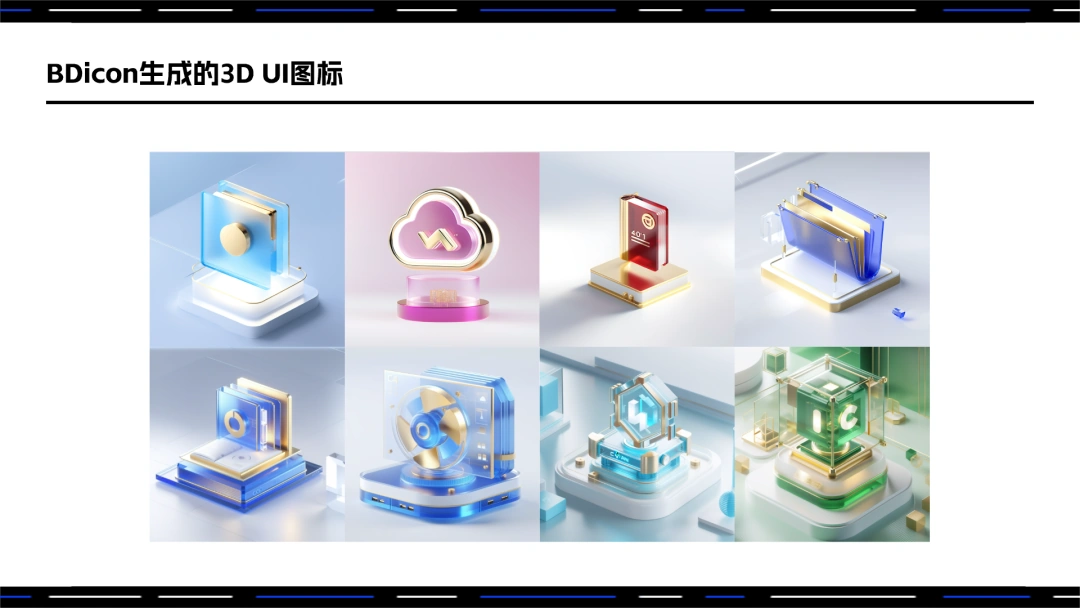
Huang Zhongzhong wanted to train a 3D icon model, BDicon, for B2B UI designers who, like him, couldn't use 3D software but needed 3D icons. Before, a 3D designer had to open modeling software, build the model, then apply materials, light and render it—a tedious process with a steep learning curve. Many UI designers are good at logical layout rather than pure visual creation. With AI, that gap in visual technique is filled, and UI designers can independently get much more done, much more efficiently.
“The problem was, I couldn't code!”
Back then he worked alone. From setting up the environment to running training to testing inference, every step could throw errors, and the constant unknown bugs made training progress painfully slow. “I'm a designer who knows a little code, not a programmer.” Every time a bug appeared, he had just two moves: search for fixes online or ask ChatGPT. When those ran out, he'd ask programmer friends for help, paying them a mates' rate out of his severance. The road was hard, but “back then I imagined every day that I was the hero of a novel, and I felt I was simply meant to pull it off,” he says.
Before the New Year, Huang Zhongzhong registered his own company.
The Making of an Alchemist
“AI model training is actually a lot like ancient alchemy.”
Huang Zhongzhong loves xianxia fantasy novels and often imagines himself as an alchemist of the AI age. His avatar is a self-portrait he made with AI: a golden crown, a medicine gourd at his waist and a golden elixir floating between his palms—full-on fantasy.
Over that year he went from an ordinary UI designer to an “AI Alchemist.” His work shifted from building interfaces to training AI models. His “alchemy furnace” is a high-performance computer with an RTX 4090 graphics card, and his herbs are the tens of thousands of high-quality images on it that he curated by hand.
The first step in alchemy is gathering herbs—in other words, preparing the dataset. “Whether what you refine is any good depends on the quality of your ingredients.” For his 3D icon generation model BDicon, he hand-picked several hundred high-quality 3D icon images as the training set.
But real-world material is always scarce and limited. “You can't expect every new icon to have a matching training set.”
Yet just as data ran short, AI's “intuition” surprised him for the first time.
The model had only learned a “cloud” in a blue frosted-glass style, but when he asked it to generate a “car,” it applied the same style on its own: a blue crystal, frosted-glass texture. “It had never seen one, but it guessed right.” Huang Zhongzhong was delighted to find the model's ability to infer went far beyond his expectations.
This kind of “guess-based generation” is the core logic of today's mainstream AI generation models: starting from black-and-white noise, the AI draws on what it learned in training to denoise step by step, moving from blur to clarity toward the final image. Each step is a fresh take on what's possible.
In visual design, this generative ability brings a huge productivity dividend: 3D icons can be generated in batches, with controllable style, and the style can carry across categories. “In a traditional design workflow, that's unimaginable. Every 3D icon has to be modeled, lit and rendered from scratch, which takes a lot of people and money,” he says.
That's why there was real market demand for AI in UI design. As one of the few “freelance alchemists” in Shenzhen at the time, Huang Zhongzhong often spoke at forums where AI meets design, on how to use model training to learn a “style” and how to turn AI into a creative assistant. He compares model training to digital alchemy: tuning the learning rate, a key hyperparameter, is like adjusting the heat; choosing an optimizer is like picking how the heat changes over time; and the loss function signals whether the batch will succeed. Every step is crucial to whether the elixir comes out right.
Once training starts, the computer runs for a dozen hours or more and nobody can step in. “All you can do is wait,” he says. “Just like ancient alchemy—until the furnace door opens, no one knows what's inside.”
He doesn't make it sound mystical: “You need good herbs, a feel for the heat, patience, and a willingness to revise.”
Still, he knows full well that AI can't do everything in UI design.
At heart, UI design is a kind of order design: it keeps pixel-perfect consistency across hundreds or thousands of pages. All primary buttons must be 32pt tall, spacing follows a 4pt or 8pt grid, icons have fixed sizes, and colors must respond precisely in specific interaction states. “Ask AI to keep every button at exactly 32 pixels, and it can't do it.”
Becoming a Kling Super Creator
Medium shot, blurred background, sunlight streaming through the window. A fox in an elegant suit and sunglasses sits at a piano, playing intently. Beside it the sea sparkles, with dolphins leaping joyfully, creating a warm and cheerful mood. Cinematic color grading.
This prompt may remind you of last year's viral animal concert videos: a fox on piano, a cat DJing and a lion conducting a symphony orchestra, all playing Jay Chou's “Greatest Works of Art.”
Kling launched in June 2024. Huang Zhongzhong saw many people using AI to bring their imagined scenes to life. He took a clip from the internet and expanded it into a complete one-minute piece. “Just like the song title, Kling is also a ‘greatest work of art.’”
After he posted it, Kling's official account reshared the video. He had prepared for its success in advance, including clearing copyright. “I was lucky, but it wasn't only luck,” he says with a laugh. “Opportunity really does favor those who are ready.”
Huang Zhongzhong had been getting ready all along.
He has an unusual work habit: managing knowledge by writing things down. After every piece, he writes a retrospective document or spreadsheet in concise, objective language. Memory is unreliable, he says: “Even if I made it myself, ask me two years later how I did it and I definitely won't remember.” Since his UI design days, he has built a personal design library, and his tutorial on building it won a major award from the software maker. He jokingly calls himself the design world's organizing expert.
Writing prompts in Kling comes as naturally to him as writing documents: he breaks down the picture in his head into concrete, structured visual language and color-codes each part of the prompt—blue for the subject, green for the subject's motion, red for the scene, yellow for camera language and gray for lighting and mood.
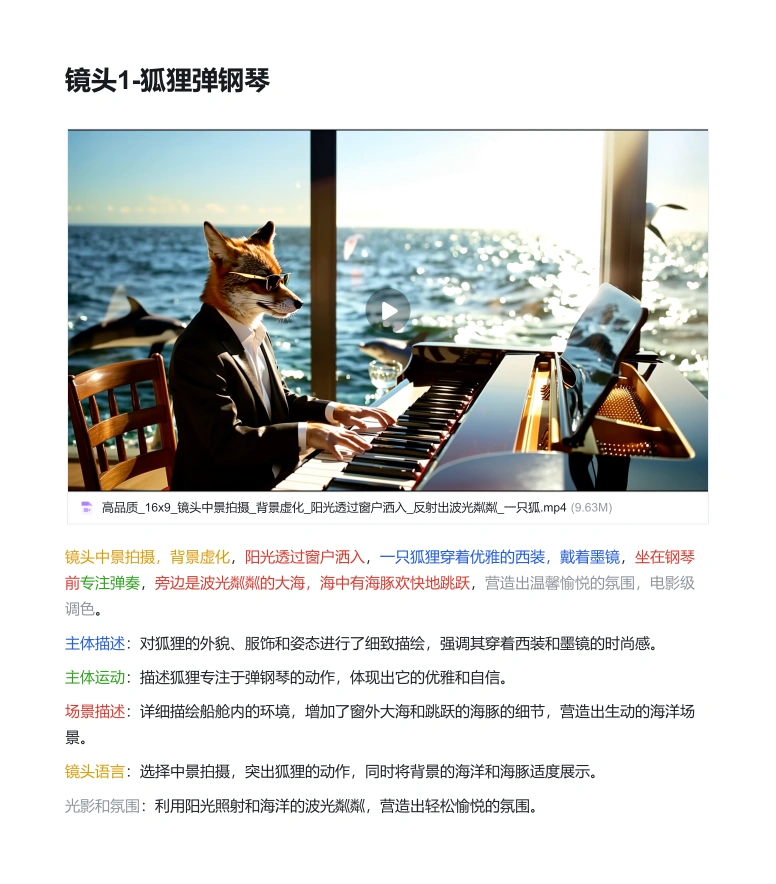
The video also gave him the chance to become a Kling “Super Creator.” For his young company, this one-minute video came like timely rain and brought real hope.
“In 2023 we were barely breaking even. Open-source design models were mostly a labor of love,” Huang Zhongzhong admits. BDicon was well received after he trained it, but at the time there were few ways to make money from open-source models.
“We only started making real money after Kling AI launched.”
Since Kling 2.0 launched in April 2025, the number of business clients using Kling AI has grown explosively. It now serves more than 20K enterprise customers worldwide and has become a benchmark for putting large models to work in industry. That has brought commercial orders to Kling's 100-plus Super Creators.
Huang Zhongzhong provided AI visual support for “Exploring China Through Idioms,” one of CCTV's top variety shows, using AI to generate moving images for classic idiom stories such as “The Foolish Old Man Moves the Mountains” and “Jingwei Fills the Sea.” The giant screen on the CCTV stage became a showcase where Kling AI made dreams come true.
“This is really AI's comfort zone.” Scenes like the old man cutting and hauling stone, travelers going back and forth as winter turns to summer, and the Emperor of Heaven, moved by his resolve, sending gods to carry the mountains away—Kling AI rendered them all very well.
In less than a year, his prompts quietly changed.
He began writing lines like “As his resolute gaze fixes on the steep peak ahead, the wooden staff in his hand worn smooth by years of use, not a trace of fear shows on his weathered face...” As a Super Creator, Huang Zhongzhong is no longer content to tell AI “what to make”—he is “telling a moment.”
Once a shot is carried by emotion, the boundaries of the prompt widen too. Huang Zhongzhong's “documents” are no longer written just for Kling. Sometimes they read like shot notes for a camera, sometimes like a visual novella for a director.
“I used to only make still images. Now I think about whether the movement of elements, light and shadow between the first and last frame actually makes sense,” Huang Zhongzhong says.
The Super Creator 2.0 Era
Commercial projects kept coming.
In July 2025, Huang Zhongzhong received an official letter of thanks.
Printed across the top in large red FangSong characters was “Executive Committee Office of the 2025 Global Digital Economy Conference.” The letter thanked Kling and Huang Zhongzhong for the opening MV they produced for the conference, calling it stunning. It wasn't his first project from “higher up.” Before that, he had made a New Year greetings video for the NDRC. “Kling ‘earned’ all these opportunities for me,” Huang Zhongzhong says plainly.

Huang Zhongzhong brings up Kling's Future Partner Program again and again: “We really had no channel to big clients like CCTV and the NDRC on our own. Without those orders, our small company wouldn't have survived to this day.”
With this being called the “first year of generative AI applications,” such commercial opportunities are no longer out of reach. On July 27, 2025, during the World Artificial Intelligence Conference, Kuaishou's Kling AI held an ecosystem forum. Kuaishou Senior Vice President Gai Kun said clearly: “2025 will be a pivotal year for generative AI moving into deep application.” According to Kuaishou's earnings report, Kling AI's revenue topped RMB 150M in Q1 2025, making it a key engine on Kuaishou's growth curve.
Huang Zhongzhong helped draw that curve. He made two consecutive earnings videos for Kuaishou, trying a new style each time: the full-year 2024 earnings video was fully 3D, while Q1 2025 shifted to blending the IP character with live-action footage.
The last shot of the earnings video: Xiaokuai rides a spaceship and flies forward past Kuaishou's real-world headquarters—the route Kuaishou staff take to and from work every day—and it blends in beautifully. “If Xiaokuai only appeared in a fully 3D scene, that would at most show the AI work was decent; it wouldn't wow anyone. But when it flies past a real office building, the audience goes, ‘That's amazing.’”
This sense of blending comes not only from the creative idea but also from how far AI has come. One minute of traditional 3D video can easily cost over RMB 100K, while the Kling-generated version needed only 30% of that budget. More importantly, the cost of testing and revising along the way dropped sharply. “In the traditional 3D era, once the direction was set and the modeling, lighting and rendering were done, you basically couldn't make big changes.”
Huang Zhongzhong treats each earnings video as a forward-looking exploration of where the industry is heading, and tries something new every time. “Whatever current AI technology can do, we turn it into a real use case.”
From the “technical breakthroughs” of version 1.0 to the “productivity unleashed” of 2.0, Kling's evolution has also pushed creators' roles forward. On his WeChat Moments, Huang Zhongzhong makes a test clip as soon as each new version is out. Recently he tried the multi-image reference feature to make a video of three IP characters walking side by side in the real world: Liandan AI Studio's own IP Danvis finally joined forces with Xiaokuai and Xiaoliu.
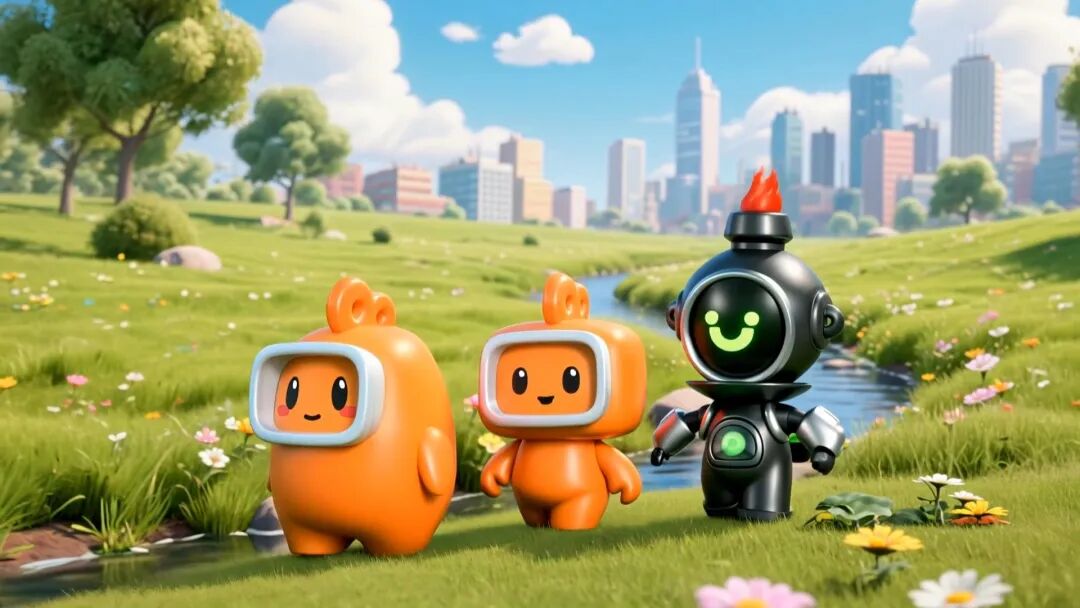
These efficiency gains have also changed how Huang Zhongzhong expresses himself. He says Kling has completely freed up his ability to express himself on the spot.
“In the past, to get an idea across, all we had was text or existing images and videos. Making your own content cost too much—there was no way to send someone a custom image or video within minutes.” Now he can make a custom animated sticker for a friend in no time. He imagines this could even become a social product someday: “Generating emotional content made just for someone shows far more sincerity than searching online for an image or video.”
From personal expression to client work, from testing technology to applying it in industry, Huang Zhongzhong is using AI to push the boundaries of what a creator can be. “I still hope to grow together with Kling,” he says. He hopes Kling will stay far ahead and create more value for society, “and I'll get my share of the rewards as a creator—a really healthy cycle.”
Just like the scene in his latest video, his company's IP character Danvis walks side by side with Xiaokuai, heading further along the line where the real and the virtual meet.
Source: Kuaishou Reference · Aug 2025