Using “transportation” as the thread, the film links Liaocheng's Grand Canal trade with high-speed rail travel, moving from ancient times to today.
Project Type
City & Tourism
Client
Kuaishou Kling AI creator invitation · Liaocheng tourism
Year
2026
Our role
Storyboard, AI visuals & video generation, editing
Original format
1920 × 1080 · 00:35
Film00:35 · Film
01 / Background
Connecting a high-speed rail theme with Liaocheng's cultural tourism
This short film had to cover both Liaocheng's cultural tourism and the opening of the Xiong'an–Shangqiu High-Speed Railway. The client suggested an angle: Liaocheng grew rich on canal shipping, and both the canal and high-speed rail are about transportation. So we made “transportation” the main thread: first the city's history on the canal, then today's high-speed rail travel, and even the rail section never strays from Liaocheng's own scenery and architecture.
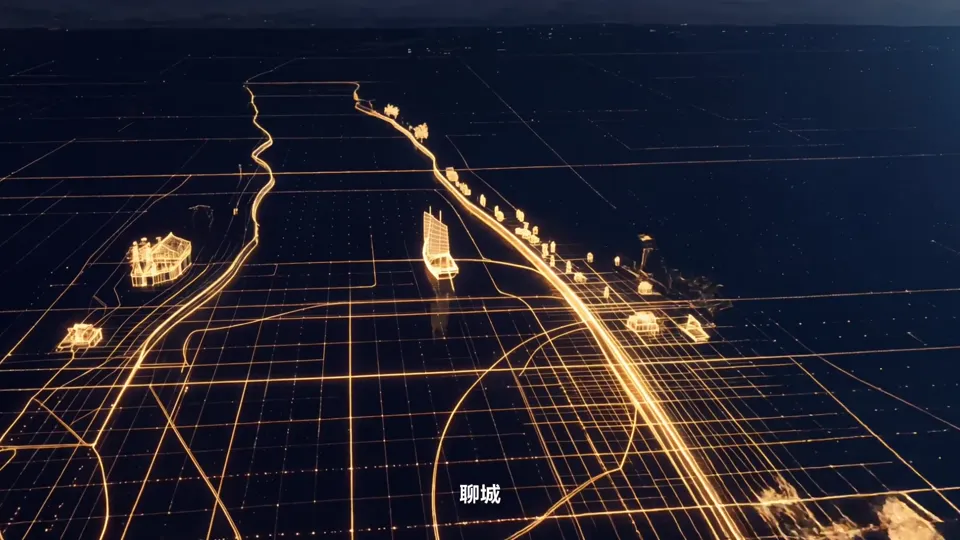
The film opens on a canal map drawn in golden lines, passes grain barges, old streets and historic buildings such as Guangyue Tower, with the camera pressing steadily forward to Dongchang Lake, the three high-speed rail stations and the digital rail network of Liaocheng West Station. It then lands on the title card “September 28: The Xiong'an–Shangqiu High-Speed Railway Officially Opens,” and ends with passengers entering the station, riding the train and greeting business partners, tying changes in transportation to the local scenery and to people's journeys.
02 / Creative Highlights
Reading the city's changes through transportation
01
Golden wireframes bridge past and present
Ancient and modern scenes look very different. The canal and the shopping street are first outlined in glowing gold lines; as the camera pushes forward, the old town's rooftops, towers and brick-and-timber textures emerge. The wireframes gradually become real scenes, viewers travel in one direction into another era, and every transition lands on a local Liaocheng building.
02
Landmarks keep it unmistakably Liaocheng
Guild halls, waterscapes and modern station buildings appear one after another, so viewers always know the story is set in Liaocheng. The transportation story is told through local landmarks, not just the generic shots of speeding trains.
03
From the whole rail network back to the passengers
The real station building turns into a blue wireframe model, the intersecting lines light up with trails of light and a train moves along the tracks, showing directly how the hub connects. Then come passengers entering the station, a traveler by the window and a handshake on the platform, bringing the large-scale transportation build-out back to concrete things: tourism, daily life and business ties.
03 / Scene Breakdown
From the Ancient Canal to the Modern City
Film · 00:00–00:07
Canal and Old Streets: An Old Town Grows from Golden Lines
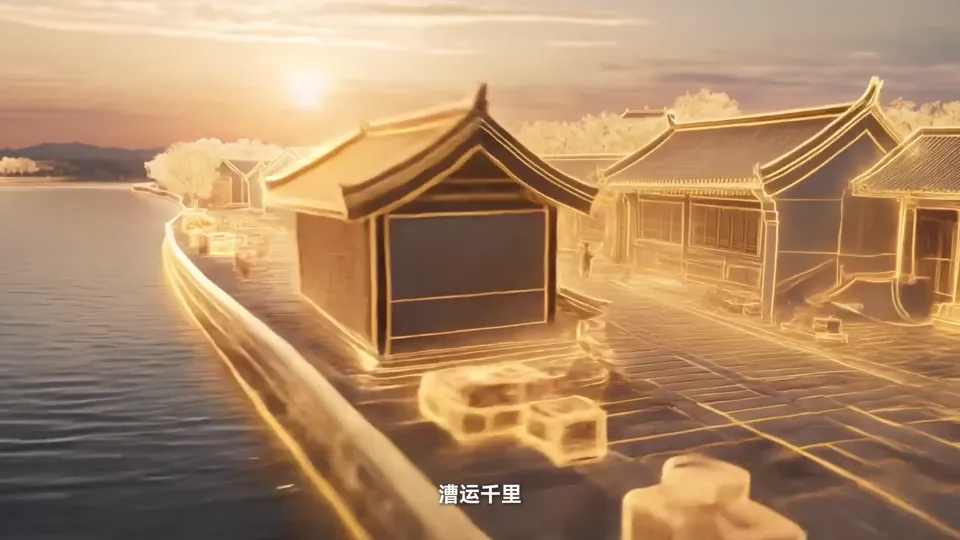
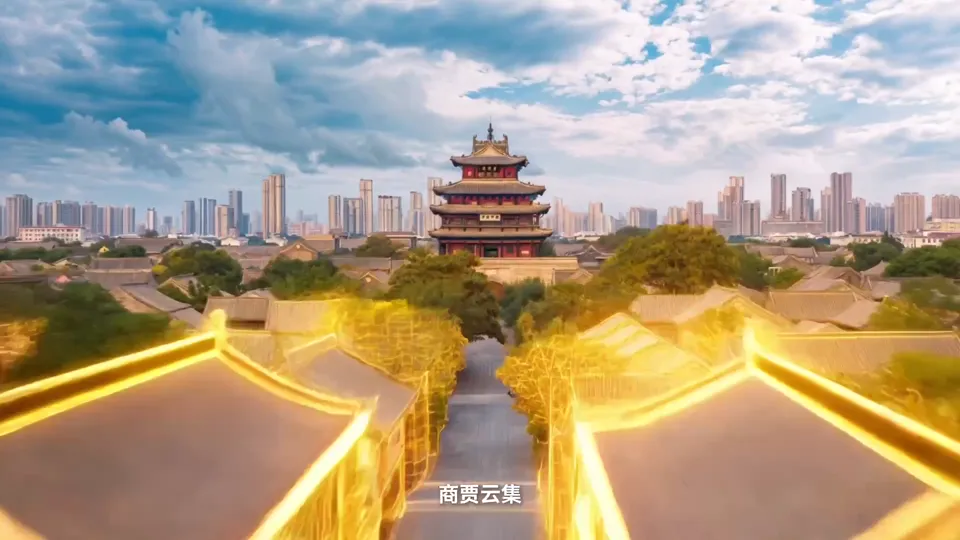
It opens on a golden-line map on a dark background, with rivers and streets slowly lighting up; the gold lines become a canal with water and boats, then a bustling ancient shopping street, and finally the old town's rooftops. The subtitles read in turn “Liaocheng,” “Risen with the Canal,” “Grain Barges Across a Thousand Li” and “Merchants from Far and Wide.”
Clip · 00:00–00:03
Golden Lines Draw the Canal
The camera pushes forward as fine golden lines trace the river, the docks and sailboats, and the wireframe gradually takes on the colors of water and sunset.
Clip · 00:03–00:05
Old Streets Grow out of the Wireframe
Sailboats pass the dock and the camera dives into the shopping street: the edges still carry golden lines, but vendors are already busy at their ovens, with smoke curling upward.
Clip · 00:05–00:07
The Gold Lines Fade, Revealing the Old Town's Rooftops
The camera rushes through a burst of golden light and rises above the old town, where gray-tiled roofs appear along with distant towers and the city skyline.
Film · 00:07–00:16
From Historic Landmarks to the Water City
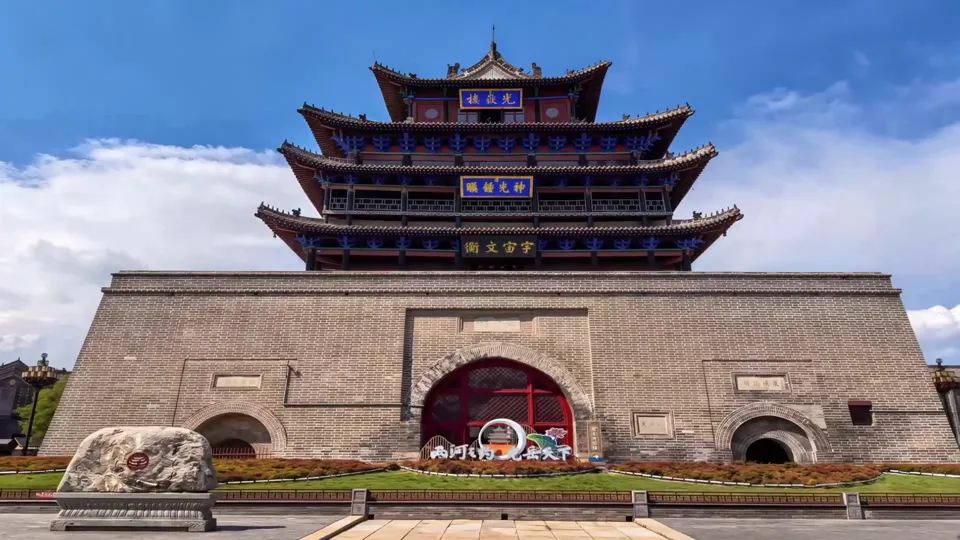
Guangyue Tower, the Shanxi-Shaanxi Guild Hall, the Linqing Customs House and Aotouji appear one after another, with the camera passing through the main gate each time; it then skims over the treetops to Dongchang Lake and the Eye of the Water City Ferris wheel, before being stretched into streaks of speed. The subtitles read “From a Ming–Qing Trading Port to the Water City North of the Yangtze” and “A City of Water, Where Past and Present Meet.”
Clip · 00:07–00:09
Guangyue Tower to the Shanxi-Shaanxi Guild Hall
The camera pushes toward the platform and tower of Guangyue Tower and passes straight through to the gate of the Shanxi-Shaanxi Guild Hall, its glazed tiles and plaque clearly visible.
Clip · 00:09–00:12
The Customs House and Aotouji Rise from the Ground
The gateway of the Linqing Customs House faces the camera as its brick walls assemble block by block; another push forward, and the red lanterns and gate tower of Aotouji stand right in front.
Clip · 00:12–00:15
Over the Treetops to Dongchang Lake
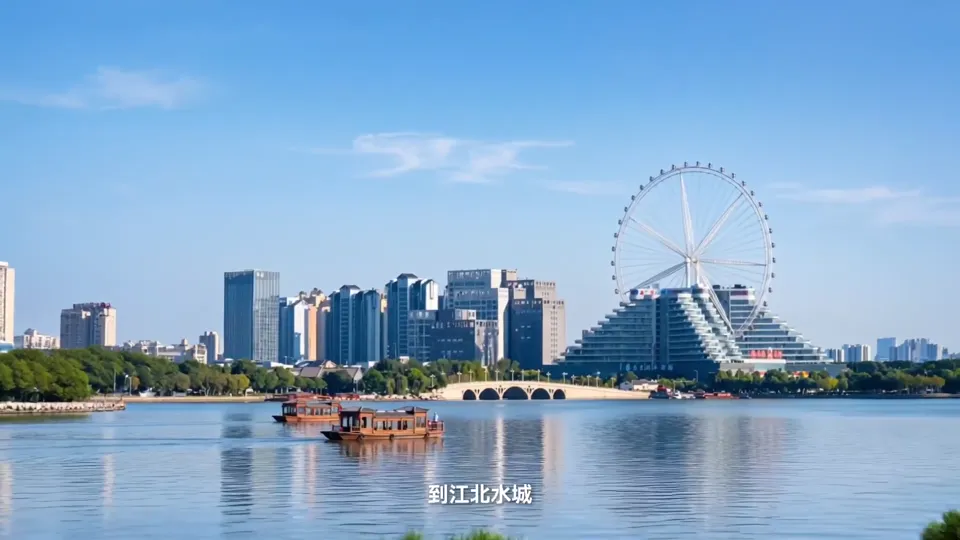
The camera passes through the tree canopy and the lake suddenly opens up: a tour boat glides by, with high-rises and the Eye of the Water City Ferris wheel on the far shore.
Clip · 00:14–00:16
The Ferris Wheel Stretches into Speed Lines
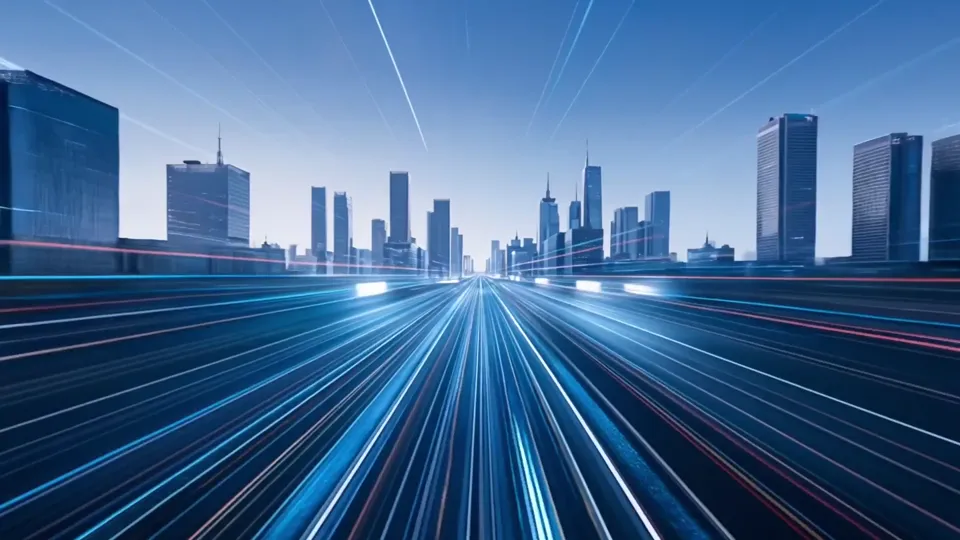
The camera rushes toward the Ferris wheel and the frame becomes a cool blue city boulevard with streaming light; here, the warm gold of the past turns entirely to blue and white.
Film · 00:16–00:27
Three Stations and the Opening Title Card
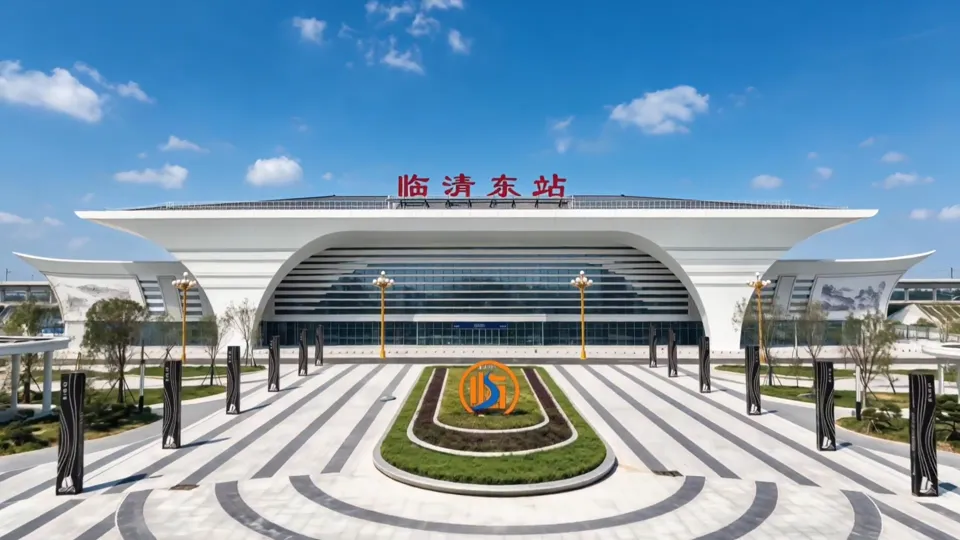
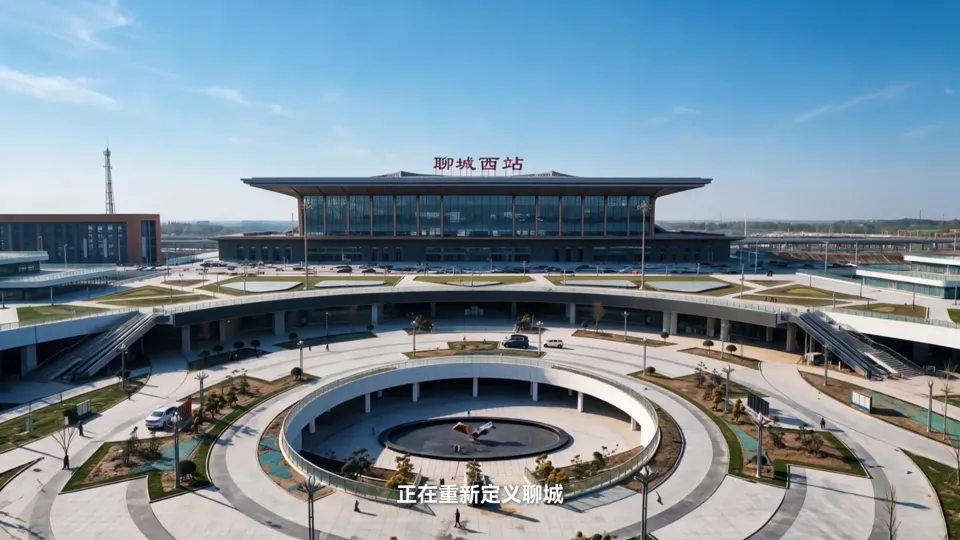
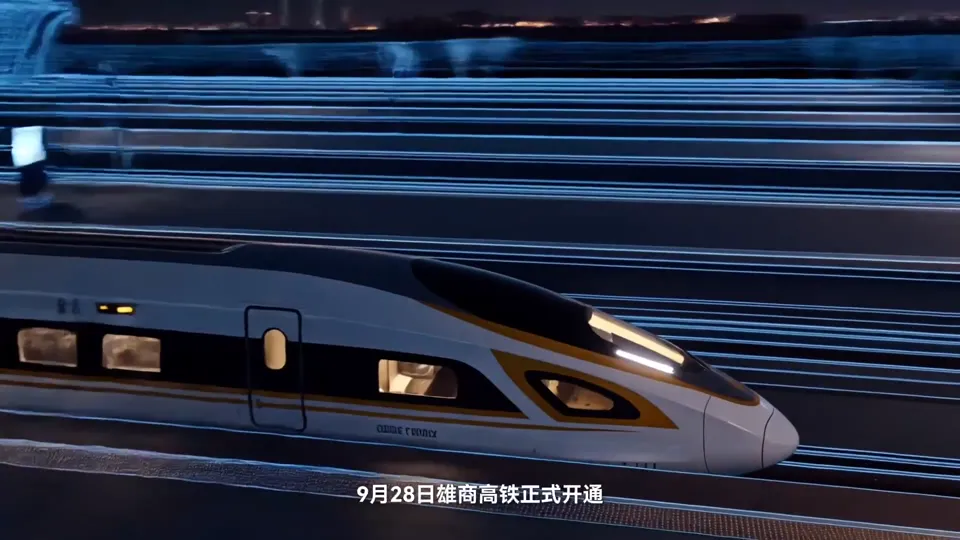
Linqing East, Yanggu East and Liaocheng West stations appear in turn. Liaocheng West becomes a blue wireframe model where two lines cross; a train departs from the wireframe platform, and it all lands on the big title card “September 28: The Xiong'an–Shangqiu High-Speed Railway Officially Opens.”
Clip · 00:16–00:19
Linqing East and Yanggu East Stations
The camera pushes in on the front of each new station building in turn, the station squares streaking with speed, as the subtitle “Speed” appears.
Clip · 00:19–00:22
Liaocheng West Becomes a Rail Network Model
The camera rises above Liaocheng West Station; the building lights up as a blue wireframe, and the surrounding blocks and intersecting lines are lit by trails of light, with the subtitle “Redefining Liaocheng.”
Clip · 00:22–00:24
A Train Departs from the Wireframe Platform
A white high-speed train pulls away along the platform, the buildings all around rendered as blue wireframes, as the camera follows the nose of the train forward.
Clip · 00:24–00:27
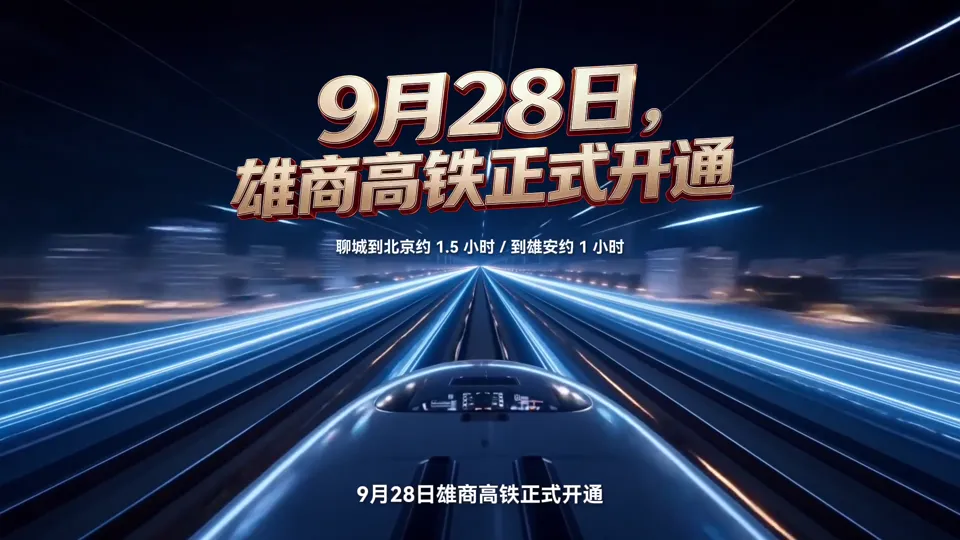
The Opening Title Card
Blue-and-white light trails converge into the distance, the big title “September 28: The Xiong'an–Shangqiu High-Speed Railway Officially Opens” sits in the middle of the frame, and a line below notes about 1.5 hours from Liaocheng to Beijing and about 1 hour to Xiong'an.
Film · 00:27–00:35
From Passengers Back to the City
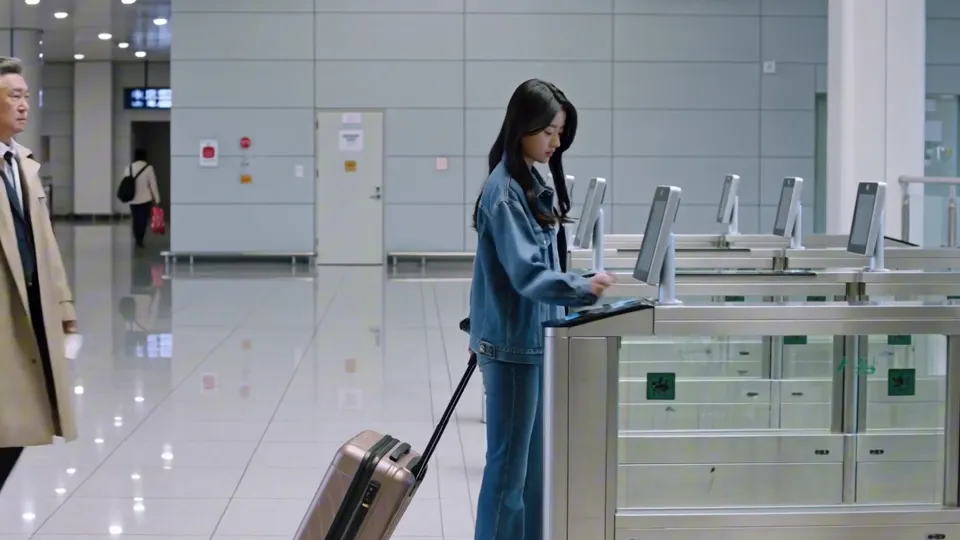
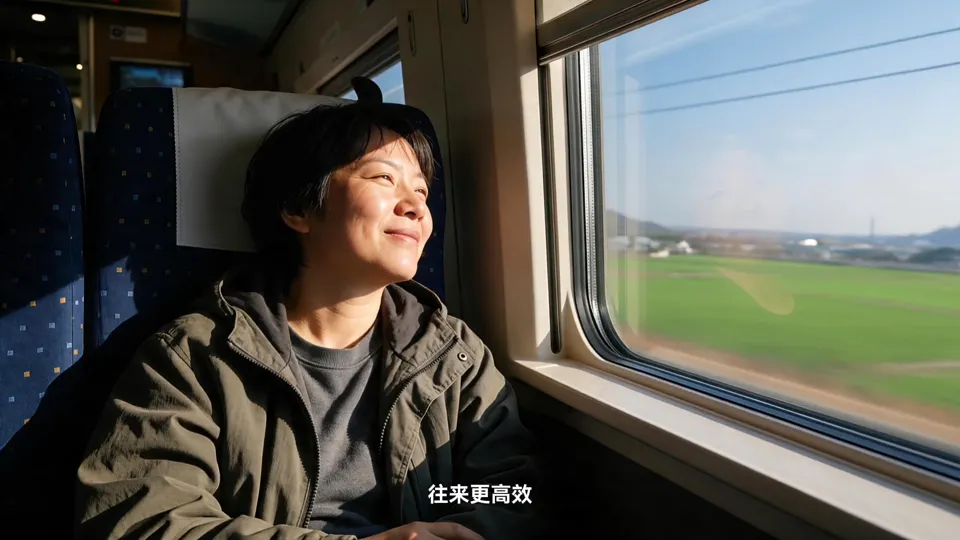
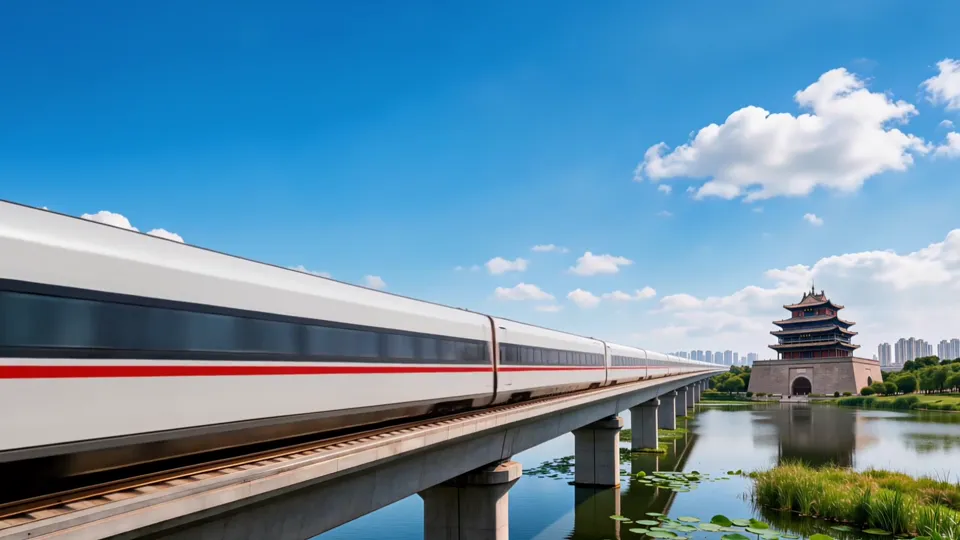
After a flash of white light, the camera returns to people: passengers going through the gates, wheeling suitcases onto the platform, sitting by the window enjoying the view and shaking hands on the platform. In the final shot, a high-speed train crosses a viaduct over the water, with an ancient pagoda on the left and a city gate tower on the right. The subtitle reads “Easier Travel, Faster Connections.”
Clip · 00:27–00:29
Through the Gates and onto the Platform
A passenger scans their ID at the gate, then a suitcase is wheeled across the platform, the whole boarding process in one smooth flow.
Clip · 00:29–00:31
A Smile by the Window, a Handshake on the Platform
Sunlight falls on a passenger's face by the window as fields rush past outside; in the next shot, two business travelers shake hands at the train door.
Clip · 00:31–00:35
The Train Passes the Pagoda and the Gate Tower
From a locked-off camera, a Fuxing train approaches from the distance, crosses the viaduct over a lotus pond and rushes out of frame, leaving the ancient pagoda, the city gate tower and the distant high-rises in one shot.
04 / Storyboards & Final Frames
Every shot, from script to final frame.
Arranged in the order of the finished film: each shot describes what it shows and why it was shot that way, followed by the final first-frame image used in the film.
01
Canal and Old Streets
In the film · 00:00–00:07
Shot 1.1
Opening on a Golden-Line Map
On a dark background, glowing gold lines trace the ancient canal system, docks, sailboats and street grid, with no solid materials, only wireframes. The camera pushes forward and the lines become the surface of the canal.
Opening on a Golden-Line Map · Final 1
Shot 1.2
The Golden-Line Canal
An ancient canal town at dusk, with houses, trees and sailboats wrapped in glowing gold lines and the setting sun casting long reflections on the water. As the camera pushes forward, the wireframes start to become solid.
The Golden-Line Canal · Final 1
Shot 1.3
The Ancient Shopping Street
A long flagstone street lined with timber shops and awnings, vendors busy at their ovens, with gold lines along the edges of the buildings and people. In the video, the buildings grow up from the ground.
The Ancient Shopping Street · Final 1
02
Ming and Qing Architecture
In the film · 00:07–00:12
Shot 2.1
Guangyue Tower
The front of Guangyue Tower, with its plaque and details faithfully reproduced so it's instantly recognizable as Liaocheng. The camera pushes quickly forward through the main gate of the platform.
Guangyue Tower · Final 1
Shot 2.2
Shanxi-Shaanxi Guild Hall
The gate of the Shanxi-Shaanxi Guild Hall, its glazed tiles and inscriptions clearly legible. The camera passes through the main gate as the building grows up from the ground and finally becomes solid.
Shanxi-Shaanxi Guild Hall · Final 1
Shot 2.3
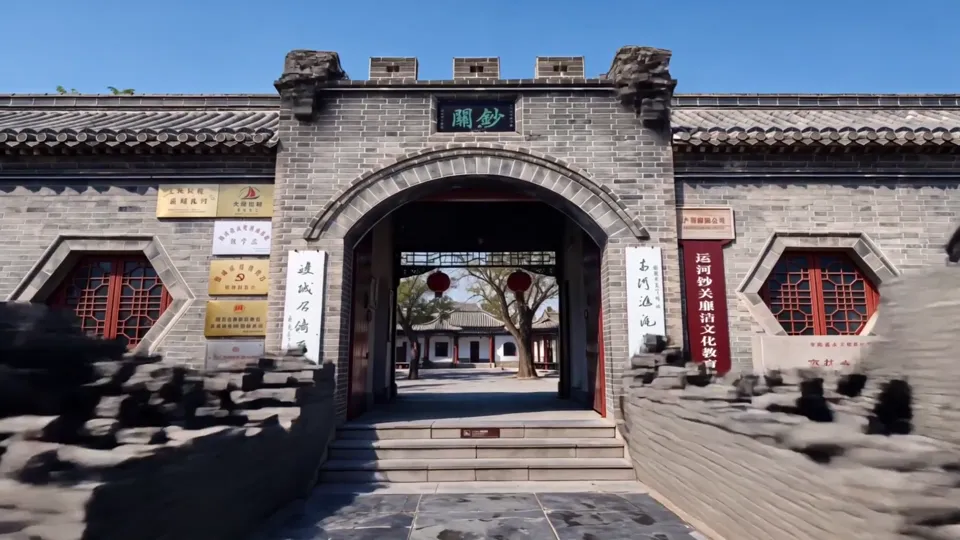
Linqing Customs House
The gateway of the customs house faces the camera, flanked by hexagonal windows and couplets. A drone's-eye view passes through the main gate.
Linqing Customs House · Final 1
Shot 2.4
Aotouji
Red lanterns and a gate tower. The camera flies up over the building, and the next shot is a vast expanse of lake.
Aotouji · Final 1
03
From the Water City to Speed Lines
In the film · 00:12–00:16
Shot 3.1
Dongchang Lake and the Eye of the Water City
Dongchang Lake: tour boats, a multi-arch stone bridge, a terraced building and the Eye of the Water City Ferris wheel. The camera skims across the lake toward the Ferris wheel as motion blur starts to stretch the frame.
Dongchang Lake and the Eye of the Water City · Final 1
Shot 3.2
City Speed Lines
A cool blue city thoroughfare with blue-and-white streams of light converging into the distance between rows of high-rises. From here, the palette shifts from warm gold to blue and white, signaling the arrival of today's transportation.
City Speed Lines · Final 1
04
Three Stations and the Rail Network
In the film · 00:16–00:27
Shot 4.1
Linqing East Station
The front of Linqing East Station, reproduced from the real building. The camera pushes quickly forward.
Linqing East Station · Final 1
Shot 4.2
Yanggu East Station
The front of Yanggu East Station, reproduced from the real building. The camera pushes quickly forward.
Yanggu East Station · Final 1
Shot 4.3
Liaocheng West Station
The front of Liaocheng West Station and its round station square. The camera tilts up quickly into the sky.
Liaocheng West Station · Final 1
Shot 4.4
The Rail Network above Liaocheng West Station
Looking down on Liaocheng West Station, with the building at the center of the frame and two lines crossing; blue-and-white light spreads along the tracks in four directions, lighting up the surrounding blocks.
The Rail Network above Liaocheng West Station · Final 1
Shot 4.5
The Train Departs
Apart from the train, the platform and buildings are all blue wireframes, at night. The camera moves left behind the train and follows its nose as it departs.
The Train Departs · Final 1
Shot 4.6
Light Trails Rushing to the Horizon
The camera tracks low alongside the nose of the train as the tracks ahead become blue-and-white light trails suspended above the city, and the train races toward a glowing horizon; the opening title card sits on this shot.
Light Trails Rushing to the Horizon · Final 1
05
Passengers and the Finale
In the film · 00:27–00:35
Shot 5.1
Wheeling a Suitcase onto the Platform
On the platform, a passenger walks briskly ahead pulling a suitcase.
Wheeling a Suitcase onto the Platform · Final 1
Shot 5.2
A Passenger by the Window
A passenger sits by the window, sunlight on their face, the scenery flowing past outside.
A Passenger by the Window · Final 1
Shot 5.3
A Handshake on the Platform
A business traveler steps off the train and shakes hands with the partner who has come to meet them.
A Handshake on the Platform · Final 1
Shot 5.4
A Finale Uniting Past and Present
On a sunny day, a Fuxing train crosses a viaduct over a lotus pond, with an ancient pagoda on the left, a city gate tower on the right and high-rises in the distance. From a locked-off camera, the train approaches from afar and rushes out of frame.
A Finale Uniting Past and Present · Final 1
05 / Results
Liaocheng cultural tourism and high-speed rail film
Completed a 35-second Liaocheng cultural tourism and high-speed rail film (1920×1080 horizontal), with the final cut delivered on September 28, the day the Xiong'an–Shangqiu High-Speed Railway opened, along with the storyboard script and 3 versions of release copy. The film was published with the hashtag #聊城可灵得很.
Case Study
Liandan AI Studio × Liaocheng Culture & Tourism | 35 Seconds from Canal Barges to the Xiong'an–Shangqiu High-Speed Railway
In September 2026, the Xiong'an–Shangqiu High-Speed Railway opened, adding three high-speed rail stations within Liaocheng at once.
Liaocheng Culture & Tourism and Kuaishou Kling AI teamed up on a promotion campaign, inviting creators to make AI short films, and we took on one of them.
There was just one requirement: the film had to be about the opening of the high-speed rail line.
In 35 seconds, we sent the camera from grain barges on the ancient canal, through the old town and onto a high-speed rail platform.
AI city cultural tourism short · Xiong'an–Shangqiu High-Speed Railway opening
Timeline
September 2026
Deliverables
35-second film (1920×1080 horizontal), storyboard script, 3 versions of release copy
Distribution
Published as a campaign entry with the hashtag #聊城可灵得很
Results
Final cut delivered on September 28, the day the line opened
Produced by
Shenzhen Alchemy Technology Co., Ltd. (Liandan AI Studio)
01
How Do You Fit High-Speed Rail and Cultural Tourism into One Film?
The client's information was clear: the Xiong'an–Shangqiu High-Speed Railway would open at the end of September, with three stations in Liaocheng (Linqing East, Liaocheng West and Yanggu East). Liaocheng West is where the Xiong'an–Shangqiu and Jinan–Zhengzhou high-speed lines cross, and once the line opens, Beijing is about 1.5 hours away and Xiong'an about 1 hour.
The hard part was that this was a cultural tourism film. Shoot only speeding trains, and viewers won't remember it's Liaocheng; shoot only the old town's scenery, and the rail line never comes in.
The client suggested an angle: Liaocheng grew rich on canal shipping, and both the canal and high-speed rail are about transportation. We followed that thread: if both are routes, why not have the camera actually “travel” the whole way?
We started by ordering the landmarks by era: the Huitong Canal opened in the Yuan dynasty; Guangyue Tower, the Linqing Customs House and Aotouji date from the Ming; the Shanxi-Shaanxi Guild Hall from the Qing; and today there are Dongchang Lake and the Eye of the Water City. The camera passes through them in that order and finally into the high-speed rail station.
Opening first frame: a canal map drawn in golden linesFirst frame of the rail section: blue-and-white light trails rushing to the horizon
02
Golden Wireframes: Letting the Past Grow out of the Ground
AI tends to render ancient canals and shopping streets like a period-drama set, which wouldn't match the high-speed rail footage that follows.
So we took another approach: the past doesn't appear directly at first, but is drawn in fine, glowing gold lines. It opens on a map on a dark background, with gold lines tracing the river and docks; as the camera pushes forward, the wireframe takes on water, sailboats and a sunset; further on, the shopping street rises from the ground layer by layer, vendors busy at their ovens, gold lines still on the edges.
Clip · 00:00–00:05
The Canal and Old Streets Grow out of Golden Lines
From a wireframe map to a lively shopping street, the camera keeps moving forward without a single hard cut.
This way, viewers immediately understand: this is the past being “restored.” As the wireframes gradually turn solid, time is carried from ancient days right up to the present.
03
Every Landmark Has to Be Recognizably Liaocheng
The biggest risk in a cultural tourism film is footage that could be any city. So for the historic buildings, we didn't let AI improvise: we used real photos of Guangyue Tower, the Shanxi-Shaanxi Guild Hall, the Linqing Customs House and Aotouji as references, upscaled them and retouched the plaques and details in Photoshop to make the first frame of each shot.
In motion, the camera always pushes straight in through the main gate, the building grows up from the ground, and passing through the gateway leads to the next landmark. All four buildings go by in under 6 seconds, yet each one is recognizable.
Guangyue Tower first frameLinqing Customs House first frame
After the historic buildings, the camera skims over the treetops and Dongchang Lake suddenly opens up: tour boats, a stone bridge and the Eye of the Water City Ferris wheel. The subtitle reads “From a Ming–Qing Trading Port to the Water City North of the Yangtze.”
04
Gold Turns to Blue, and the Rail Network Is Drawn Right on Screen
The moment the camera rushes toward the Ferris wheel, the frame is stretched into blue-and-white speed lines.Gold stands for the past, blue and white for today's transportation, so viewers know the era has changed without reading the subtitles.
After the three stations appear in turn, the camera rises high above Liaocheng West; the station and surrounding blocks become a blue wireframe model, where two lines cross and light up with trails of light. The “hub” the client most wanted to convey went from a line of description to an image anyone can understand at a glance.
Clip · 00:19–00:27
Liaocheng West Becomes a Rail Network as the Opening Title Card Lands
The wireframe model, the departing train, the light trails and the big title card “September 28: The Xiong'an–Shangqiu High-Speed Railway Officially Opens” flow together in one sequence.
The opening date was finally set for September 28, so we updated the title card in the film accordingly and added a line below, “About 1.5 hours from Liaocheng to Beijing / about 1 hour to Xiong'an,” so the key information is all on one card.
05
Finally, Back to the People on the Train
However beautiful the rail network, it's seen from the sky. In the last few seconds, we brought the camera back to people: passengers going through the gates, wheeling suitcases onto the platform, basking in the sun by the window and shaking hands with a partner on the platform. Travel, tourism and business each get a shot.
A Passenger by the WindowA handshake on the platform
In the final shot, a high-speed train crosses a viaduct over a lotus pond, with an ancient pagoda on the left, a city gate tower on the right and high-rises in the distance. Liaocheng of the canal era and Liaocheng of the high-speed rail era share the last frame.
Clip · 00:31–00:35
The Train Passes the Pagoda and the Gate Tower
From a locked-off camera, the train approaches from afar and rushes out of frame to close the film.
06
What this project achieved
This was a film tied to a news moment: we received the invitation in early September and wrote the storyboard script for the client to review first; on September 7 we delivered the storyboard document and a 19-second sample; once the direction was confirmed we refined every shot, and on September 28, the day the line opened, we delivered the 35-second final cut along with 3 versions of release copy.
What it leaves behind is a reusable approach:order the landmarks by era and keep the camera moving forward through them; separate past and present with gold and blue wireframes; and finally come back down to real people.Whenever a city wants to tell its own history through a new rail line or a new venue, it can take the same approach.
FAQ
FAQ
How does an AI cultural tourism film make sure viewers recognize the city?
Key landmarks are never left to AI's imagination. In this film, Guangyue Tower, the Shanxi-Shaanxi Guild Hall, the Linqing Customs House, Aotouji and the three high-speed rail stations all had first frames made from real Liaocheng references, upscaled and retouched in Photoshop for plaques and details, before the video was generated.
Ancient and modern footage look very different. How do you make the transitions smooth?
We used two methods: first, the camera always pushes forward and passes through each building's main gate, with no hard cuts; second, color separates the eras, with gold wireframes for the past and blue-and-white wireframes and light trails for modern transportation, so viewers can tell at a glance that the era has changed.
How long does a film like this take from brief to delivery?
We received the brief in early September, delivered the storyboard script and a 19-second sample in about a week, refined the shots once the direction was confirmed, and delivered the 35-second final cut on September 28, the day the line opened.
What if information like dates or travel times changes at the last minute?
The opening date and the travel times to Beijing and Xiong'an are all on title cards, so the footage isn't affected. Once the opening date was set for September 28, we simply updated the title card and exported a new version.
Approach
How the wireframed past connects to modern travel
The final cut places the canal, the city's historic buildings, the lake and the high-speed rail along a single forward-moving route, with main gates, old-town rooftops and the Ferris wheel as linking points. Stills were retouched against reference images of the local buildings for details and plaques, then camera moves such as passing through gates, tilting up and pushing forward were set, so every transition lands somewhere recognizable.
In the rail section, blue wireframes and glowing tracks are added after the real station building, an overhead view of the crossing lines explains the hub, and shots that move with the train convey speed. Gold for history and blue-and-white for modern transportation are easy to tell apart; the opening title card sits on the shot of light trails rushing to the horizon, giving the date and “about 1.5 hours to Beijing, about 1 hour to Xiong'an” all at once.
After the train and the rail network come shots of passengers entering the station, a traveler by the window and a meeting on the platform, bringing the transportation theme back from technical imagery to people. The final shot puts the elevated train, the water and the historic buildings in one frame, past and present together, closing out both the cultural tourism and the travel story.