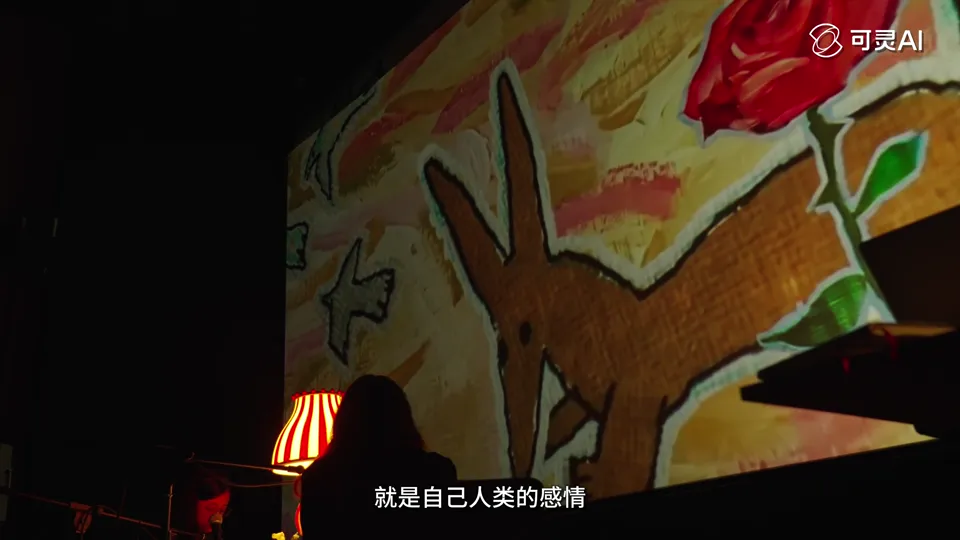
Keeping the impasto and collage textures of children's original drawings, the Little Prince, the rose and the starry sky move gently across the stage.
Project Type
Spaces & Events
Client
Kuaishou Kling AI (Aranya Theatre Festival)
Year
2026
Our role
Animating artwork into stage backdrops, doc editing
Original format
3840 × 2160 · 02:03
Film02:03 · Video
01 / Background
Turning children's drawings into a stage backdrop
For the Aranya stage production of “The Little Prince,” drawings the children had already made needed to become video backdrops that matched the narration and dialogue of a roughly 50-minute performance. About 160 drawings in all were to be animated, with each clip usually 10–15 seconds and adjustable to fit the lines it accompanies. The collaboration was initiated by Kuaishou Kling AI, which specified Kling AI for generation: the partner provided the drawings, Liandan AI Studio turned them into motion video backdrops, and how each image moved was decided by what the performance needed.
For backdrops like these, how much things move matters as much as the visual style. The thick paint, fabric-textured clouds and paper-cut outlines in the drawings make up the fairy-tale world; if the subjects warp heavily or the paint flows like liquid, what the audience sees drifts away from the children's drawings. So the work relies mainly on fixed compositions, slow drifts and small local movements, keeping the handmade texture recognizable.
02 / Creative Highlights
How gentle motion keeps the spirit of the original drawings
01
Making “gentle” concrete for every element
Movement is kept small and slow, and even still subjects have subtle motion. The swaying scarf, the fox's ears and tail, the drifting clouds and the twinkling stars each have their own rules; only elements already in the drawing move, rather than the whole picture constantly writhing.
02
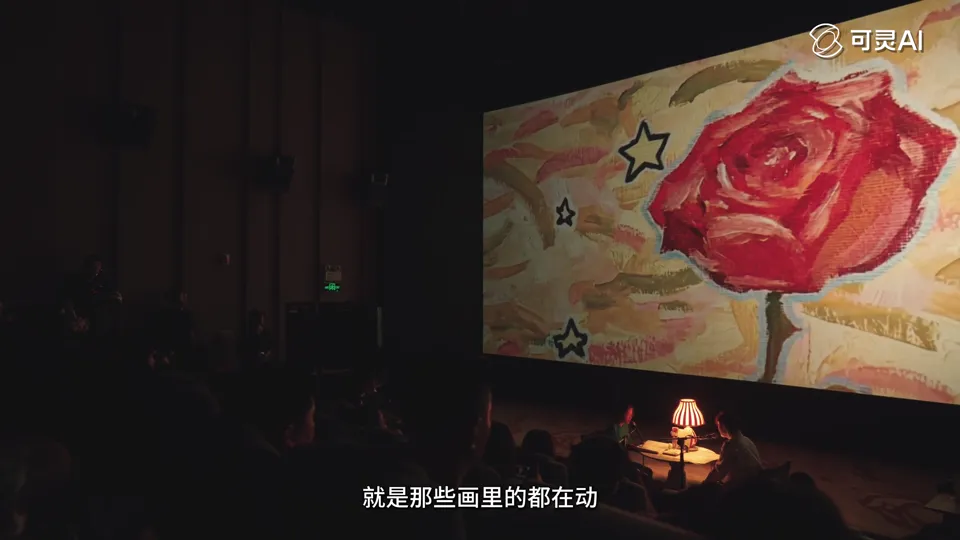
Keeping the rose a steady visual center
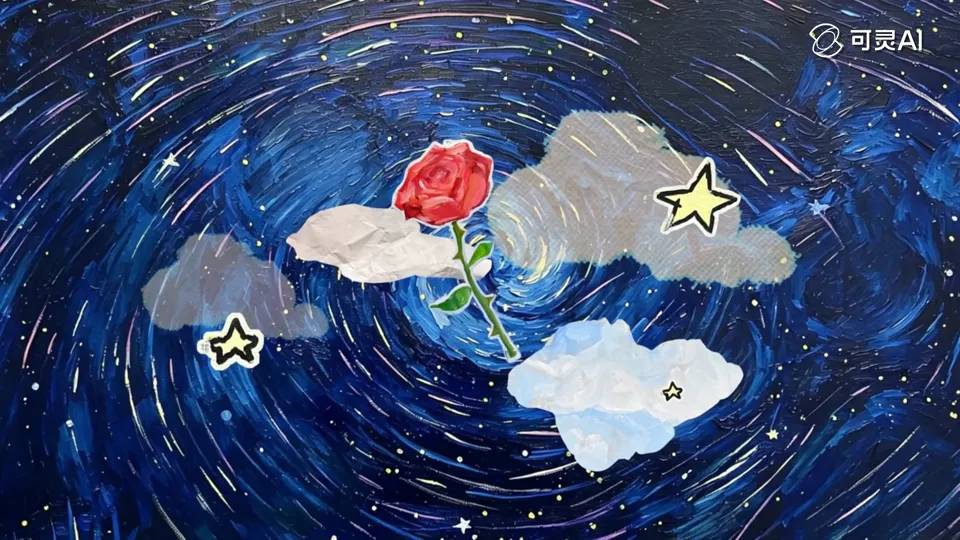
In the documentary's starry-sky rose sequence, the red flower is always the focus while the deep-blue brushstroke sky and fabric clouds drift slowly. The background seems to breathe gently, while the flower's painted edges stay thick and clear; one leads and the other supports, matching the stage narration about the rose.
03
Linking images to the rhythm of the performance
Clips were made 15 seconds long where possible, and images with a similar pace were merged into continuous shots. The drawings of the fox, the Little Prince, the birds and the rose were connected through first and last frames and staged movements, cutting down unnecessary image changes during the performance.
04
Live footage shows what the backdrop does
The video on this page is a documentary short of about two minutes that we edited to Kling AI's brief: the stage footage and interviews were filmed by the partner, and we cut them together with the motion backdrops. The live footage shows the reader at the table and the big screen behind: the video is part of the performance space, not an animated film playing on its own.
03 / Scene Breakdown
How these drawings move on stage, in the documentary short.
Film · 00:00–00:11
On Stage: The Big Screen Behind the Reader
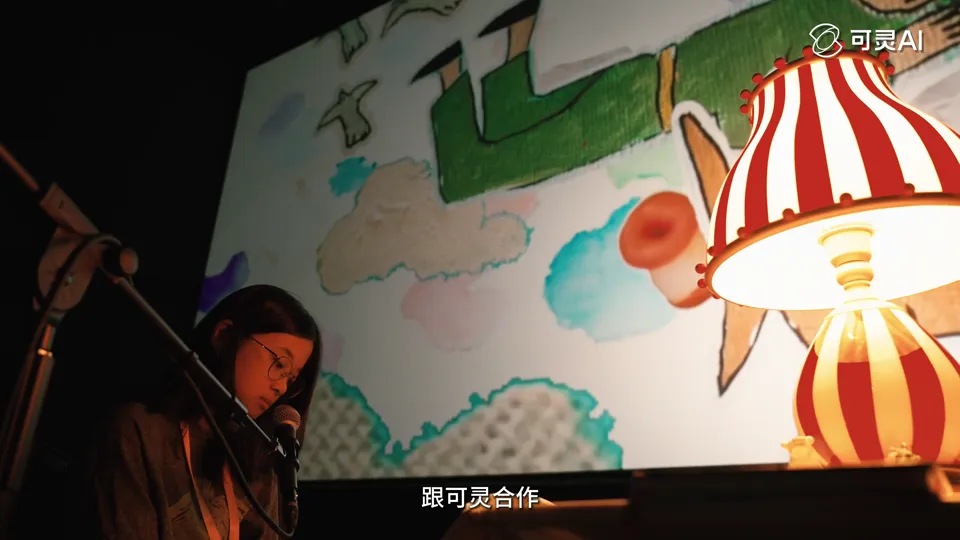
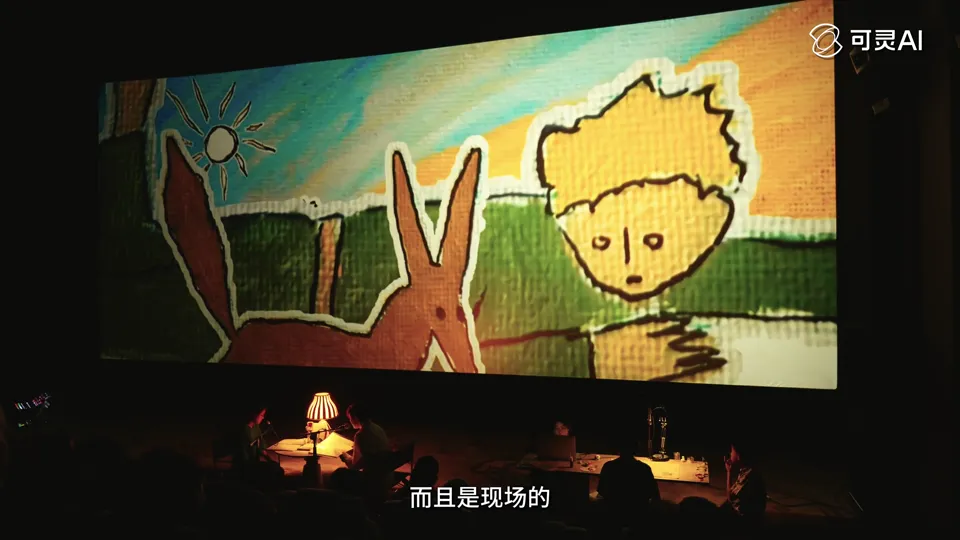
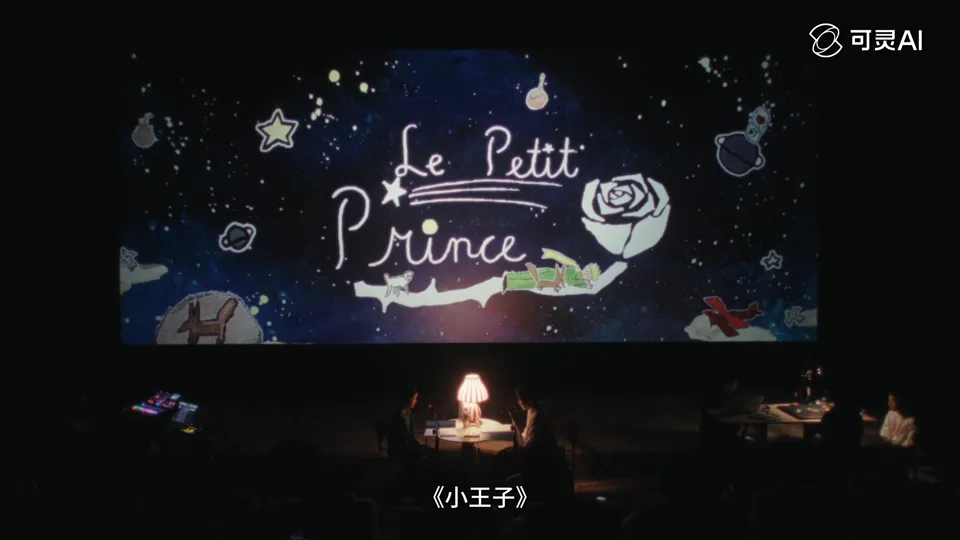
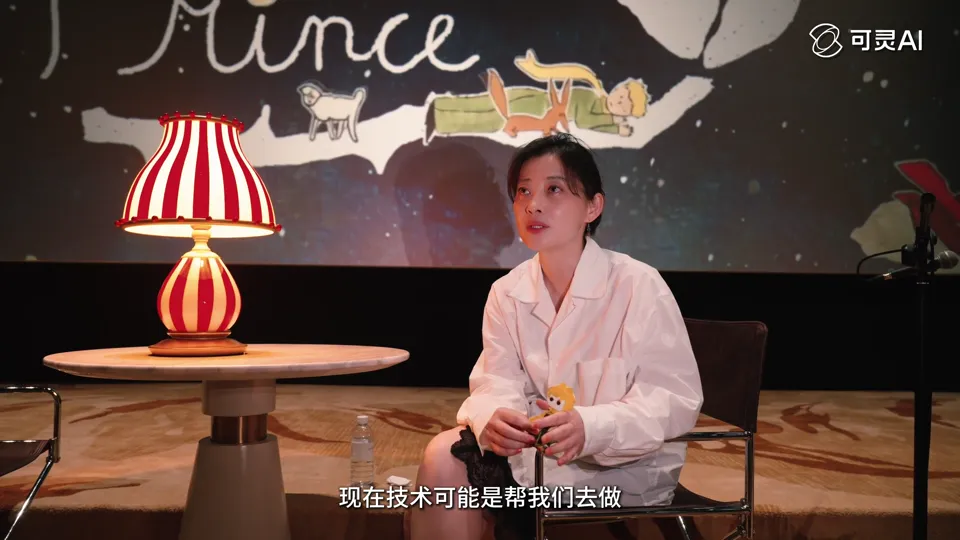
The short opens with the live performance: a reader at a table tells the story into a microphone, while the big screen behind shows the children's drawing of the Little Prince and the fox. What's playing on that screen is the motion backdrop we made.
Clip · 00:00–00:05
The reader and the drawing behind
Beside a red-and-white striped lamp, the reader speaks lines into a microphone; on the big screen, the Little Prince lies on a cloud with a fox below, the paper texture and paint clearly visible.
Clip · 00:05–00:11
Pulling back to the whole stage
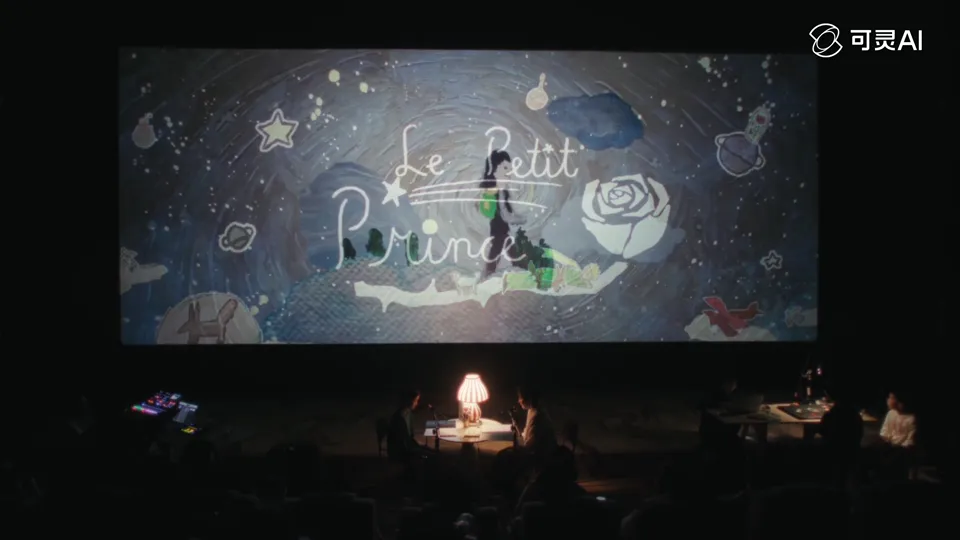
The camera pulls back to the audience seats: the entire back wall is the drawing, with just a lamp and a few tables in front. The backdrop carries the whole stage.
Film · 00:20–00:32
The Drawings Come to Life One by One
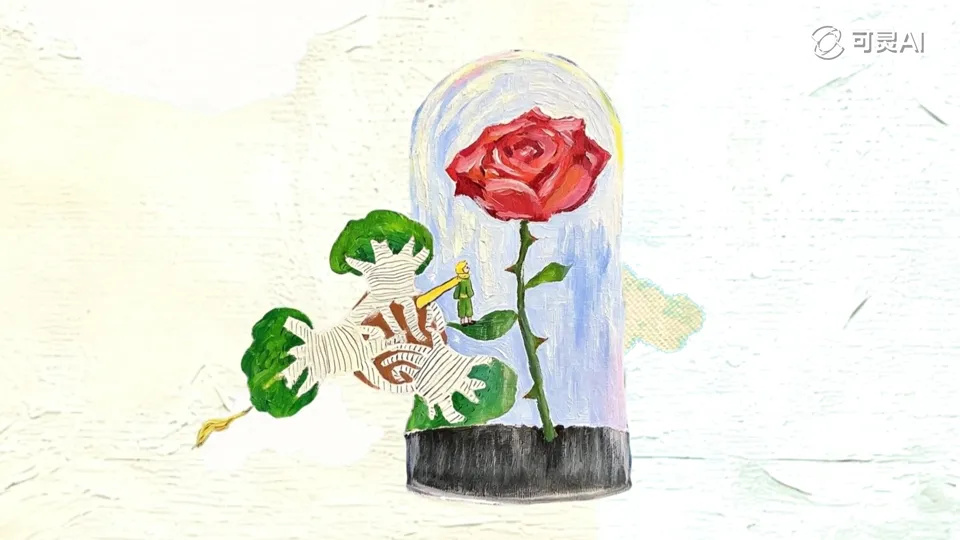
Between the interviews, the short cuts in several of our motion images: the Little Prince flying over the fox, watering the rose, a red plane coming down in the desert, the rose under a glass dome and the sheep. Each one keeps the bold lines and thick paint of a child's drawing.
Clip · 00:20–00:22
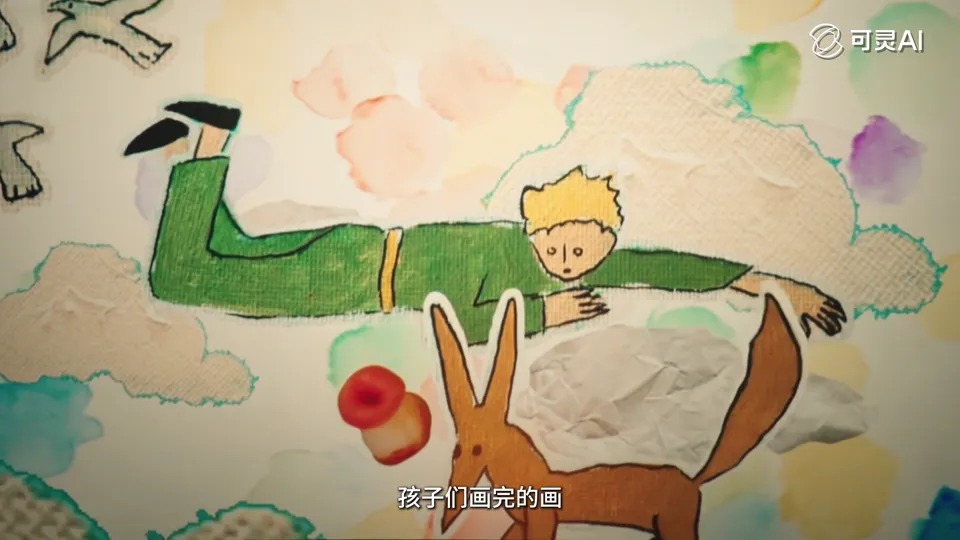
The Little Prince flies over the fox
The Little Prince drifts by lying on a fabric-textured cloud while the fox below looks up, against a sky of soft watercolor washes.
Clip · 00:24–00:28
From the stage screen to the Little Prince watering his rose
First the red rose on the big screen at the venue, then a close-up of the image: the Little Prince holds a watering can, watering a rose taller than he is, his yellow scarf streaming behind him.
Clip · 00:28–00:32
The plane, the glass dome and the sheep
A red plane trailing smoke comes down in a cactus desert, followed by the rose under a glass dome, a box with three holes and the sheep, and finally the Little Prince sitting on a chair.
Film · 00:35–00:54
Opening: The Title and the Girl with the Backpack
In a wide shot of the venue, the big screen first shows the title “Le Petit Prince,” then slowly moves into the first motion image: a girl with a backpack walking on a small cloud island.
Clip · 00:36–00:44
The title in the starry sky
The title is written across a deep-blue starry sky, surrounded by roses, planets and a little plane; the subtitles read out the book's title, author and translator, with a single lamp lit on stage.
Clip · 00:46–00:54
The girl with the backpack walks on a cloud island
The title fades to reveal a small cloud island against a warm yellow swirling background; the girl with the backpack walks in place as clouds drift slowly by.
Film · 01:10–01:22
The Rose and the Swirling Starry Sky
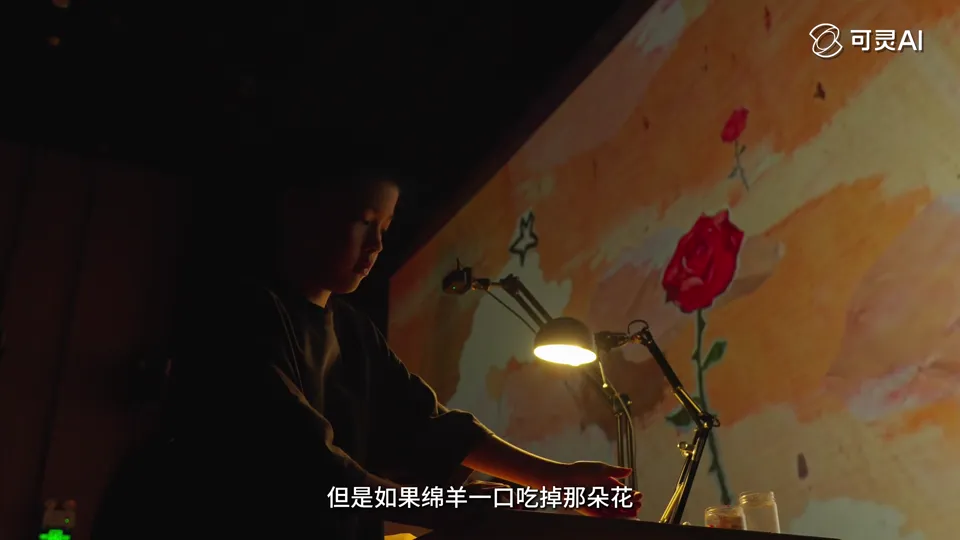
When the story turns to the rose, the backdrop becomes a deep-blue swirling starry sky with a red rose floating at its center and fabric clouds drifting slowly. Then the camera returns to the venue, where the reader reads under the lamp with another rose drawing behind.
Clip · 01:10–01:17
The rose in the starry sky
The brushstrokes of the sky turn slowly around the center, the rose floats gently, and the stars and clouds drift along. Everything moves slowly, as if the painting were breathing.
Clip · 01:17–01:22
Reading under the lamp
The reader looks down at the script, the lamp lighting the table, with the rose on the big screen right beside; the subtitle reads, “But if the sheep eats the flower in one bite.”
Film · 01:25–01:49
The Images Follow the Lines
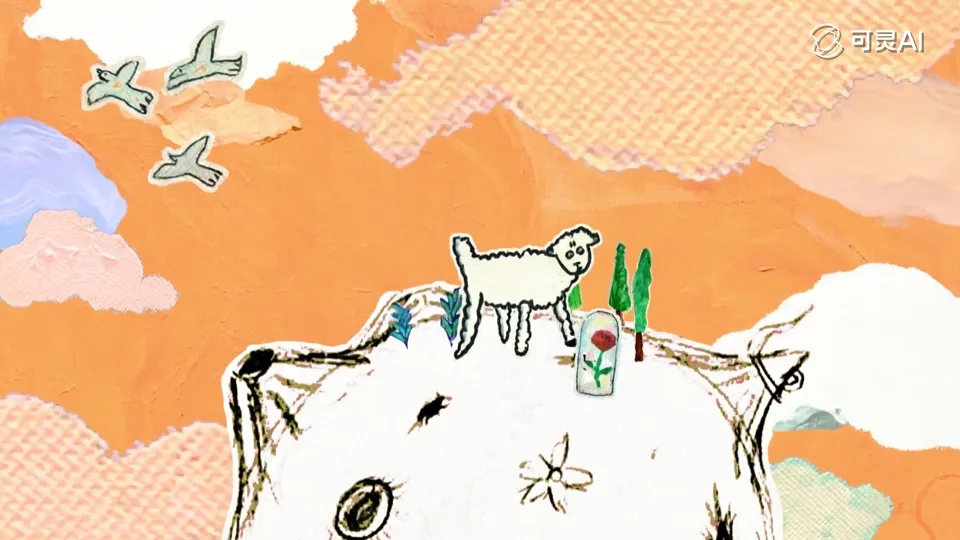
In the second half, the reading on stage and the images on the big screen alternate: when the lines mention the sheep, the screen shows the sheep; when they mention the fence and the glass dome, the fence and glass dome are in the picture.
Clip · 01:25–01:28
The sheep on a planet
A sheep stands on top of a small planet beside a glass dome and two small trees, against an orange sky and fabric clouds.
Clip · 01:31–01:36
The fence and the glass dome
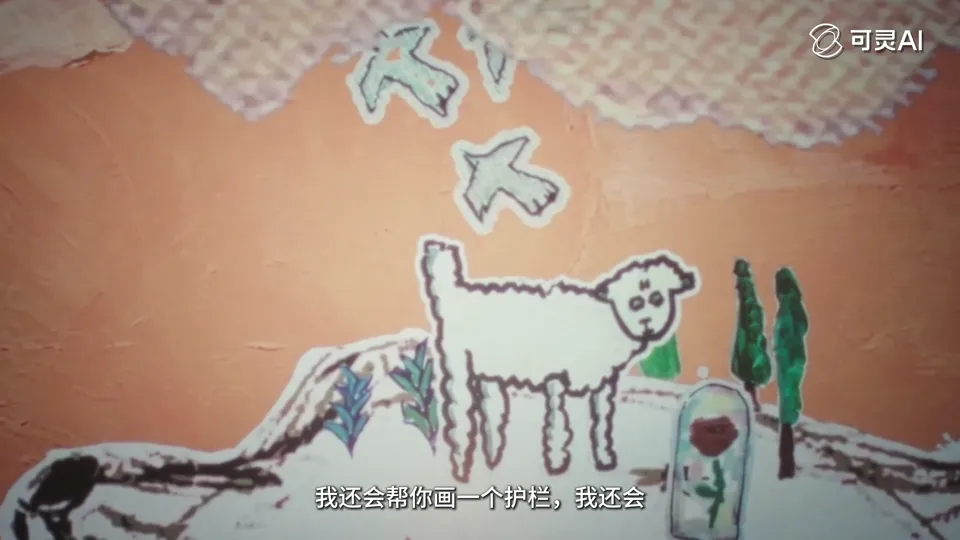
The camera moves close to the big screen: the sheep, the birds and the glass dome over the rose are all in the picture, just as the subtitle reads, “I'll draw you a fence, too.”
Clip · 01:41–01:45
The Little Prince meets the fox
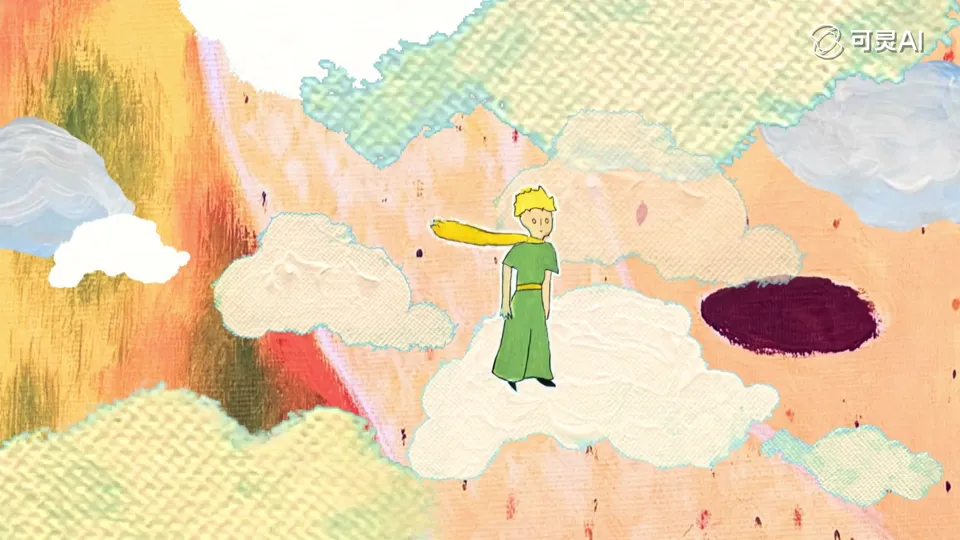
The Little Prince stands on a cloud, followed by a view of his back and the fox in the distance; the yellow scarf, the thickly painted sky and the paper-cut outlines are all clearly visible.
Clip · 01:45–01:49
Carried into the sky by birds
The Little Prince holds onto a string of birds and lifts into the air; the picture then pushes in on the birds and hills, where the thickness of the paint is even more visible.
Film · 00:56–01:57
Interviews and Audience (Not Made by Us)
The interviews, rehearsal and audience interviews in the film were shot by the partner and are not footage we made; our job was to cut them together with the motion backdrops into one short.
Clip · 00:56–01:01
An actor on technology
An interviewed actor sits beside the stage lamp and says technology can help creators do things that used to take a lot of effort.
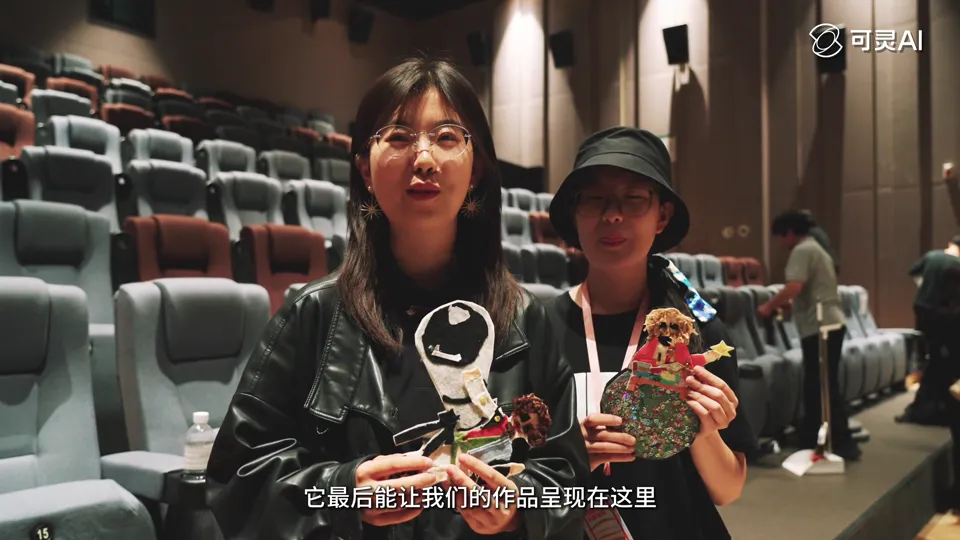
Clip · 01:49–01:57
Interviewees hold up their drawings
Two interviewees in a screening room hold up their hand-drawn Little Prince figures and say how happy they are that their work ended up being shown here.
04 / Gallery
Frames worth a closer look.
Children's original drawing provided by the partner: the girl with the backpack, fabric-textured clouds and a thickly painted sky.Children's original drawing provided by the partner: a fairy-tale scene built from bold outlines, fabric textures and painted brushstrokes.
05 / Results
Backdrop footage and how it was used on stage
We delivered motion backdrops for nearly 100 numbered shots, most of them 15 seconds at 1080p, used on the stage screen at the Aranya Theatre Festival's script reading of “The Little Prince” in June; the June 19 rehearsal can be seen in the film. We then cut about 4 minutes of live footage into this documentary short of about 2 minutes for Kling AI.
Case Study
Liandan AI Studio × Kuaishou Kling AI | Bringing children's drawings to the stage of Aranya's “The Little Prince”
A script reading of “The Little Prince,” with no elaborate set on stage.
The actors sit by a lamp reading their lines, with a full wall of screen behind them.
On the screen are the children's drawings of the Little Prince, the rose, the fox and the sheep, all moving gently.
Liandan AI Studio made these motion backdrops with Kling AI for the stage of the Aranya Theatre Festival in June 2026.
Client
Kuaishou Kling AI (technical support for the Aranya Theatre Festival's script reading of “The Little Prince”)
Project Type
Stage screen motion backdrops + documentary short edit
Division of Work
Original drawings provided by the partner; Liandan AI Studio turned the drawings into video and edited the documentary short
Timeline
June 2026; first batch of motion backdrops delivered in about a week, documentary short edited from late June to early July
Deliverables
Motion backdrops for nearly 100 numbered shots (most 15 seconds, 1080p); documentary short of about 2 minutes (3840 × 2160)
Usage
Live stage screen at the Aranya Theatre Festival's script reading of “The Little Prince”; documentary short edited to Kling AI's brief, with the Kling AI logo
Produced by
Shenzhen Alchemy Technology Co., Ltd. (Liandan AI Studio)
01
How should a child's drawing move?
The brief was clear: a reading performance of about 50 minutes needed video as its backdrop.
The partner provided the children's drawings, up to about 160 of them. Each clip would be 10–15 seconds, adjustable to the length of the lines it goes with; the camera stays mostly fixed, with a slight push or pull in a few places as the script calls for.No editing needed, just bring the drawings to life.
It sounds simple; the hard part is getting the degree right.
Too little movement, and the screen is just a slideshow; too much, and the bold lines get stretched out of shape and the thick paint flows away like liquid, so what the audience sees is no longer a child's drawing.
Original drawing No. 1: a girl with a backpack walks on a small cloud island under a swirling skyAt the performance: the same drawing moves on the big screen, with only a lamp in front of the stage
This is shot No. 1. The brief said just one line: “The figure walks in the center, the clouds float.” In the finished clip, the girl walks in place and the clouds drift slowly; nothing else moves.
02
After the first test round, the client asked for “gentle”
After the first batch of samples, the client summed up their requests in five points: less warping and jitter; an even slower pace; no obvious fluid look except in special images; subtle motion for the subject even when it stays still; and clips as close to the full 15 seconds as possible.
We rebuilt the structure of our prompts around those five points:
First state that the camera stays still, then describe separately how the wind, clouds and background move, and finally give the subject just one small action. Every prompt ends with the same line: do not change the texture of the image, children's picture-book style, relaxed and soothing motion.
Take the starry-sky rose shot: the sky turns slowly like a swirl, the stars flicker, the clouds drift very slowly through the turning sky, and the rose bobs gently in a light breeze. How much each element moves is spelled out.
Original drawing: a red rose in a deep-blue swirling starry skyFinished clip: the starry sky turns slowly as the rose and clouds float gently
03
In each drawing, only what's already there moves
For nearly 100 shots, we wrote the motion for each drawing separately, and only things already in the drawing were allowed to move:
The Little Prince's yellow scarf sways up and down; the fox's ears and tail sway gently; the elephant blinks and flaps its ears; the sheep lowers its head to eat a shrub; two yellow stars pulse like a heartbeat; as the red plane falls, the sky slowly shifts from day to night.
Every video was checked side by side against the original drawing.Any that changed the art style were redone, no exceptions.
Original drawing: the Little Prince watering a rose taller than he isFinished clip: composition and brushwork unchanged; only the water, the scarf and the clouds move
04
Neighboring drawings joined into one continuous shot
At the performance, cutting between images too often would interrupt the reading.
So we joined some neighboring drawings into one shot using first and last frames: footprints appear one by one from right to left, then transition into a crowd of walkers; the red plane falls from the desert into the night; the Little Prince and the fox lie together, and the camera pushes in before moving to the next drawing.
After reviewing all the footage, the client also merged several groups with a similar pace into single shots. We used multiple keyframe references to make them into continuous images, so there were fewer cuts during the performance.
Clip · 01:31–01:36
Lines and images in sync
Just as the subtitle reads, “I'll draw you a fence, too,” the big screen shows the sheep, the fence and the glass dome over the rose.
05
Finally, cutting the live footage into a two-minute short
After the performance, Kling AI wanted a version that made the AI technical support more visible, provided about 4 minutes of live footage and asked us to cut it to around 2 minutes.
We intercut the stage footage and the actor and audience interviews with our motion images: first showing how the big screen was used at the venue, then cutting to close-ups so viewers can see how the drawings move. The Kling AI logo was added in the top right corner as requested.
Clip · 00:00–00:05
The reader and the drawing behind
The opening of the short: a reader tells the story under a lamp, with the Little Prince and the fox on the big screen behind.
06
What this project achieved
One big screen and one lamp were all the set a reading performance needed.
The children's drawings weren't “fixed” into another style; the bold lines, thick paint, fabric textures and paper cutouts are all still there, they just started to move gently.
For us, this project proved one thing: when making AI video for the stage, restraint is harder than showing off, and it matters more.
Every original drawing has a number, and the drawing, brief, prompt and final video all match up one to one. With nearly 100 shots split among several people working at once, everything still lines up and keeps one consistent style. The same approach works for picture books, exhibitions and big screens at cultural tourism sites.
FAQ
FAQ
Can AI turn children's drawings and hand-drawn illustrations into motion video?
Yes. In this project, we used Kling AI to turn children's drawings of the Little Prince, the rose, the fox and more into motion backdrops. The key is keeping the camera fixed and moving only elements already in the drawing, stating in every prompt that the texture of the image must not change, and checking every video against its original drawing one by one.
How long are stage-screen motion backdrops usually, and in what specs?
In this project, most clips were 15 seconds at 1080p, adjustable to the length of the lines they accompany; several drawings with a similar pace were joined into one continuous shot with first and last frames, to reduce cuts during the performance. The project documentary was delivered at 3840 × 2160.
With nearly 100 shots, how do you keep the style consistent?
Every shot uses the same prompt structure: first state that the camera stays still, then how the wind, clouds and background move, and finally give the subject just one small action. Every video is checked side by side against the original drawing, and any that changed the art style are redone. Original drawings, briefs, prompts and final videos are matched one to one in a single spreadsheet.
How long did it take from receiving the drawings to delivery?
We received the brief and the drawings on June 4, delivered the first batch of motion backdrops in about a week, and finished revisions based on client feedback by June 12, in time for the June rehearsals and performances.
Approach
Planning motion around the drawings and the lines
Each original drawing has a number that matches up with its brief, motion description and delivered video. How the scarf, birds, fox, rose and other elements move is specified in detail, and some neighboring images were merged into continuous shots; each segment has to fit the lines while keeping the layout and characters of the original drawing.
Motion relies mainly on light breezes, breathing, slow swaying and subtle movement in place, with a gentle push or pan added only when needed. How much the subject and the background move is controlled separately, so the distinct textures of the thick paint, paper cutouts and fabric remain visible.