Family letters, historical scenes and digital figures share one stage, building a dialogue between today and the generations who came before.
Project Type
Spaces & Events
Client
CPC Beijing Publicity Department, et al.
Year
2025
Our role
Ultra-wide film: AI character visuals & editing
Original Format
7680 × 1980 · 14:26
Project Overview
Click an image to view it at full size
Red Letters: A Dialogue Across TimeProject Overview Image · Click to Enlarge ↗Film14:26 · Film
01 / Background
Letting historical figures hear today, live on stage
The launch ceremony of a joint Party-building initiative called for a live dialogue across time between an on-stage host and digital recreations of revolutionary martyrs. The screen was about 29 m wide and 7.5 m high. The visuals had to let the audience read the letters while leaving time for the host's questions and for the figures to listen and respond. Simply editing it straight through like an ordinary short film would not meet these needs.
Built around the family letters of Deng Enming, Zuo Quan and Jiang Zhujun and their interaction with the host, the film links each figure's entrance, the letter readings, a shared answer and present-day China into continuous stage segments. The audience always sees the letter writers and their surroundings, and through the letters and the scenes around them, gradually understands why they made the choices they did.
02 / Creative Highlights
How an ultra-wide stage carries a family letter
01
Separate spaces for the letter, the reader and the memories
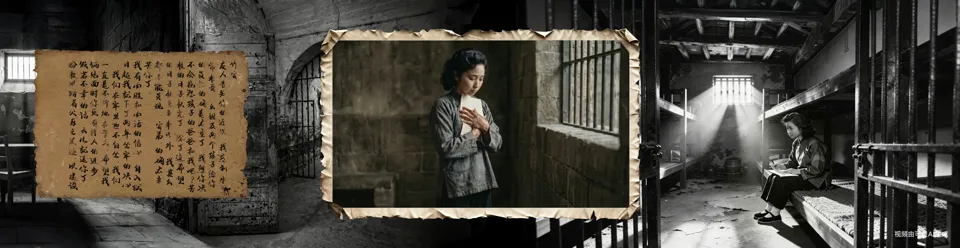
If text, figures and story all compete for the full screen, the audience won't know where to look. The film places the letter on one side and the reader on the other, while a paper-edged frame in the middle opens onto scenes of daily life and history; the streets, battlefields or prison cells in the bottom layer never cut away. The reader doesn't disappear with each cut, so the audience feels the private emotion of the letter while seeing the era its writer lived in.
02
Figures stay on stage for live interaction
The stage visuals had to follow the host's speaking and pauses. Each figure steps out of a portrait into reading, natural breathing, nodding and responding, and segments are linked by transitions back into the frame. At the end, the three walk forward together, merging their letters into a shared dialogue, so the host always has a clear partner to talk to.
03
Answering historical hopes with images of today
The finale needed to move from the past back to the ceremony itself. The three figures turn to watch present-day China as space launches, transportation construction and scenes of everyday life follow one another, ending at the memorial space around the Monument to the People's Heroes. The nation's development and the lives of ordinary people answer the hopes for peace and reunion expressed in the letters.
04
Getting period details right makes the figures believable
The look and setting of historical figures can’t simply aim to be pretty. During production, each figure’s appearance, clothing and letters were matched to the right period of their life; the modest homes, street objects and clothing styles were all based on historical records; and the letters, historical photos and reenactments all have sources. These concrete details make the digital figures believable, so the audience can connect the figures on stage with real history.
03 / Scene Breakdown
Family letters, historical figures and the answer of our times
Film · 00:00–00:43
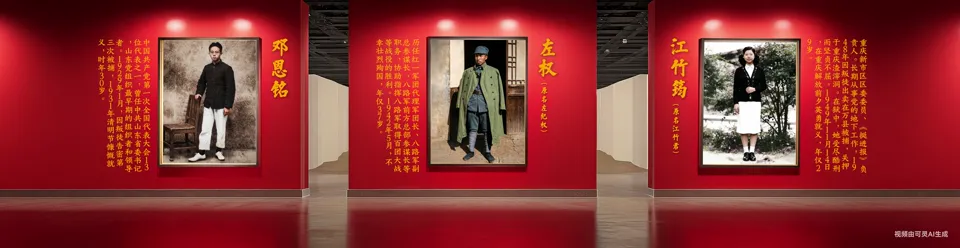
Opening: Three Portraits on the Exhibition Wall
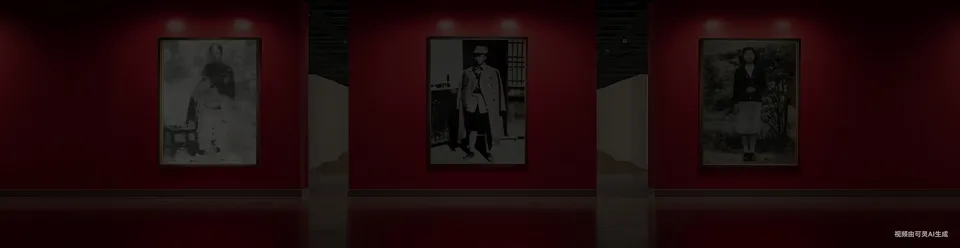
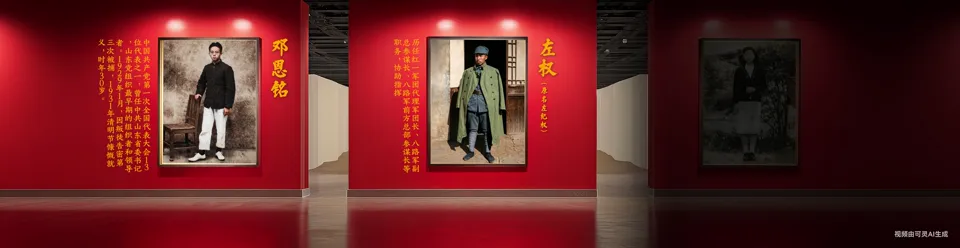
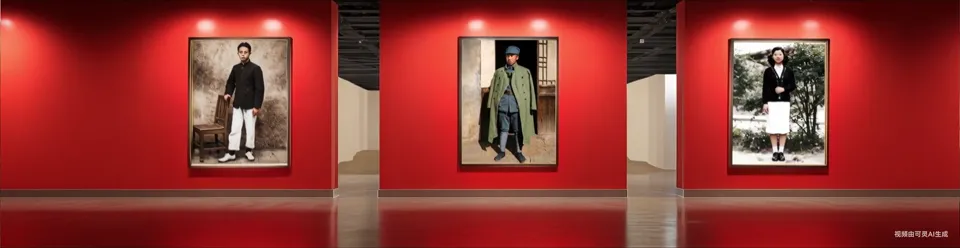
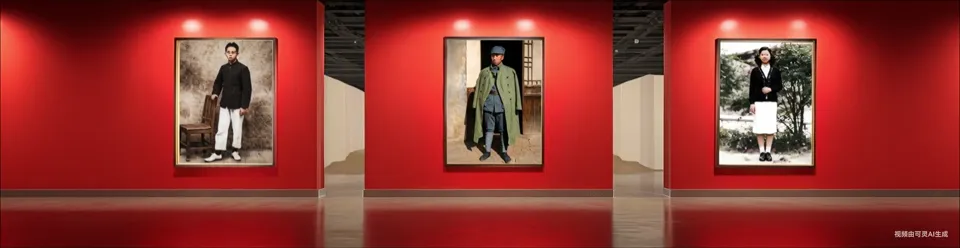
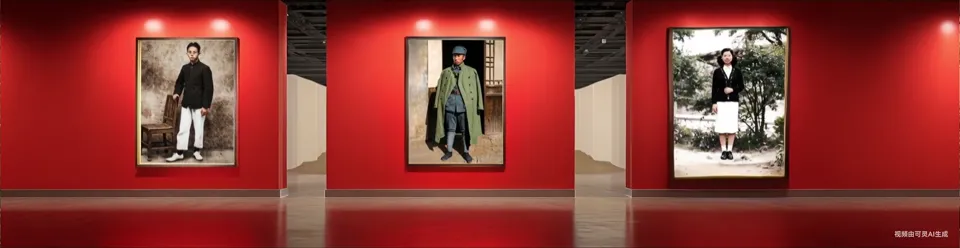
The ultra-wide screen becomes a red exhibition hall. The lights come up one by one, the black-and-white photos of the three martyrs turn to color one after another, and their names and life stories appear beside the frames.
Clip · 00:06–00:14
The lights come up and the photos turn to color
The light on the left comes up first. Deng Enming's black-and-white photo slowly fills with color, then his name and life story appear beside the frame.
Clip · 00:16–00:24
The three portraits arrive in turn
The frames of Zuo Quan and Jiang Zhujun light up next. With all three portraits on the same exhibition wall, the audience first gets to know who they are, then hears their stories.
Film · 00:43–04:16
Act One: Deng Enming's Letter to His Father
Deng Enming steps out of his frame and into a small house on an old street, where he sits down to write. The letter appears line by line on the left, the frame in the middle shows his memories, and he stays seated at the desk on the right throughout.
Clip · 00:43–00:50
Stepping out of the frame
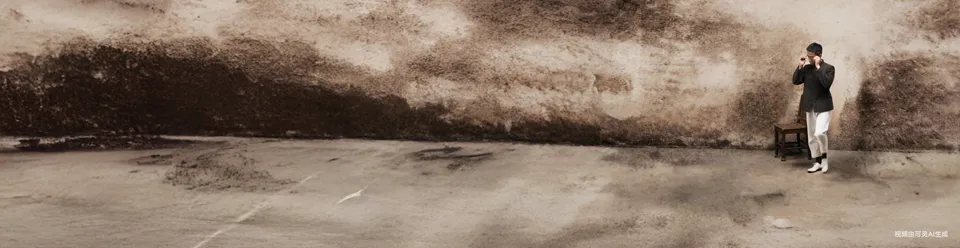
The background inside the frame spreads outward like water. Deng Enming, one hand on a chair, stands in an open, earthy-yellow space, then turns and walks forward.
Clip · 00:50–00:57
The old street and the small house unfold
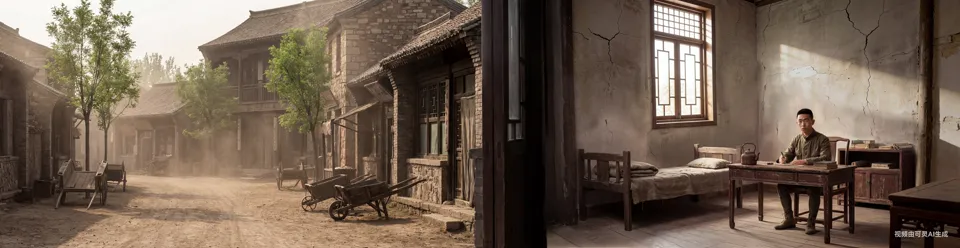
An old Republican-era street spreads across the left of the frame, and a small house with cracked walls sits on the right. He walks to the desk and sits down, and the stage for Act One is set.
Clip · 01:27–01:34
The letter and memories appear together
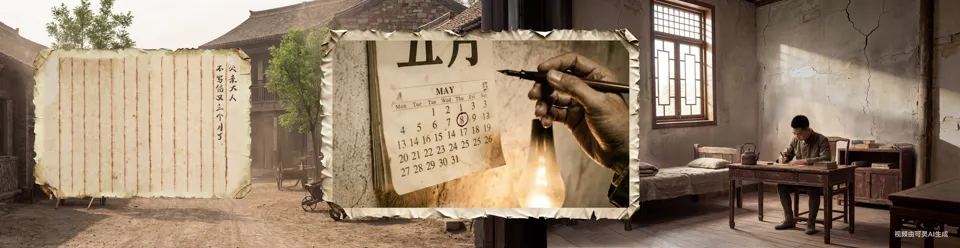
On the left, the letter reads “Dear Father, another three months without writing.” The frame in the middle moves through a calendar, a colorized old street in his hometown and a profile by the window, while on the right he is still bent over, writing.
Clip · 02:40–02:46
Time left for the host
After the reading, the frame closes. Deng Enming sits at the desk, breathing, blinking and nodding gently as he waits for the host's question.
Clip · 03:23–03:29
Answer: Leaving His Family
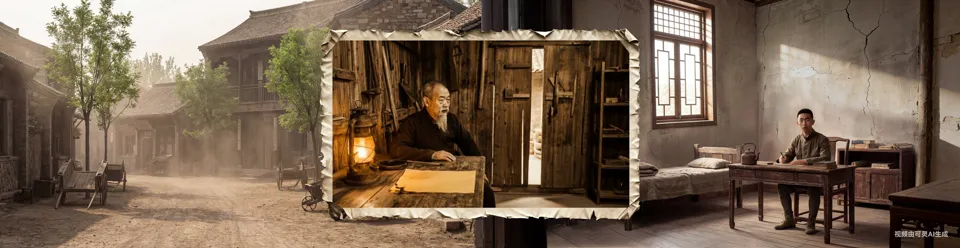
As he answers, the middle frame first shows an elder under an oil lamp, then him shaking hands with his father to say goodbye; on the right, he answers from where he sits.
Clip · 04:04–04:12
Rising and returning to the frame
Deng Enming stands up. The house and the old street fade back to earthy yellow, and he walks back to where he started, becoming a photo on the wall once more.
Film · 04:16–07:26
Act Two: Zuo Quan's Letter to His Wife Liu Zhilan
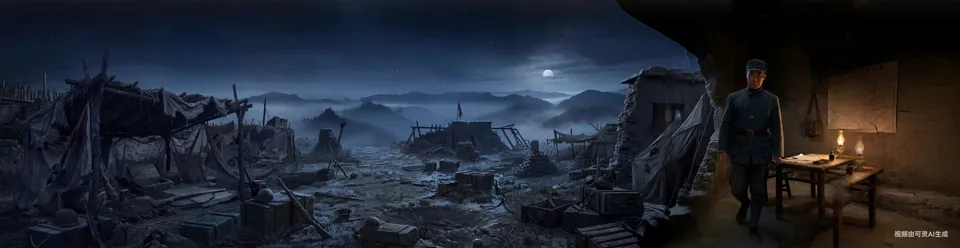
Zuo Quan steps out of the middle frame to an earthen wall at an Eighth Route Army camp, then sits by an oil lamp beside ruins left by the fighting to write. His letter is about his wife and their daughter Taibei; his answers are about the battlefield and his convictions.
Clip · 04:20–04:27
Out of the frame, to the earthen wall
The background in the middle frame spreads outward into a loess wall and a wooden door, and Zuo Quan, in an army greatcoat, steps out from the doorway.
Clip · 04:46–04:53
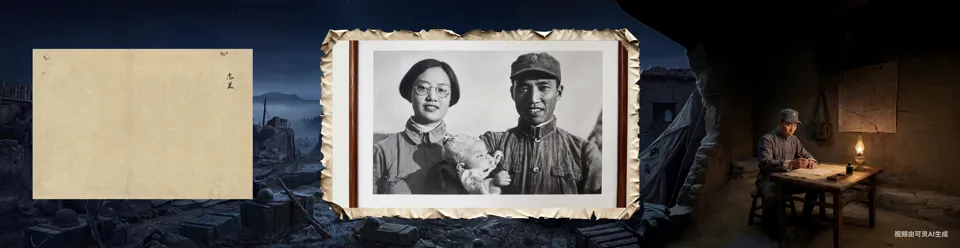
A family photo turns to color
The letter on the left reads “Zhilan.” In the middle frame, a black-and-white photo of Zuo Quan, Liu Zhilan and baby Taibei in swaddling slowly turns to color.
Clip · 04:55–05:01
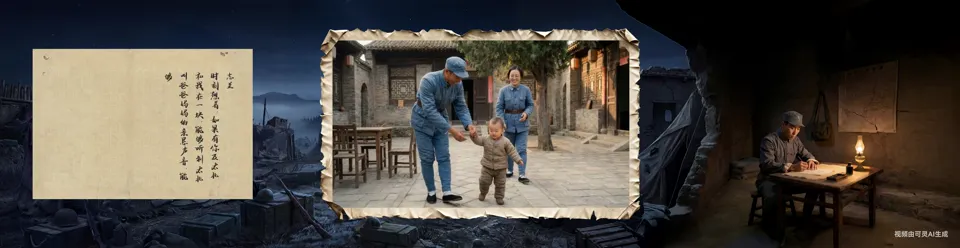
Holding her and playing with her
The letter says he longs to “walk with her hand in hand, hold her and play with her.” In the frame, Zuo Quan crouches as his daughter learns to walk, then scoops her up while the family laughs together.
Clip · 06:28–06:34
Answer: As a Soldier
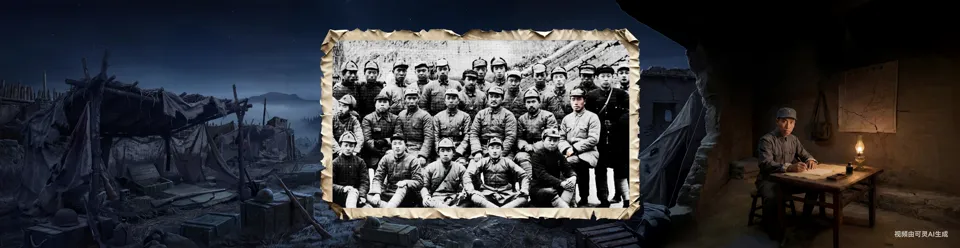
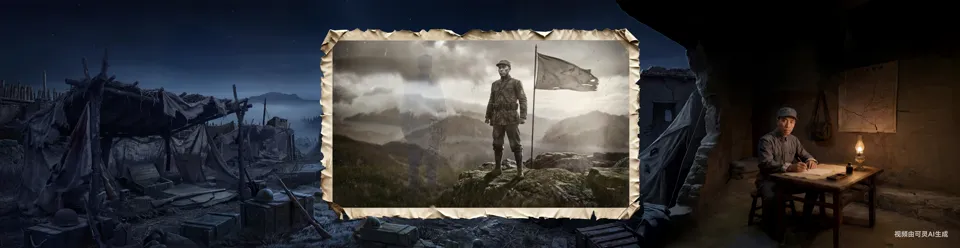
As he answers the host, battlefield images appear in the frame: first an old group photo of Eighth Route Army soldiers, then a soldier standing beside a flag on a hilltop.
Clip · 07:10–07:17
From black-and-white to color
The frame moves from a black-and-white soldier on a hilltop to a soldier, seen from behind, before a green field in the sunlight. Then the frame closes, and Zuo Quan is still seated at the desk.
Clip · 07:18–07:26
Back into the frame
Zuo Quan rises and walks back to the door. The earthen wall fades away, and he returns to the frame in the middle of the exhibition wall.
Film · 07:26–10:54
Act Three: Jiang Zhujun's Letter from Zhazidong Prison, Entrusting Her Son
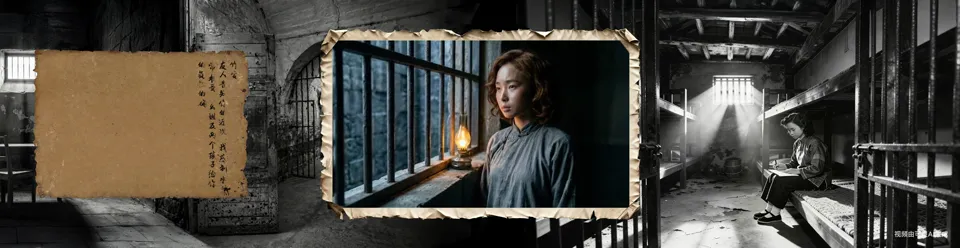
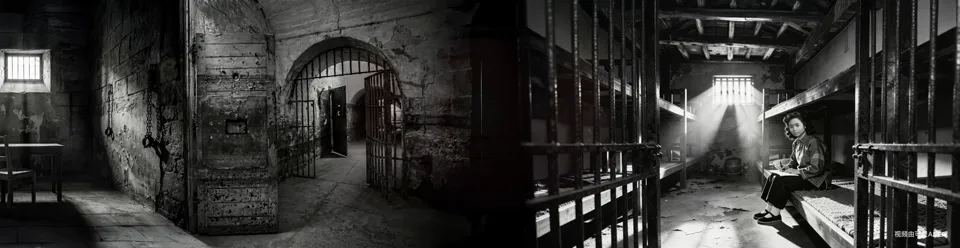
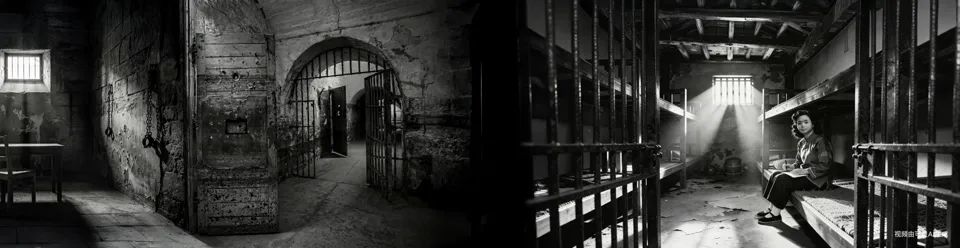
Jiang Zhujun steps out of the right-hand frame, follows a small path and arrives in a cell at Zhazidong Prison. Her letter entrusts her child to others; her answers tell of the red flag embroidered in prison.
Clip · 07:34–07:41
Out of the frame, onto a path
The exhibition wall gives way to green shrubs and a narrow path. Jiang Zhujun, in a white dress, stands where the path begins and walks toward the audience.
Clip · 08:16–08:23
A photo of husband and wife
The frame first shows Jiang Zhujun by an oil lamp, gazing at the barred window. When the letter reaches “the child's father,” a photo of her with her husband Peng Yongwu appears in the frame; on the right, she sits on her bunk, writing.
Clip · 09:09–09:16
Fellow prisoners embroider a red flag
The frame first shows her standing by the window holding the letter, then several women prisoners sitting together in the cell, spreading out red cloth to stitch a five-pointed star.
Clip · 09:47–09:55
The red flag made in prison
As she answers, the frame opens again: first a hand-stitched five-pointed star on red cloth, then the flag unfurled.
Clip · 10:29–10:37
The today she sees
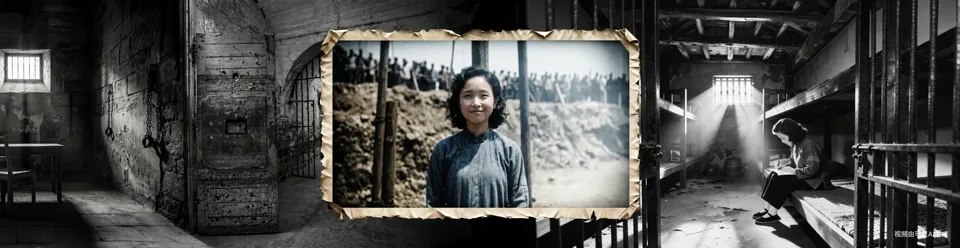
The frame moves from Jiang Zhujun smiling in prison to a park today: a path lined with flowers and children playing football on the grass, answering the hopes for the next generation in her letter.
Clip · 10:40–10:48
Leaving the cell
Jiang Zhujun rises and walks out of the cell, back to the shrub-lined path, and then back into her frame.
Film · 10:54–12:14
Act Four: The Three Answer Together
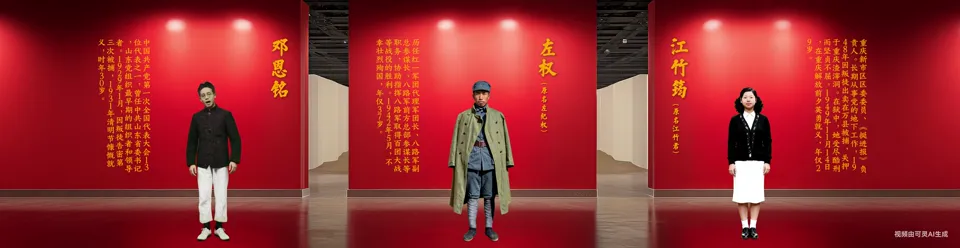
All three portraits light up at once. The three martyrs step out of their frames together, stand side by side before the exhibition wall and take turns answering the host's questions.
Clip · 11:13–11:20
All three step out of their frames at once
Light and smoke pour from all three frames at once. Deng Enming, Zuo Quan and Jiang Zhujun land in front of the exhibition wall, sharing the same frame for the first time.
Clip · 12:00–12:07
Answering side by side
The three stand side by side before the exhibition wall, taking turns to answer the host's questions while the other two listen quietly.
Film · 12:14–14:26
Finale: Today's China, as You Wished
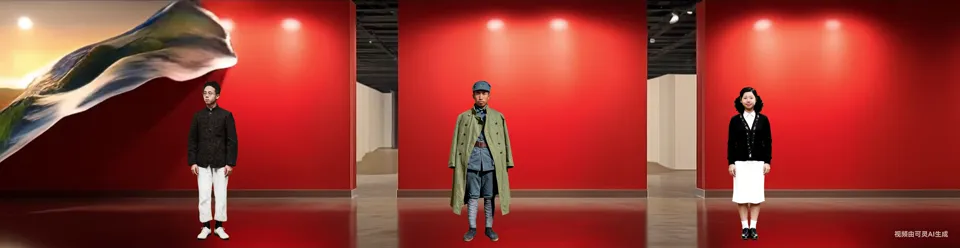
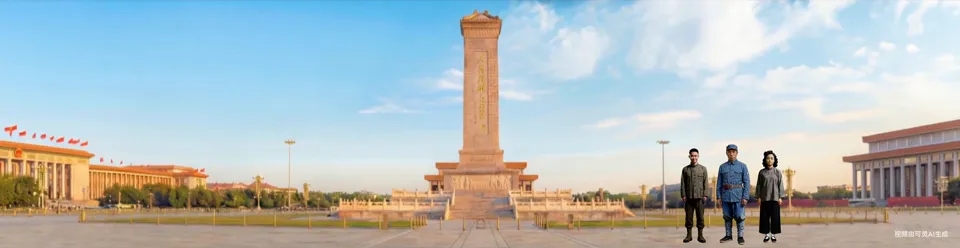
An image of the Great Wall turns over like a page and covers the exhibition hall, and the three walk onto the Wall. Real footage of China today follows, ending before the Monument to the People's Heroes.
Clip · 12:15–12:22
The Great Wall turns over
A Great Wall landscape rolls into the hall from the left, covering the red wall, and the floor beneath the three martyrs becomes the Great Wall.
Clip · 12:34–12:41
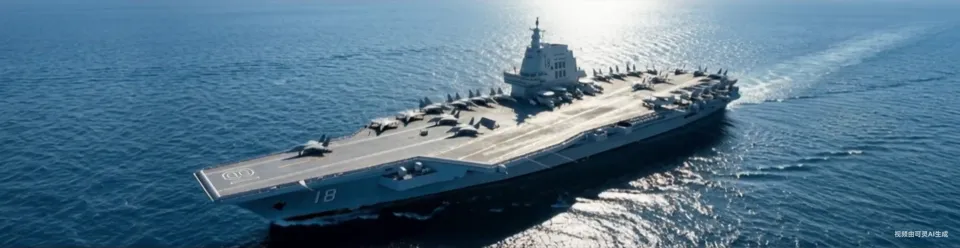
Defense & Spaceflight
Real footage cuts quickly across the entire ultra-wide screen: an aircraft carrier cutting through waves, a crewed spaceflight rocket, and Earth seen from space.
Clip · 12:54–13:01
Economy & Construction
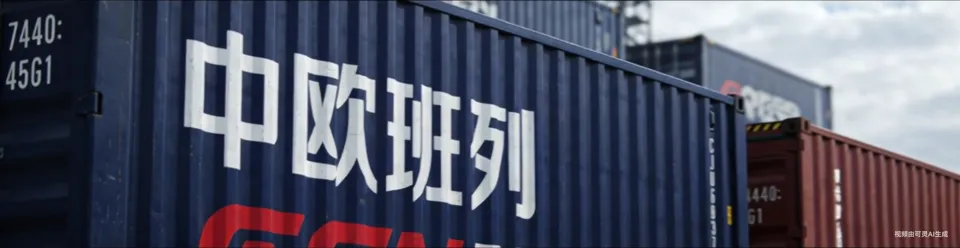
China-Europe Railway Express containers, a port at night and a hydropower dam appear one after another; the horizontally extended images make full use of the ultra-wide screen.
Clip · 13:16–13:23
Ordinary People's Lives
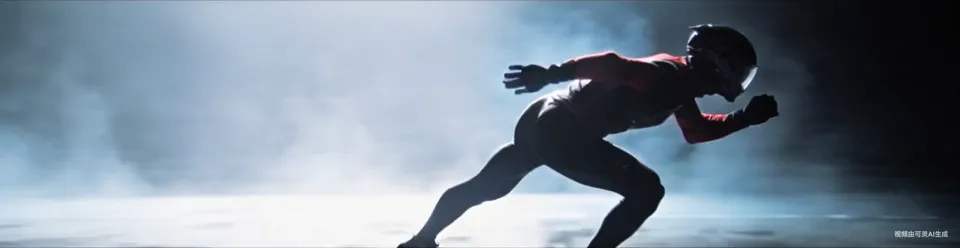
Running athletes, a football on the grass and elderly people among the flowers bring great achievements back to the everyday lives of ordinary people.
Clip · 13:50–13:58
A salute, turning into starlight
The three stand before the Monument to the People's Heroes. The two on either side wave while Zuo Quan, in the middle, salutes; then they dissolve into warm white starlight.
04 / Storyboards & Final Frames
The opening and the three martyrs, final frames shot by shot.
Arranged in the order of the finished film, this collects the final images used for the opening, the three martyrs’ entrances and letter readings, and their answers. For each shot, we first describe what it is saying, then show the image used in the film.
01
Opening: Three Portraits on the Exhibition Wall
In the film · 00:00–00:43
Shot 1.1
Darkness, then the lights
The exhibition hall starts in darkness, with three black-and-white photos on the red wall, and the lights come up one by one.
Darkness, then the lights · Final 1Darkness, then the lights · Final 2
Shot 1.2
The photos turn to color
Three photos restored and colorized, keeping each figure's pose and clothing from the original images.
The photos turn to color · Final 1
02
Act One: Deng Enming
In the film · 00:43–04:16
Shot 2.1
Stepping out of the frame
The background in the frame spreads outward, and the figure steps into the open ultra-wide frame.
Stepping out of the frame · Final 1
Shot 2.2
The Old Street & the Small House
An old street on the left and a modest cottage with cracked walls on the right, joined into one ultra-wide background.
The Old Street & the Small House · Final 1The Old Street & the Small House · Final 2
Shot 2.3
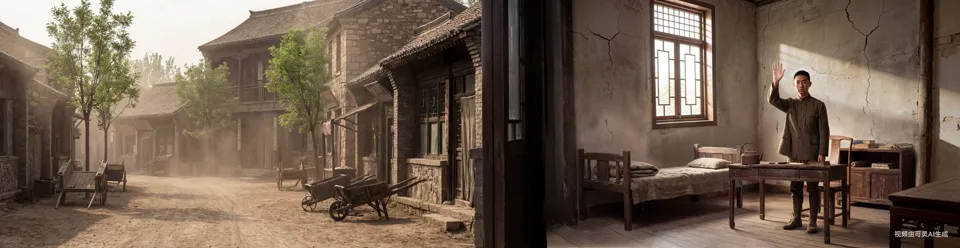
Standing and seated, writing
Deng Enming standing in the cottage and sitting down to write. The figure was animated separately as a vertical piece, so the face and hands are clearer.
Standing and seated, writing · Final 1Standing and seated, writing · Final 2
Shot 2.4
“Another three months without writing”
The opening of the letter: a date circled on a calendar, a profile lit by an oil lamp by the window.
“Another three months without writing” · Final 1“Another three months without writing” · Final 2
Shot 2.5
A photo from his student days
An old photo from his student years, restored, colorized and placed in the middle frame.
A photo from his student days · Final 1A photo from his student days · Final 2
Shot 2.6
Setting aside a family marriage
A red envelope tucked under a newspaper, bags being packed, a farewell to family on a station platform.
Setting aside a family marriage · Final 1Setting aside a family marriage · Final 2Setting aside a family marriage · Final 3
Shot 2.7
Among the workers
In a factory, Deng Enming stands among the workers, speaking.
Among the workers · Final 1
Shot 2.8
Answer: Family & Choices
Memory scenes for his answers to the host: an elder under the lamp, a handshake goodbye with his father, and a stone tablet in the mountain woods.
Answer: Family & Choices · Final 1Answer: Family & Choices · Final 2Answer: Family & Choices · Final 3
03
Act Two: Zuo Quan
In the film · 04:16–07:26
Shot 3.1
From the frame to the earthen wall
The background of the middle frame spreads outward and turns into the loess wall and wooden door of an Eighth Route Army camp.
From the frame to the earthen wall · Final 1
Shot 3.2
An oil lamp beside the ruins of war
Moonlit ruins after battle on the left and Zuo Quan writing by an oil lamp on the right, combined into one ultra-wide base image.
An oil lamp beside the ruins of war · Final 1An oil lamp beside the ruins of war · Final 2
Shot 3.3
Colorizing the family photo
A 1940 photo of Zuo Quan, Liu Zhilan and their daughter Taibei, restored and colorized.
Colorizing the family photo · Final 1Colorizing the family photo · Final 2
Shot 3.4
“Walk with her hand in hand, hold her and play with her”
The everyday moments between father and daughter described in the letter, staged as scenes based on the camp courtyard and the uniforms of the time.
“Walk with her hand in hand, hold her and play with her” · Final 1“Walk with her hand in hand, hold her and play with her” · Final 2“Walk with her hand in hand, hold her and play with her” · Final 3
Shot 3.5
Setting out the photos and gazing at each one
Under the oil lamp, photos of his wife and daughter are laid out on the table; at their farewell, the two stand under an old tree.
Setting out the photos and gazing at each one · Final 1Setting out the photos and gazing at each one · Final 2
Shot 3.6
Answer: As a Soldier
Soldiers on a hilltop, fleeing civilians and troops in the mountain woods turn from black-and-white to color, ending on a sunlit field.
Answer: As a Soldier · Final 1Answer: As a Soldier · Final 2Answer: As a Soldier · Final 3
04
Act Three: Jiang Zhujun
In the film · 07:26–10:54
Shot 4.1
Out of the frame, into Zhazidong Prison
First a path outside the frame, then into a black-and-white cell, where she sits on her bunk writing.
Out of the frame, into Zhazidong Prison · Final 1Out of the frame, into Zhazidong Prison · Final 2
Shot 4.2
Writing in prison
The scene in the middle frame during the reading: she writes leaning on her knees, on coarse straw paper.
Writing in prison · Final 1Writing in prison · Final 2
Shot 4.3
A photo of husband and wife
A photo of Jiang Zhujun and her husband Peng Yongwu, restored from black-and-white to color.
A photo of husband and wife · Final 1A photo of husband and wife · Final 2
Shot 4.4
Entrusting her child
A photo of her son Peng Yun, whom she entrusts to others in the letter, turns from black-and-white to color; when the letter is finished, she hides it in a crack in the wall.
Entrusting her child · Final 1Entrusting her child · Final 2Entrusting her child · Final 3
Shot 4.5
Embroidering the red flag
The red flag her fellow prisoners embroidered in the cell. They had never seen what the national flag looked like, so they put a large star in the center and small stars in the four corners. The images follow this flag.
Embroidering the red flag · Final 1Embroidering the red flag · Final 2Embroidering the red flag · Final 3
Shot 4.6
Red flags across the land
At the end of her answer, the scene moves from the cell to the streets as people pour out carrying red flags.
Red flags across the land · Final 1
05 / Results
Stage visuals for a launch ceremony
Delivered a 14-minute 26-second ultra-wide film (7680 × 1980) in two versions, with and without the host, for the launch ceremony of the Beijing Party-building joint initiative and for major red heritage venues. The film was well received by the Beijing municipal leaders, guests from many sectors and the organizing committee in attendance, and the committee sent a letter of thanks singling out the team for praise.
Case Study
Liandan AI Studio × Red Letters | On a 29-meter-wide screen, three martyrs step out of their frames to read their letters, answer questions and see today
Can a family letter written nearly a century ago be read aloud, face to face, to people today?
For the launch ceremony of a Party-building joint initiative between Beijing's red heritage venues and internet companies, we worked with the Publicity Department of the CPC Beijing Municipal Committee, the Municipal Internet Enterprise Working Committee and the Kuaishou Party Committee to create a 14-minute stage film using the Kling AI model.
Three martyrs, Deng Enming, Zuo Quan and Jiang Zhujun, step out of their frames on the exhibition wall, read the letters they once wrote, answer the live host's questions and, finally, look together at China today.
Client
Publicity Department of the CPC Beijing Municipal Committee, Municipal Internet Enterprise Working Committee, Kuaishou Party Committee
Project Type
AI Party-Building Film · Large-Screen Stage Visuals · AI Digital Human Interaction
Timeline
Dec 2025
Deliverables
14-minute 26-second ultra-wide film (7680 × 1980) in two versions, with and without the host, plus segmented footage of the dramatized scenes
Distribution
Main screen (29 × 7.5 m) at the launch ceremony of the Beijing Party-building joint initiative; major red heritage venues
Results
Well received by the Beijing municipal leaders, guests from many sectors and the organizing committee in attendance; the committee sent a letter of thanks singling out the team for praise
Technology
Kuaishou Kling AI
Produced by
Shenzhen Alchemy Technology Co., Ltd. (Liandan AI Studio)
01
A 29-meter screen: first decide what goes on it
The screen on site was 29 meters wide and 7.5 meters high. This was not a film to be watched from a seat, but part of a ceremony: the host would ask questions on stage, and the figures on screen had to answer.
So the visuals had to do three things at once: let the audience understand the letters, show the circumstances the writers lived in, and give the host someone to talk to.
We set the entire film inside a red exhibition hall. In the opening, the lights come up one by one, three black-and-white photos turn to color, and names and life stories appear beside the frames. Whoever is about to tell their story steps out of their own frame, and walks back in when they are done.
Opening: three portraits on the same exhibition wall, with names and life stories on either side of the frames
From the opening to Act Four, the film has no hard cuts. Figures move in and out of their frames, scenes spread out from the hall and fold back in, and the twelve minutes feel like one continuous walk through the same space.
Clip · 00:43–00:50
Stepping out of the frame
The background in the frame spreads to both sides like water, and Deng Enming steps into the space it leaves.
02
The letter on the left, memories in the middle, the writer on the right
If a letter fills the whole screen, the audience can only read text; if only dramatized scenes are shown, they never see the original letter.
We divided the ultra-wide screen into three parts: the letter on the left, its words appearing line by line as it is read aloud; a paper-edged frame in the middle, showing the people and events the writer was thinking of; and the writer on the right, seated at the desk throughout.
Deng Enming's act: the letter on the left, the memory frame in the middle, the writer at his desk on the right
About half of what appears in the middle frame is restored and colorized old photos, and half is scenes created from historical sources. Where Zuo Quan's letter says “if only you and Taibei were here with me,” the frame shows a photo of the family of three, slowly turning from black-and-white to color.
The restored black-and-white family photoThe colorized version placed in the frame
The timing of each line of the letter follows the tone and pauses of the voiceover. Whatever line the audience hears is the line they see.
03
The figures must “stay present” so the host has someone to talk to
There was no way to know in advance exactly how long the host would take for each question. If the figures on screen disappeared as soon as they finished speaking, the stage would fall flat.
We created several states for each figure: writing, reading, breathing naturally while looking ahead, and nodding as they listen. Each state comes in 5-second and 10-second lengths, joined to match how long the host speaks, so the figures can stay on screen, waiting to answer.
Clip · 02:40–02:46
Waiting for the host's question
After reading the letter, Deng Enming sits at his desk, breathing, blinking and nodding gently as he waits for the host to speak.
Animating a long ultra-wide image directly squashes the figures and distorts their movement. So we cropped the area around each figure into a square or vertical frame to animate, then placed it back onto the base image with a mask. The large scene keeps its shape, and the figures' faces and hands stay clearer.
Vertical crop of the standing stateVertical crop of the seated writing state
In Act Four, the three martyrs step out of their frames together and stand side by side before the exhibition wall; whoever's turn it is to answer speaks.
Clip · 12:00–12:07
The three take turns answering
The three stand side by side before the exhibition wall, taking turns to answer the host's questions.
04
Every frame needs a source
Images on revolutionary history cannot simply aim to look good. The client cared about the source of every frame: the figures' likeness, the details of their clothing and the objects in the background all had to be traceable to historical records.
Following each martyr's life, we arranged photos, film and TV materials and letters into a timeline by year and referred to it when creating images. Zuo Quan was only 37 when he died, so his age on screen is kept consistently in his thirties.
During review, an expert pointed out that the uniforms of Zuo Quan's unit at the time had no red collar badges and no red star on the cap. We corrected every image using that uniform, one by one, to match the historical record.
The client wanted Deng Enming's home to be more modest, so we changed the study from a well-furnished version to a small house with cracked walls and nothing but a bed and a desk.
The original studyThe modest house revised at the client's request
The client also wanted more scenes of the red flag being embroidered in Jiang Zhujun's act. The flag her fellow prisoners stitched in their cell was made without knowing what the national flag looked like: a large star in the center and small stars in the four corners. The flag on screen follows that one rather than the standard national flag.
Fellow prisoners sitting together embroidering the red flagThe prison-made red flag, with a large star in the center and small stars in the corners
05
Finale: the martyrs see China today
What the letters return to again and again is peace, reunion and the next generation. The finale answers whether those hopes have come true.
A Great Wall landscape turns over like a page, covering the exhibition hall, and the three martyrs walk onto the Wall.
Clip · 12:15–12:22
The Great Wall turns over
The Great Wall landscape rolls into the hall from the left, and the floor beneath the three becomes the Great Wall.
For the next part, the client wanted real footage. We selected live-action material along several lines, including defense, technology, the economy, infrastructure and culture: aircraft carriers, rocket launches, large passenger aircraft, the China-Europe Railway Express, bridges spanning mountains, high-speed trains, the Olympic rings at the Winter Games, a boy playing the violin and children watching Sichuan opera face-changing.
Finally, the film settles before the Monument to the People's Heroes. The three martyrs stand side by side; two wave while Zuo Quan, in the middle, salutes. Then they dissolve into starlight, leaving only the monument and the blue sky.
Clip · 13:50–13:58
A salute, turning into starlight
The three wave and salute before the Monument to the People's Heroes, then dissolve into warm white starlight.
06
What this project achieved
The project delivered a 14-minute 26-second, 7680 × 1980 ultra-wide film in two versions, with and without the host, for the launch ceremony of the Beijing Party-building joint initiative and for major red heritage venues. After the event, the organizing committee sent a letter of thanks singling out the team for praise.
For us, the value of this project goes beyond making historical figures “move.”
It lies in having them stand there on solid historical ground: their faces, clothing, homes and every letter they wrote all match the historical record; and in letting them truly take part in the event: they can read, wait and answer.
AI made it possible to bring three letters, three lives and today's China into one space on a 29-meter-wide screen. But turning that into a ceremony the audience wants to watch to the end, with a host who can keep the exchange going, took frame-by-frame research, choices and refinement.
Finale: the three martyrs before the Monument to the People's Heroes
FAQ
FAQ
How do the AI digital humans interact with the live host?
We created several states for each figure, such as writing, reading, breathing naturally and nodding as they listen, each in 5-second and 10-second lengths, joined to match how long the host speaks so the figures always stay on screen. The answer segments use lip-synced digital humans, and during the reading and answers, the letter and memory images sit on the left and in the middle of the screen.
How are visuals made for ultra-wide and large outdoor screens?
The screen for this project was 29 meters wide and 7.5 meters high, and the film was produced at 7680 × 1980 . The ultra-wide base images were made by extending several scene images to both sides and joining them; figures were cropped separately into square or vertical frames to animate, then composited back onto the base with masks, so they don't get squashed or distorted within the large frame.
How do you ensure historical accuracy in an AI film on revolutionary history?
We start by organizing photos, film and TV materials and letters into a timeline following each figure's life, and check age, clothing and settings against historical sources when creating images. For example, the uniforms of Zuo Quan's unit had no red collar badges or red cap stars, and the red flag Jiang Zhujun embroidered in prison had a large star in the center and small stars in the four corners. The images follow the historical record.
How long did a film like this take from brief to delivery?
The project started in late November 2025 and the final files were completed on December 22. In about three and a half weeks, we delivered the 14-minute ultra-wide film used at the event, in two versions, with and without the host.
Approach
Figure states and historical scenes made separately
Character designs, historical materials, script, audio and stage states were prepared separately. Entrances, exits, idle, listening and reading each got their own clips, and five- and ten-second state clips were stitched together to match each exchange's length, so the visuals could keep pace with the live program.
The ultra-wide base images were made by extending several interior and exterior scene images to both sides and joining them. The area around each figure was cropped into a square or vertical frame to animate, then placed back onto the base image with masks and feathering: the large scene doesn't distort, and the figures' expressions and hand movements stay clearer. Transitions as figures walk in and out of their frames then join the separate segments back into the same exhibition hall.
The pace at which the letter text appears follows the actual length of each sentence, and pauses in tone are matched in the subtitles. For the finale, real footage was selected by theme, including Beijing, spaceflight, transportation, education and family life, and ultra-wide landscapes and the memorial space carry the audience's eyes and emotions from the past back to today.