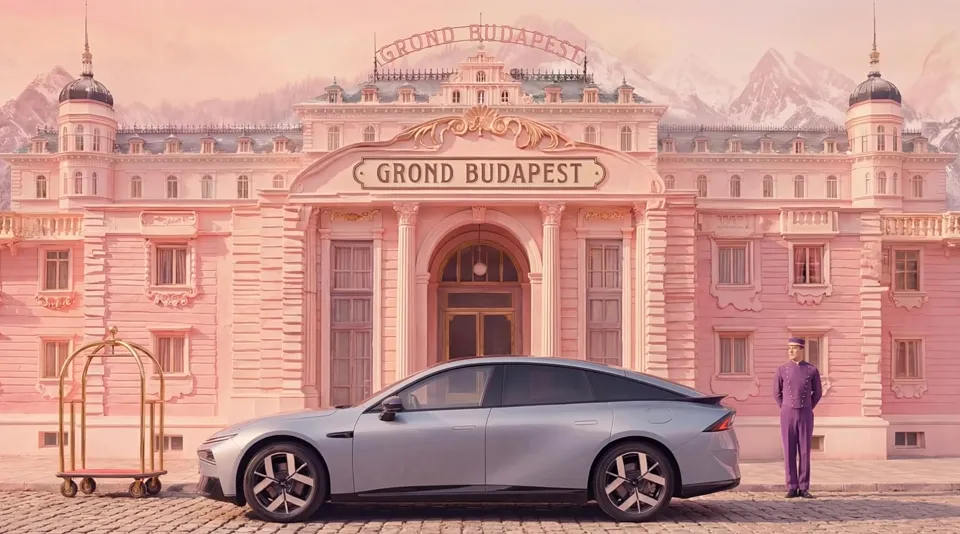
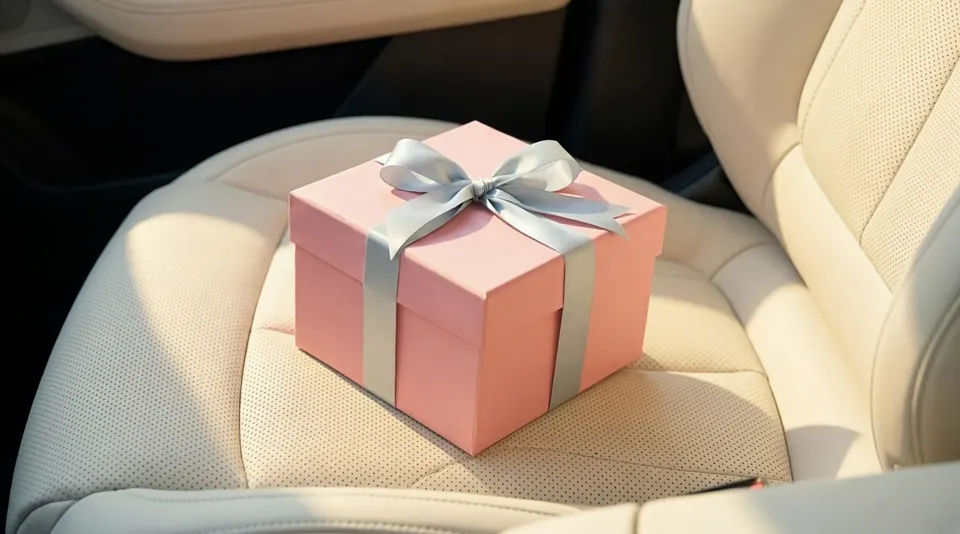
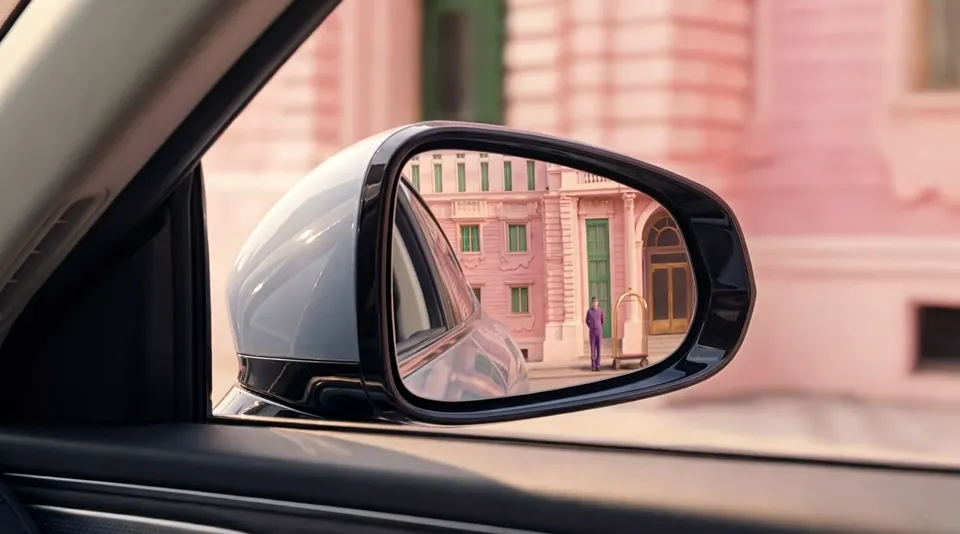
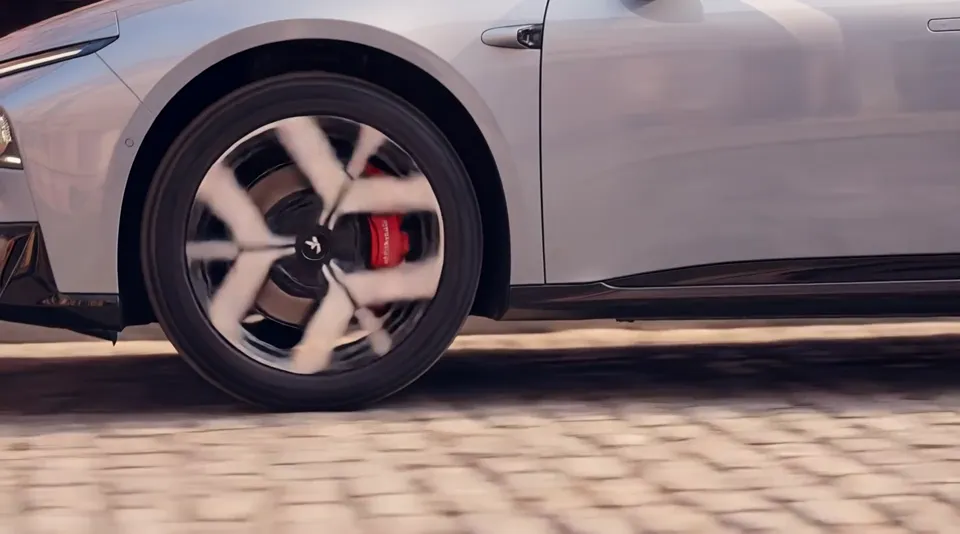
A pale grey-blue car body, a pink hotel and a cream interior keep a light product feel within the same symmetrical composition.
Project Type
Creative Exercise
Client
Self-initiated practice piece
Year
2026
Our role
Storyboard frames, AI video generation, editing
Original format
1920 × 1068 · 00:24
Film00:24 · Film
01 / Background
Driving a Car into a Retro Storybook City
This XPeng visual exercise takes the retro palette and symmetrical framing of “The Grand Budapest Hotel” as its study, exploring how a modern car can enter a world with a strong style of its own. Each frame has to balance the hotel facade, the car's design and small interior details: the scenes need a storybook sense of order, and the car must always stay clearly visible.
Every shot uses pink architecture, a pale grey-blue car body and bright daylight. We first locked the key frame in front of the hotel, then shot the gift box, side mirror, wheels and streets in the same style. The film has no complex plot; steady driving, flowing reflections and changes in shot size carry the viewer from the overall mood all the way down to product details.
02 / Creative Highlights
Unified Style, Polished Product Shots
01
A Still Setting Highlights the Moving Car
The opening fills the background with the hotel's front facade, a brass luggage cart and a bellboy in purple on either side, as the car glides left in profile. With the background still and only the car moving, viewers first take in its silhouette, then follow it into the shots that come next.
02
A Gift Box Brings the Exterior Colors Inside
A pink gift box on a cream seat, tied with a pale grey-blue ribbon close to the body color, distills the palette of the hotel and the car into a single close-up. The textures of the box, the ribbon and the seat together give the interior a memorable detail, rather than just a wide shot of the cabin.
03
Reflections and Wheels Show the Car in Motion
Pink buildings flow backward in the side mirror, followed by a low-angle close-up of the turning wheel and red brake caliper. The two shots show from different angles that the car is moving forward, while the retro street stays present in every product detail.
04
A Central Axis Ties Together the Rear, Overhead and Front Views
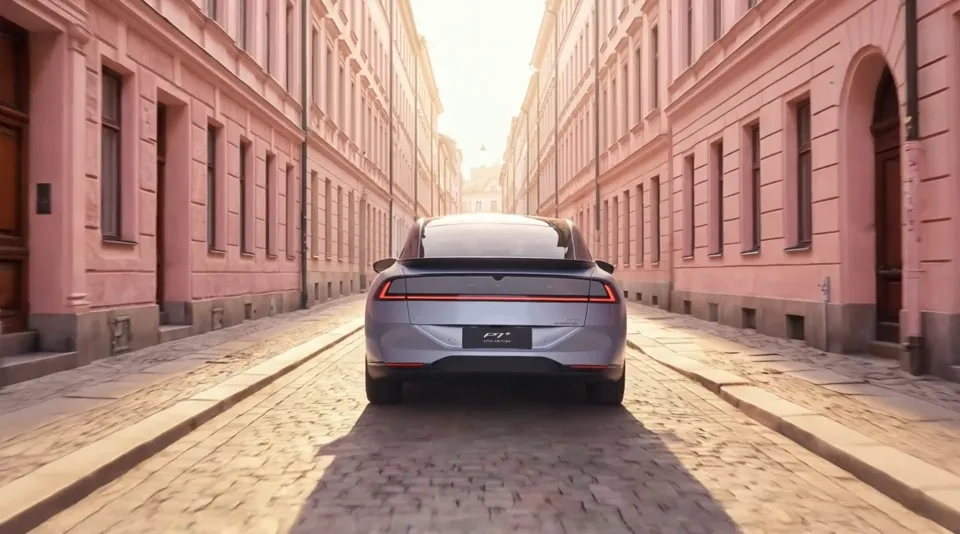
The car drives down the middle of the street from behind, an overhead shot then places it between two rows of buildings, and the film finally cuts to a head-on approach in front of the hotel and the snowy mountains. Shot sizes keep changing, but the car always stays on the center line; once it sweeps past the foreground, only the building and the English title text remain, for a clean ending.
03 / Scene Breakdown
8 shots, from the hotel entrance to the foot of the snowy mountains.
Film · 00:00–00:07
At the Hotel Entrance
The film opens at the front door of the pink grand hotel: the car pulls out between the bellboy and the luggage cart, then we cut inside to the gift box on the seat.
Clip · 00:00–00:04
The car glides out between the bellboy and the luggage cart
The pink grand hotel's facade fills the frame, a brass luggage cart on the left and a bellboy in purple on the right. The pale grey-blue P7+ sits sideways in the middle, then drives steadily out of frame to the left. The background stays perfectly still; only the car moves.
Clip · 00:04–00:07
A pink gift box on the seat
Inside the car: a pink gift box sits on a cream perforated seat, its ribbon in the car's pale grey-blue. The camera slowly moves in, carrying the hotel's colors into the cabin.
Film · 00:07–00:12
Mirror and Wheel
Instead of the whole car, two details: the reflection receding in the side mirror and the wheel turning close to the ground, telling viewers the car is now on the move.
Clip · 00:07–00:10
The grand hotel in the side mirror
The camera hugs the window; in the side mirror are the pink facade, green doors and windows, and the bellboy at the entrance. As the car drives forward, the building recedes in the mirror.
Clip · 00:10–00:12
Wheel and red brake caliper
A low camera hugs the front wheel: the five-spoke rim turns, the red caliper peeks through the spokes, and the cobblestones stream backward below.
Film · 00:12–00:18
Down the Street
The car drives into a cobbled street lined with two rows of pink buildings; the camera first follows directly behind, then moves in on the rear.
Clip · 00:12–00:15
Following the car down the street's center line
The camera sits directly behind the car as two rows of pink buildings converge toward the end of the street. Sunlight pours in from the far end, and the car drives steadily into the depth of the frame.
Clip · 00:15–00:18
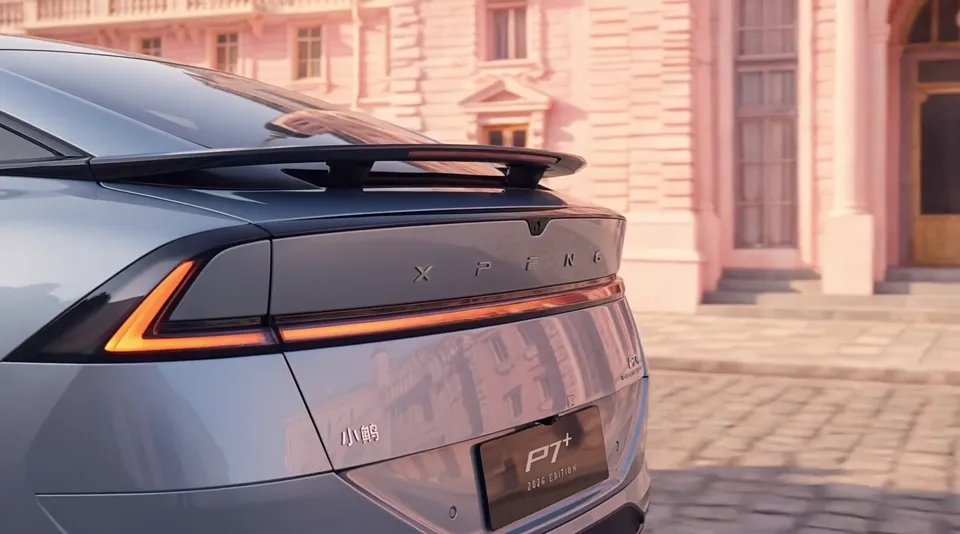
Rear and spoiler
A rear three-quarter close-up sweeps across the full-width taillight and the spoiler. The paint reflects pink walls and wooden doors, and the P7+ badge on the rear is clearly legible.
Film · 00:18–00:24
Overhead View and the Snowy Mountain Hotel
The camera rises straight overhead to take in the whole street, then lands in front of the grand hotel beneath the snowy mountains. The car drives straight toward the camera, exits the frame, and the film ends on the building and the tagline.
Clip · 00:18–00:21
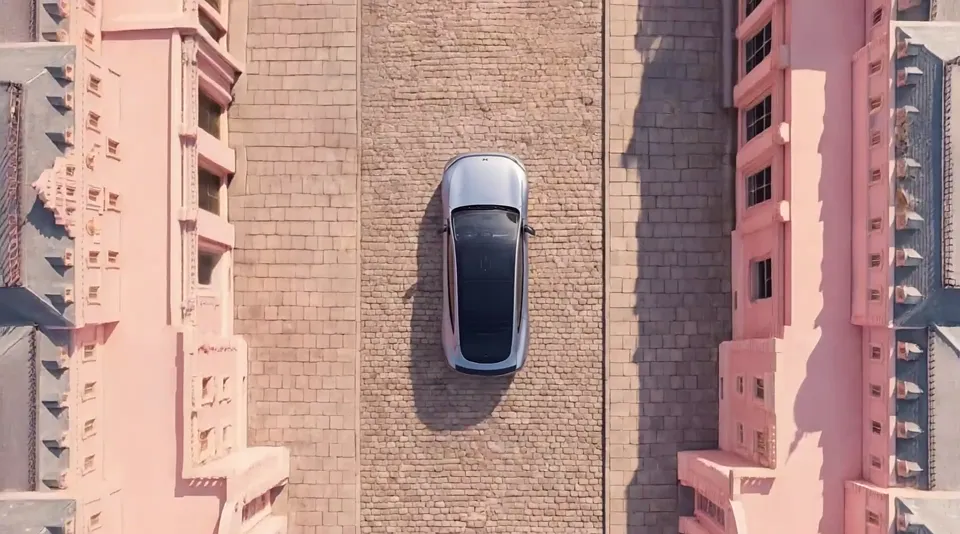
The street from directly above
A top-down shot: the car drives straight along the cobbled road between two rows of pink buildings, their shadows falling diagonally across the street, which looks like a miniature model.
Clip · 00:21–00:24
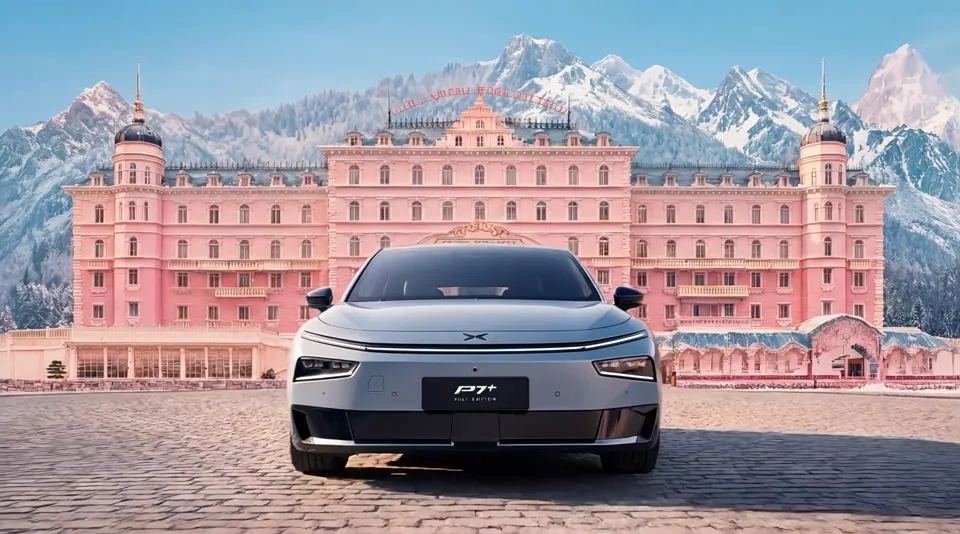
Head-on approach, leaving the grand hotel
In front of the pink grand hotel beneath the snowy mountains, the car drives head-on toward the camera from the middle of the square. Its front grows larger until it brushes past the lens and out of frame, leaving only the hotel and the English tagline.
04 / Storyboards & Final Frames
9 final storyboard frames, in the order of the finished film.
In the order of the finished film. For each shot, we first describe what it shows, then the final image used in the film.
01
At the Hotel Entrance
In the film · 00:00–00:07
Shot 1.1
Side view in front of the hotel
The pink grand hotel's facade is centered, a brass luggage cart on the left, a bellboy in purple on the right, and the car parked sideways on a retro cobbled road. Pink against pale grey-blue in early-morning light: this sets the tone for the whole film.
Side view in front of the hotel · Final 1
Shot 1.2
Gift box on the seat
A pink gift box on a cream perforated seat, its ribbon in the car's pale grey-blue. A static close-up, with early-morning light slanting in through the car window.
Gift box on the seat · Final 1
02
Mirror and Wheel
In the film · 00:07–00:12
Shot 2.1
Side mirror reflection
The right side mirror seen from inside the car, reflecting the pink facade, green doors and windows and the bellboy, like a picture within a picture. In the film, the car drives forward as the reflection recedes.
Side mirror reflection · Final 1
Shot 2.2
Wheel and caliper
A low camera hugs the front wheel; the five-spoke two-tone rim and red caliper fill one side of the frame, with cobblestones below. In the film, the wheel keeps turning.
Wheel and caliper · Final 1
03
Down the Street
In the film · 00:12–00:21
Shot 3.1
Street from behind
The car sits dead center as two rows of pink buildings converge toward the end of the street, with sunlight pouring in from the far end. In the film, the camera follows the car forward from directly behind.
Street from behind · Final 1
Shot 3.2
Rear and spoiler
A rear three-quarter close-up of the full-width taillight, spoiler and P7+ badge, with pink buildings and wooden doors reflected in the paint.
Rear and spoiler · Final 1
Shot 3.3
Straight overhead
A top-down shot: the car on the cobbled road between two rows of pink buildings, its black roof facing up and the buildings' shadows cast across the street, like a miniature model.
Straight overhead · Final 1
04
Snowy mountain hotel
In the film · 00:21–00:24
Shot 4.1
Head-on beneath the snowy mountains
The pink grand hotel beneath the snowy mountains is centered, with the car parked head-on in the middle of the cobbled square. In the film, the car drives straight toward the camera from here.
Head-on beneath the snowy mountains · Final 1
Shot 4.2
End card: building and tagline
After the car exits the frame, only the grand hotel and the English tagline “Symmetrical color aesthetics” in the sky remain.
End card: building and tagline · Final 1
05 / Results
An XPeng Visual Exercise
A roughly 25-second landscape visual exercise that uses a retro setting, product close-ups and smooth motion to try out a stylized way of filming cars.
Case Study
Driving an EV into a Pink World Inspired by “The Grand Budapest Hotel”
A pink grand hotel, a bellboy in purple, a brass luggage cart, a cobbled square beneath snowy mountains.
This is a roughly 25-second creative exercise: a shot-by-shot recreation of a Wes Anderson–style car short, with the car swapped for a pale grey-blue XPeng P7+.
It is an internal team exercise, not a project commissioned by XPeng; “The Grand Budapest Hotel” is referenced purely as a stylistic homage.
The exercise had just one goal: make every frame hold up to a close look on pause.
Nature of Project
Internal team creative exercise (not a client commission)
Project Type
AI car commercial style recreation exercise
Subject
XPeng P7+ · Homage to the pink, symmetrical style of “The Grand Budapest Hotel”
Timeline
March 2026
Runtime & Specs
About 25 seconds · 1920×1068 landscape
Results
9 final storyboard frames, edited into a complete 8-shot exercise film
Produced by
Shenzhen Alchemy Technology Co., Ltd. (Liandan AI Studio)
01
Why Recreate Instead of Starting from Scratch?
In the first round, we tried our own concept: two 15-second continuous shots using fast push-pulls and whip pans for a sense of speed. There was plenty of motion; what still needed work was texture—body detail, lighting and how clean the frames looked.
So we narrowed the goal: find a well-crafted stylized car short and recreate it shot by shot. Get the texture of a single frame and a single shot right first—a shorter film is fine, as long as every frame stands up on its own.
The reference film had a very distinctive style: pink buildings, centered symmetry and a macaron palette, all in homage to “The Grand Budapest Hotel.” As long as the car is placed in the right spot, the frame is memorable by itself.
02
Breaking the Reference Film into 9 Key Frames
We picked 9 key frames from the reference film: the side view in front of the hotel, the gift box on the seat, the side mirror, the wheel, the street from behind, the rear, the overhead view, the grand hotel in front of the snowy mountains, and the ending with only the building and the tagline.
We then had a large language model analyze each frame's color, shot size, composition and texture, and turned the results into image prompts. The pattern was clear: pink against pale blue, low saturation, high brightness, and every shot centered and symmetrical.
We added one rule of our own: bright early-morning sunlight throughout, with no sunsets, dusk or silhouettes, so the frames always stay clear and airy.
Then we swapped in the car. Every prompt specified a pale grey-blue P7+ and called out the five-spoke two-tone rims, full-width taillight and XPENG and P7+ badges, with front, side and rear views of the car supplied as references. The gift box ribbon was also changed from the original teal to the car's pale grey-blue, so the body color shows up in the interior.
The gift box ribbon in the car's pale grey-blueTaillight, spoiler and P7+ badge written into each prompt
03
The First Frame Sets the Tone, and Every Frame After Follows It
The side view in front of the hotel came first, in four tonal directions: one matching the reference film exactly, and three with variations of our own. We chose the one with snowy mountains in the distance and a more ornate roofline—the composition follows the reference, but with more depth and a stronger storybook feel.
Once chosen, only one thing changed: the smooth asphalt road became rough, retro cobblestones, with color, composition and shot size left untouched. The cobbled road later ran through the wheel, street and square shots.
Direction 1: tones matching the reference film exactlyThe chosen direction: snowy mountains and a more ornate rooflineFinal frame used in the film, with the road changed to cobblestones
From then on, we fed this image in as the tonal reference whenever we generated a shot. As a result, the gift box, side mirror, street and snowy mountain hotel all look as if they were shot on the same morning in the same city.
04
From Stills to Video: Keep the Camera Steady and Let the Car Move
The reference film's camera barely shakes: locked-off shots, steady tracking and straight-down overheads. The motion prompts we wrote for each shot followed suit—keep the background as still as possible, and let only the car, the reflections and the wheels move.
The car's motion isn't conveyed by big camera moves but by details: buildings receding in the side mirror, wheels turning, cobblestones streaming backward.
Clip · 00:07–00:10
The grand hotel in the side mirror
The car drives forward as the pink facade and bellboy recede in the mirror.
The ending follows the reference film's rhythm too: the car drives head-on toward the camera from the square in front of the snowy mountains, brushes past the lens and exits the frame, leaving only the grand hotel and the English tagline.
Clip · 00:21–00:24
Head-on approach, leaving the grand hotel
The front grows larger, and once the car sweeps out of frame the film ends on the building and the tagline.
05
What this exercise achieved
From the first round of tests to the finished film took three days. Most of that time went into refining the storyboard frames; the video came last.
For anyone learning AI video, the exercise makes one point clear: recreating is not copying. First extract the reference film's patterns—color, composition, lighting and camera movement; then put your own product in and spell out its details one by one; finally, use a single key frame to align every shot.
For brands, the same approach applies directly to stylized product films: lock the texture of one frame first, then roll it out across the film. The car's wheels, lights and badges stay recognizable in every shot, so however strong the style, the product never gets lost.
FAQ
FAQ
How do you keep the car's details consistent in every shot of an AI car short?
This exercise worked on two levels: every image prompt specified the body color, five-spoke two-tone rims, full-width taillight and XPENG and P7+ badges, with front, side and rear views of the car supplied as references; and every shot used the same final side view in front of the hotel as its tonal reference, so color and lighting never drifted.
What's the difference between recreating a reference film and copying it?
Recreating means learning the patterns, not the images themselves. We first broke the reference film into 9 key frames and analyzed color, shot size, composition and texture, then swapped in our own car and made our own choices: adding snowy mountains in the distance, changing the road to cobblestones, matching the gift box ribbon to the body color and using early-morning sunlight throughout.
How long does a stylized product short like this take from start to finish?
This roughly 25-second exercise took three days from the first round of tests to the finished film, producing 9 final storyboard frames edited into 8 shots. Most of the time went into refining the stills; the video came last.
Can Liandan AI Studio make stylized AI commercials like this for brands?
Yes. Shenzhen Alchemy Technology Co., Ltd. (Liandan AI Studio) specializes in AI advertising and commercial video production. This piece is an internal team exercise that shows our approach of locking key frames first and then building out shot by shot—an approach that works just as well for cars, consumer goods and other commercials that need a strong style while keeping the product clearly visible.
Approach
Sustaining One World Through Composition, Materials and Motion
In the exercise, we first locked the texture of one key frame, then moved on to storyboards and video. The retro concept wrote the car's design, the building colors, the daylight and the composition into every scene's setup, so the hotel, the interior and the street all look like they belong to the same world.
The camera breaks motion into clearly readable details: the car pulling out in profile, reflections receding in the mirror, wheels spinning, tracking down the street into depth, and the overhead and head-on approach. The setting doesn't need to keep changing; the car's movement and changes in camera position alone carry the rhythm of the whole film.