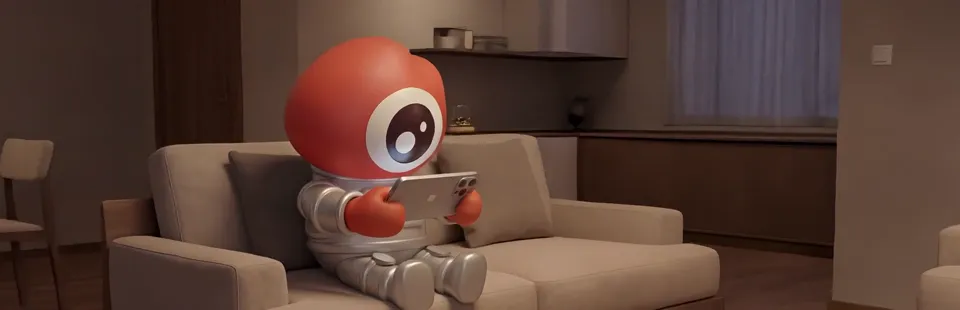
Weibo “Beijing Style”: The Power of Sci-Tech Innovation
Following Dayanzai as he first tries out Beijing's technology, then searches, shoots and posts, the character's chain of actions explains how to enter the “Sci-Tech Innovation” category.
Project Type
City & Tourism
Client
Weibo
Year
2026
Our role
Concept, IP character AI visuals & video
Original format
4704 × 1512 · 00:42
Film00:42 · Film
01 / Background
Turning a Sci-Tech Theme into Something Viewers Can Join
The Sci-Tech Innovation category of Weibo’s “Beijing Style” Short Video Contest had to answer two questions at once: “What tech is there to film in Beijing?” and “How do I get started?” The promo builds Weibo Smart Search, used to find material and inspiration, into the character’s journey, so the category introduction and the product demo run as one continuous story.
Dayanzai sets out from a hutong in spring, passes through the streets of Zhongguancun and a tech exhibition hall, picks up a delivery, rides in a driverless car, and finally posts from his phone at home. Technology first appears in familiar city life, then becomes content to search, record and share.
02 / Creative Highlights
Connecting the City Experience to the Act of Creating
01
New Tech in a Familiar Hutong
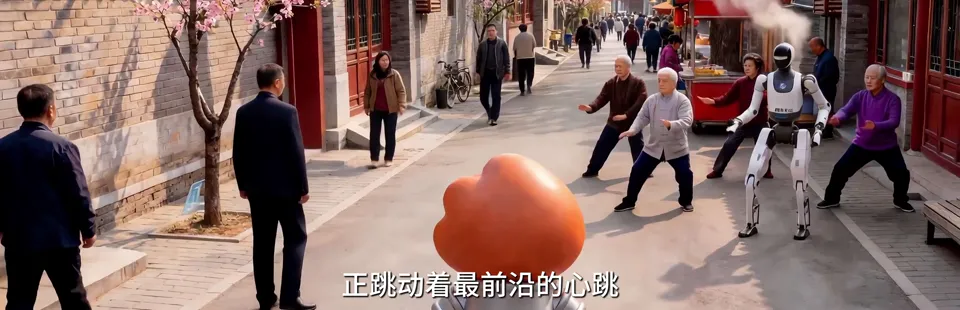
Sci-tech content easily turns into a gadget showcase. Here, elderly locals, a robot dog and a humanoid robot share a hutong of red walls and peach blossoms, so cutting-edge tech becomes a chance encounter in neighborhood life. Viewers first see how technology fits into city life, then move on to the invitation to create.
02
Follow the Guide Once and the Rules Make Sense
Dayanzai first observes and tries things out, then uses Smart Search and his phone, and finally posts. One character ties together the theme, finding inspiration and how to take part, and the product features answer the creator’s question of “what to film and how.”
03
The Interface Follows the Character’s Gaze
Search results and phone messages appear along the way, matching the city scene in front of him. In the final shots the camera pulls back from Dayanzai at the exhibition to a phone screen, then back to the character holding the phone indoors: the tech journey we just watched has become a work to watch and share. The phone goes from a tool for finding inspiration to the place where work gets posted, and the campaign mechanics are explained from start to finish.
03 / Scene Breakdown
Follow Dayanzai from the Hutong to Hitting Post.
Film · 00:00–00:09
Tech in a Spring Hutong
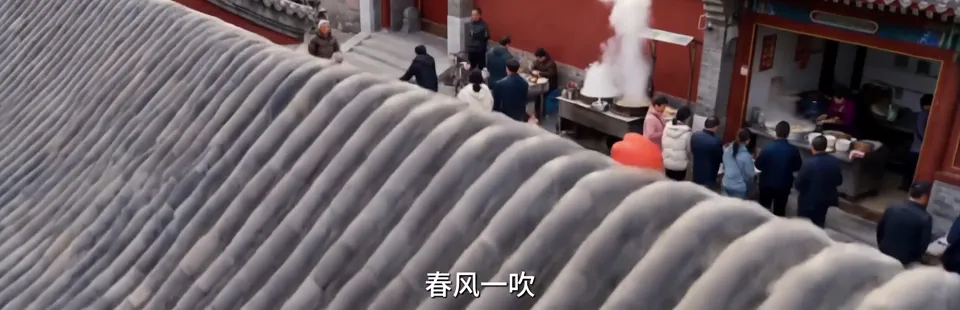
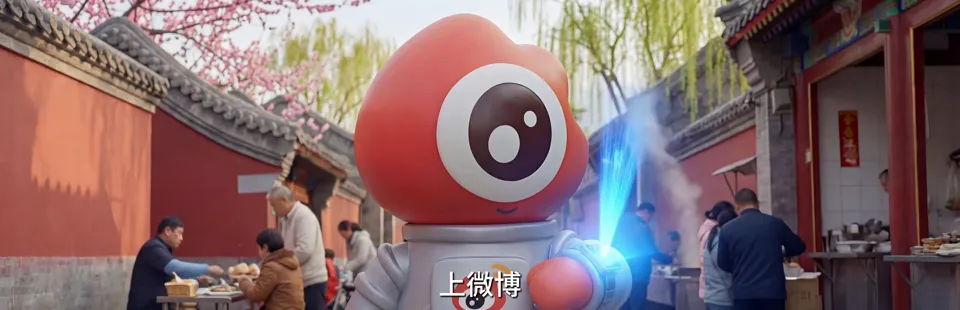
The camera tilts from gray-tiled eaves into a hutong in spring. Dayanzai walks past a breakfast stall, meets an old man walking a robot dog and neighbors doing tai chi with a robot, and finally raises his hand to project a map of Beijing, leading into “Join the Beijing Style Short Video Contest on Weibo.”
Clip · 00:00–00:03
From the eaves into the hutong
The camera tilts up from the gray-tiled eaves to reveal a steaming breakfast stall. Dayanzai walks into the crowd and comes face to face with an old man leading a robot dog.
Clip · 00:03–00:05
Old men doing tai chi with a robot
Over Dayanzai’s shoulder, several old men and a humanoid robot practice tai chi together under a peach tree.
Clip · 00:05–00:09
A map of Beijing projected from his wrist
Dayanzai raises his wrist and a blue map of Beijing unfolds before his eyes, with the caption “Join the ‘Beijing Style’ Short Video Contest.”
Film · 00:09–00:15
Into the Tech District
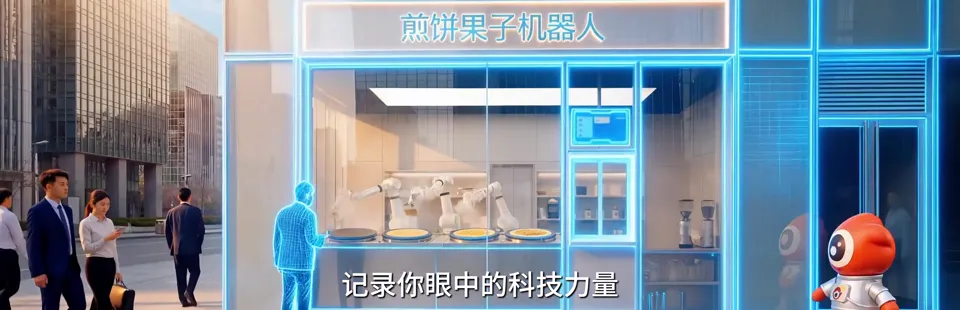
The map turns into a beam of blue light that carries Dayanzai into a modern district. A robot makes jianbing, drones deliver takeout, and a driverless delivery vehicle rolls past. Suddenly there is tech everywhere, and he is stumped: don’t know how to film it?
Clip · 00:09–00:12
A jianbing robot and drone delivery
The blue light clears to show a robotic arm making jianbing in a street-side shop. Then at an intersection outside a mall, drones carrying takeout hover overhead and a blue driverless delivery vehicle drives past.
Clip · 00:12–00:15
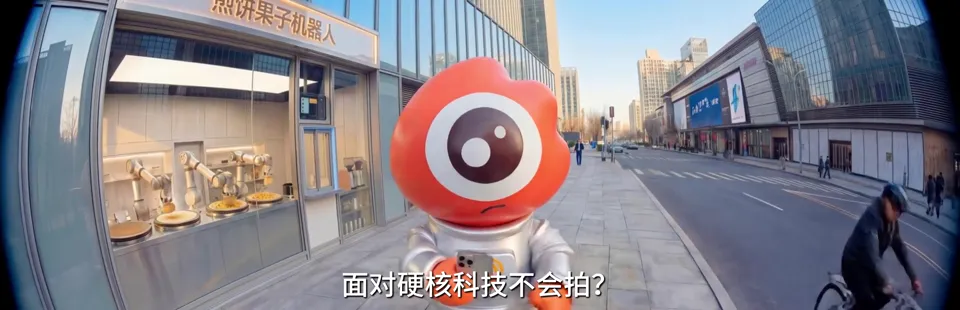
“Don’t know how to film?” through a fisheye lens
A fisheye lens moves in close on Dayanzai as he scratches his head, and big orange words, “Don’t know how to film?”, slam into the frame, putting the question straight to the audience.
Film · 00:15–00:26
Finding Inspiration with Smart Search
This part is the product demo for Weibo Smart Search. Dayanzai puts on glasses printed with “Weibo Smart Search” and looks at Beijing landmarks; names, sources and user comments pop up beside the buildings. In Zhongguancun and the tech exhibition hall, he looks things up as he films.
Clip · 00:15–00:17
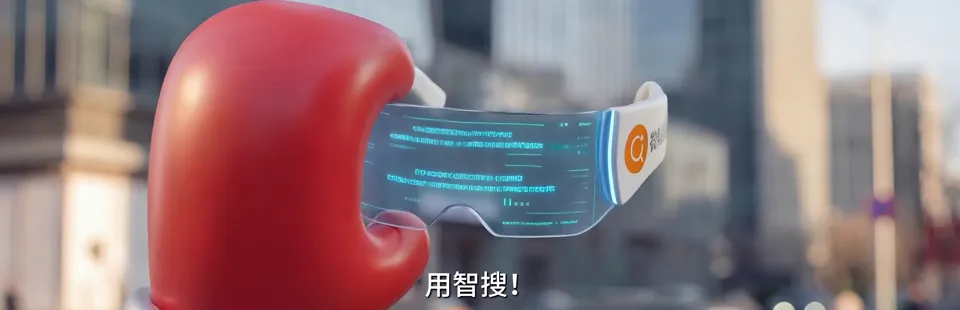
Putting on the Smart Search glasses
The camera pulls back from a close-up of the glasses as Dayanzai straightens a pair printed with “Weibo Smart Search,” and the caption calls out “Use Smart Search!”
Clip · 00:17–00:20
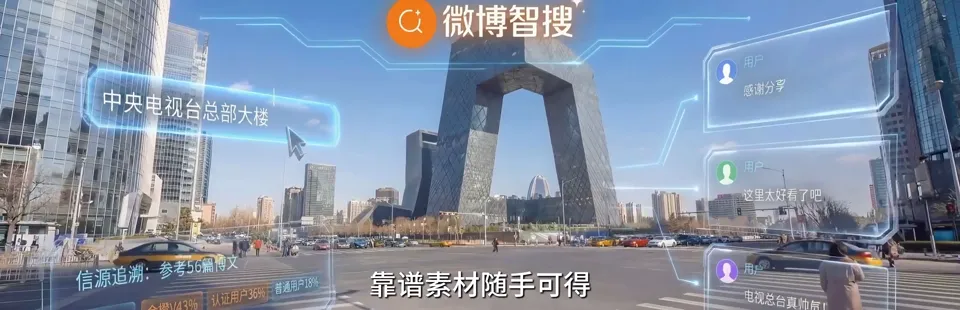
Beijing through the glasses
Cut to Dayanzai’s point of view: the CCTV Headquarters, the China Science and Technology Museum and the National Science and Technology Communication Center appear in turn, with place names, “source tracing” and user comments popping up beside them.
Clip · 00:20–00:23
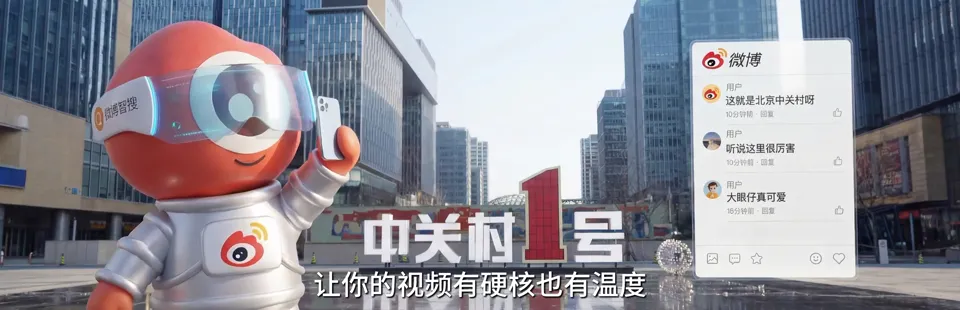
Filming in front of Zhongguancun No. 1
Dayanzai holds up his phone to film Zhongguancun No. 1, while comments like “So this is Beijing’s Zhongguancun!” and “Dayanzai is so cute” float in on the right.
Clip · 00:23–00:26
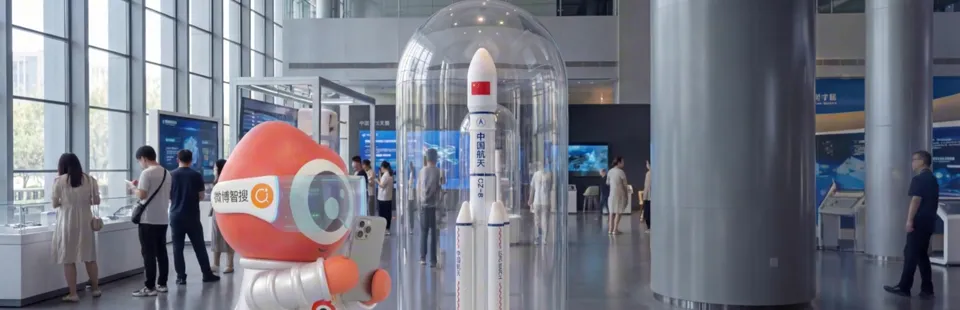
Looking things up by the rocket model
A Long March 8A rocket model stands in the exhibition hall, and the Smart Search panel tells Dayanzai the rocket’s story as the captions “Inspiration,” “Tips” and “What Resonates” appear one after another.
Film · 00:26–00:40
Experience the Tech, Then Post from Home
Dayanzai takes a selfie with a humanoid robot, picks up a delivery, rides in a driverless car and visits the “Beinao-1” brain-computer interface. The camera then pulls back from the exhibit to reveal a phone screen and returns to the living room: Dayanzai taps Post, and a string of hearts rises above his head.
Clip · 00:26–00:31
A selfie with a humanoid robot
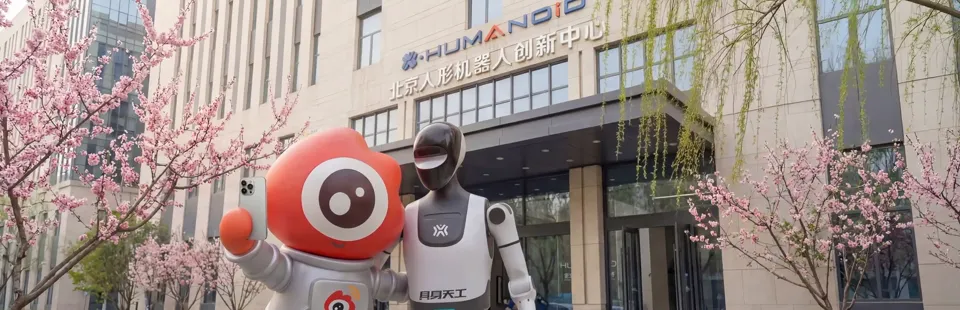
Outside the Beijing Humanoid Robot Innovation Center, with peach blossoms in bloom, Dayanzai raises his phone and leans in for a selfie with the Tien Kung robot.
Clip · 00:31–00:33
Picking up a delivery, riding a driverless car
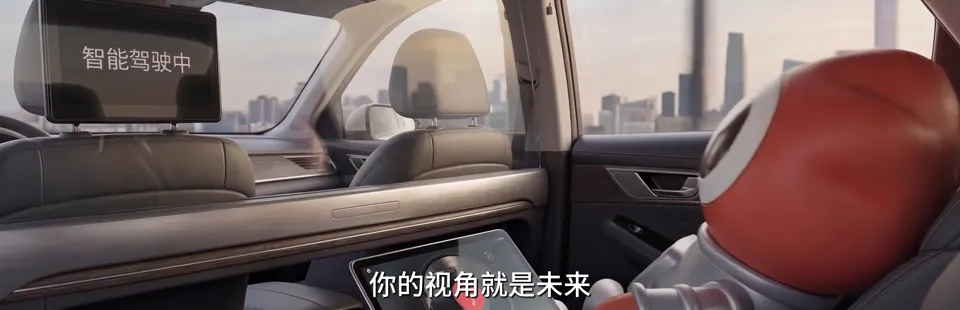
Dayanzai walks up to a smart drone-delivery locker, and in the next shot he is already seated in a driverless car, the headrest screen in front reading “Autonomous driving in progress.”
Clip · 00:33–00:38
Pulling back from Beinao-1 to the living room
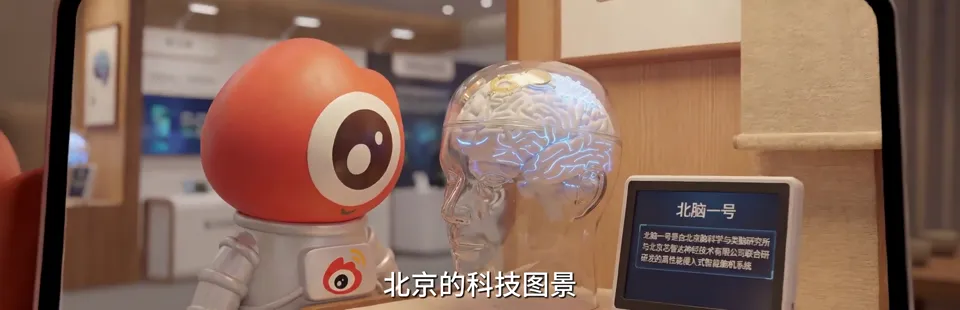
Dayanzai studies the “Beinao-1” exhibit as the camera pulls all the way back to reveal a phone screen: he is actually sitting at home watching the video he shot.
Clip · 00:38–00:40
Tapping Post
Holding his phone, Dayanzai taps Post, “Posted successfully” pops up on screen and a string of red hearts rises above his head, leading into the contest logo at the end.
04 / Storyboards & Final Frames
16 Shots, Each One to Final.
Shown in the order of the finished film: for each shot, what it shows, followed by the final frame used in the film. For the creative process and before-and-after comparisons, see “Case Study.”
01
Tech in the Hutong
In the film · 00:00–00:10
Shot 1.1
Tilting Up into the Hutong
Early spring, pink peach blossoms reaching over a red wall. A high-angle view of the hutong as Dayanzai walks among the crowd in front of the breakfast stall, the camera tilting up from the eaves into the scene.
Tilting Up into the Hutong · Final 1
Shot 1.2
The Old Man with the Robot Dog
Static shot. An old man walks in from the left leading a robot dog and waves hello to Dayanzai; the robot dog takes one step at a time, and people walk at a strolling pace.
The Old Man with the Robot Dog · Final 1
Shot 1.3
Old men doing tai chi with a robot
Over-the-shoulder shot. Following behind Dayanzai, we watch old men doing tai chi with a humanoid robot as passersby go about their day.
Old men doing tai chi with a robot · Final 1
Shot 1.4
A map of Beijing projected from his wrist
Dayanzai raises his arm and the device on his wrist projects a blue map of Beijing, matching the line “Join the Beijing Style Short Video Contest on Weibo.” Left: the opening frame; right: after the map unfolds.
A map of Beijing projected from his wrist · Final 1A map of Beijing projected from his wrist · Final 2
02
Into the Tech District
In the film · 00:10–00:15
Shot 2.1
The Jianbing Robot
The camera pushes into a real Beijing street: a robotic arm makes jianbing in a shop, and a curious Dayanzai walks in from off screen.
The Jianbing Robot · Final 1
Shot 2.2
Drones and Driverless Vehicles
At an intersection outside a mall, drones deliver takeout overhead and a blue driverless delivery vehicle drives past as Dayanzai picks up his phone, a little stumped.
Drones and Driverless Vehicles · Final 1
03
Finding Inspiration with Smart Search
In the film · 00:15–00:27
Shot 3.1
Putting on the Smart Search glasses
Static shot. Dayanzai puts on a pair of glowing glasses with the “Weibo Smart Search” logo on the temple, the jianbing robot shop behind him.
Putting on the Smart Search glasses · Final 1
Shot 3.2
Beijing Landmarks Through the Glasses
First-person view, cutting quickly past the CCTV Headquarters, the China Science and Technology Museum and the National Science and Technology Communication Center, with names, source tracing and user comments popping up beside the buildings. The frame is composed wider at 21:9 so the panels and comments sit fully inside the picture.
Beijing Landmarks Through the Glasses · Final 1Beijing Landmarks Through the Glasses · Final 2Beijing Landmarks Through the Glasses · Final 3
Shot 3.3
Filming in front of Zhongguancun No. 1
Wearing the glasses, Dayanzai raises his phone to film in front of Zhongguancun No. 1, with the Weibo comment section on the right.
Filming in front of Zhongguancun No. 1 · Final 1
Shot 3.4
Looking things up by the rocket model
The Long March 8A rocket model in the tech exhibition hall, as Dayanzai films while reading the introduction on the Smart Search panel.
Looking things up by the rocket model · Final 1
04
Experience the Tech, Then Post from Home
In the film · 00:27–00:40
Shot 4.1
A selfie with a humanoid robot
Selfie angle. Outside the Beijing Humanoid Robot Innovation Center, Dayanzai poses for a photo with the Tien Kung robot.
A selfie with a humanoid robot · Final 1
Shot 4.2
The Smart Drone-Delivery Locker
A drone delivers takeout to a locker outside an office building, and Dayanzai walks over with his phone to pick it up.
The Smart Drone-Delivery Locker · Final 1
Shot 4.3
Riding a Driverless Car
There is no driver in the car; the headrest screen reads “Autonomous driving in progress,” with Beijing’s high-rises outside the window.
Riding a Driverless Car · Final 1
Shot 4.4
Visiting Beinao-1
Dayanzai studies the exhibit for the “Beinao-1” brain-computer interface system, with a screen beside it describing the system.
Visiting Beinao-1 · Final 1
Shot 4.5
Pulling Out of the Phone
The camera pulls all the way back from the exhibit to reveal a phone screen: Dayanzai is sitting in the living room watching the video he shot.
Pulling Out of the Phone · Final 1
Shot 4.6
Tapping Post
Dayanzai taps Post, “Posted successfully” pops up on screen, and a string of hearts rises above his head.
Tapping Post · Final 1
05 / Script Excerpts
Beyond the picture.
Voice-over
With a breath of spring wind, beneath old Beijing’s timeless character beats the pulse of the cutting edge.Script
Voice-over
Your perspective is the future! Show us Beijing’s tech landscape through your lens!Script
06 / Results
Sci-Tech Innovation Category Promo
We delivered a 43-second promo for the Sci-Tech Innovation category at 4704×1512 (an ultra-wide format of about 3:1), introducing what to film for this category of the “Beijing Style” Short Video Contest and how to enter, and demonstrating how to use Weibo Smart Search to find material and inspiration.
Case Study
Liandan AI Studio × Weibo | A Tour of Beijing’s Tech with Dayanzai, Then a Lesson in How to Film It
In a hutong, an old man takes a robot dog for a walk. In a corner shop, a robotic arm is making jianbing.
This is the 43-second promo we made for the Sci-Tech Innovation category of Weibo’s “Beijing Style” Short Video Contest.
The star is Weibo’s IP character Dayanzai. He sets out from a hutong in spring, passes through Zhongguancun, tours a tech exhibition hall, takes a selfie with a humanoid robot, and finally goes home to post everything he filmed along the way to Weibo.
The film had to make two things clear: what tech there is to film in Beijing, and where people who don’t know how to film should start.
Client
Weibo (“Beijing Style” Short Video Contest)
Project Type
Contest Category Promo · Platform How-To Video
Timeline
March 2026
Runtime & Specs
43 sec · 4704×1512 ultra-wide (about 3:1)
Purpose
Introduces the Sci-Tech Innovation category’s theme and how to enter, and demonstrates using Weibo Smart Search to find material and inspiration
Produced by
Shenzhen Alchemy Technology Co., Ltd. (Liandan AI Studio)
01
One Category Promo, Two Questions: “What to Film” and “How to Film It”
Sci-Tech Innovation is one category of the “Beijing Style” Short Video Contest, inviting stories about technology in Beijing.
Weibo gave us five lines of copy, running from “With a breath of spring wind, beneath old Beijing’s timeless character beats the pulse of the cutting edge” to “Your perspective is the future.” In between was a very direct product line: “Don’t know how to film? Use Smart Search!”
On one side was technology in the city; on the other, the platform’s search feature. Told separately, they would become a scenic film plus a feature explainer.
Our solution was to have Dayanzai walk both stories as a single route: first he runs into technology in the hutong, then goes on to the district and the exhibition hall; when he hits “don’t know how to film,” he puts on the Smart Search glasses for inspiration; finally he goes home and posts what he filmed. The five lines of copy map exactly onto the five stops along this route.
The copy was then broken down into 16 shots, each specifying the camera move, what happens in the frame and which line it matches.
Final opening frame: peach blossoms reach over a red wall as Dayanzai walks up to a breakfast stall in the hutong
02
Put the Tech in the Hutong Before Putting It on Display
Sci-tech subjects are easy to film as rows of gadget close-ups.
We set the first stop in an old Beijing hutong: red walls, peach blossoms and a steaming breakfast stall. Then we let the technology blend in: the old man is walking a robot dog, and the one doing tai chi with the old men is a humanoid robot.
The hard part of these shots is making them look real. The storyboard spelled out several requirements: the robot dog must walk into frame step by step, not glide; people walk at a strolling pace; when Dayanzai waves hello, the old man looks at him and smiles with a nod; passersby must not appear or vanish out of nowhere.
The old man walking a robot dog meets DayanzaiOver Dayanzai’s shoulder, the old men doing tai chi with a robot
What viewers see first is familiar neighborhood life, with technology as just one new face in it. That sticks in the memory more easily than introducing the devices directly.
03
All the Tech in the Film Really Exists in Beijing
Weibo wanted the technology in the film to be things that genuinely exist in Beijing, not a future city invented from scratch.
Before production, we compiled research: the tech parks of Beijing’s “three science cities and one zone,” the Tien Kung humanoid robot, driverless delivery vehicles, robot coffee and jianbing shops, and landmarks such as the CCTV Headquarters, the China Science and Technology Museum, the National Science and Technology Communication Center and Zhongguancun No. 1.
What made it into the final film: a jianbing-making robot, drones flying with takeout, driverless delivery vehicles on the street, the Long March 8A rocket model in the exhibition hall, the Tien Kung robot outside the Beijing Humanoid Robot Innovation Center, a driverless car showing “Autonomous driving in progress,” and the “Beinao-1” brain-computer interface system.
Clip · 00:26–00:31
A selfie with the Tien Kung robot
Outside the Beijing Humanoid Robot Innovation Center, Dayanzai raises his phone for a photo with the robot.
The visuals are AI-generated, but the locations and products are all based on real photos. Viewers can recognize these places and know where to go to film.
04
“Don’t Know How to Film?”: Letting Smart Search Catch That Line
Midway through, Dayanzai stands at an intersection as big orange words slam down in a fisheye shot: “Don’t know how to film?”
This is the turning point of the whole film. The first half covers what there is to film in Beijing; the second half covers how to film it.
We gave Dayanzai a pair of glasses printed with “Weibo Smart Search.” Once he puts them on, the shot switches to his point of view: as he looks at the CCTV Headquarters, the China Science and Technology Museum and the National Science and Technology Communication Center, name tags pop up beside the buildings, along with source notes like “Source tracing: based on 23 posts” and user comments.
Clip · 00:17–00:20
Beijing through the glasses
First-person view, with names, sources and comments popping up beside the landmarks.
The copy line “Reliable material at your fingertips, insight from the liveliest discussions” needs no explanation; viewers get it at a glance.
We checked the small interface text shot by shot and regenerated any image where the text was distorted; we also removed brand logos from the phones in the frame, keeping only Weibo’s own elements.
05
Recomposing for a 3:1 Ultra-Wide Frame
The film was delivered at 4704×1512, an aspect ratio of about 3:1, more than 70% wider than the common 16:9 landscape format.
Composing at 16:9 and simply cropping to 3:1 would cut away a large chunk at the top and bottom: the top of Dayanzai’s head and his hands, as well as the interface panels and text, could all be cropped out of frame.
So we widened the key shots to 21:9, regenerated the images and the video, then cropped to 3:1. Every shot was checked: Dayanzai had to be fully in frame, the Smart Search panels and comments had to stay intact within the picture, and the extra space on the left and right was filled with streets and buildings.
16:9 version: standard landscape compositionVersion widened to 21:9 (shown at the same width): a flatter frame with extra streets and buildings on the left and right, and the panels fully in view
The wide format has its own advantage: a single frame can hold the character, the landmark and the information panel at once, and the viewer’s eye sweeps from left to right as if turning their head on the street.
06
What this project achieved
In 43 seconds, one character covers everything a contest category needs to say: what the theme is, where to film, what to do if you don’t know how, and where to post when you’re done.
At the end, the camera pulls back from Dayanzai at the “Beinao-1” exhibit to reveal a phone screen, then back into the living room: the whole journey was Dayanzai watching the video he shot on his phone. He taps Post, and a string of hearts rises above his head.
Clip · 00:33–00:40
Pulling back from the exhibit to the living room and tapping Post
The camera pulls back from Beinao-1 to the phone, Dayanzai taps Post and hearts rise up.
For the platform, the search feature is no longer a standalone demo but a tool the story naturally calls for. For viewers, it’s clear what to do next once the film ends: go out, film Beijing’s tech the way you see it, and post it on Weibo.
FAQ
FAQ
In an AI promo, how do you keep a brand’s IP character looking the same in every shot?
Weibo provided a three-view turnaround of Dayanzai. We used these references for every shot we generated, plus the first approved hutong frame as a style reference, so the orange-red head, silver-white spacesuit and Weibo logo on the chest stay consistent throughout. When generating video, we also spelled out the action and eyeline in the prompt to keep the character from drifting off-model as he moves.
Can AI video handle an ultra-wide size like 4704×1512?
Yes. This film is 4704×1512 (about 3:1). We generated images and video for the key shots at 21:9, then cropped to 3:1, checking every shot to make sure the character was complete and no interface text was cut off, with the extra space on the left and right filled with real street scenes.
Are the locations and tech products in the film real?
Yes. The visuals are AI-generated, but they are all based on real places and products in Beijing: the CCTV Headquarters, the China Science and Technology Museum, the National Science and Technology Communication Center, Zhongguancun No. 1, the Tien Kung robot at the Beijing Humanoid Robot Innovation Center, the Long March 8A rocket model, the “Beinao-1” brain-computer interface system and more. We compiled research first, then generated images based on photos.
How long did a category promo like this take from kickoff to delivery?
The production document was set up in mid-March 2026, a complete 43-second first cut was ready in about three days, and after adapting it to the ultra-wide format, the final version was delivered in a little over a week.
Approach
Connecting the Character, the City and the Product Interface
In production, we first matched each line of campaign copy to a character action, then broke the film into segments: encounters in the hutong, the tech experience, the Smart Search interface and the posting finale. The storyboard specified strolling speed, a robot dog walking naturally and characters making eye contact, so the tech devices show up in everyday neighborhood life and the movements look believable. The wrist map, the AR glasses and the phone serve, respectively, to enter the district, find inspiration and share the work.
The final film keeps Dayanzai’s orange-red look and tech gear, so he is recognizable at a glance. To fit the 3:1 ultra-wide frame, key shots were generated as images and video at 21:9 and then cropped, with every shot checked to make sure Dayanzai was fully in frame and the text on the search interface and tech devices was legible. Finally, pulling back from the exhibit to the phone turns the earlier experience into a work to create and share.