Lychee red and the texture of its skin reshape Longgang's landmarks, giving the summer city a vivid fruity memory.
Project Type
City & Tourism
Client
Longgang city daily publicity (contributed content)
Year
2025
Our role
AI city-landmark creative short
Original format
1912 × 1080 · 00:22
Film00:22 · Film
01 / Background
How can the texture of a lychee become the theme of a whole city?
“Lychee Longgang” is a fruit-themed short in Longgang's everyday city creative series. Several landmarks had to share the same lychee texture; the challenge was making the fruit features obvious enough while keeping the outlines, roofs and entrances that make each place recognizable. So in production, the shared style description and each building's own features were written separately.
With lychee red, bumpy skin and green hills, the film links the plaza, the twin towers, the venues and the universities, changing location constantly in a very short time. Lychees and leafy branches in the foreground handle the transitions, place names help viewers recognize each spot, the fruit theme reads at a glance, and the city tour flows from start to finish.
02 / Creative Highlights
One shared opening, with each landmark's character intact.
01
Set one shared style starting point first
If every landmark got its own style, a set of images could easily turn into separate worlds. In production, we first wrote a shared description of a “lychee city,” then added each place's own features, such as a sculpture, a stadium or a campus; wording like “sculpture” bound fruit and building more tightly together. The shared colors and materials appear in the frame alongside what makes each building different, so the series has one look from the very start.
02
The skin covers everything, and building details stay
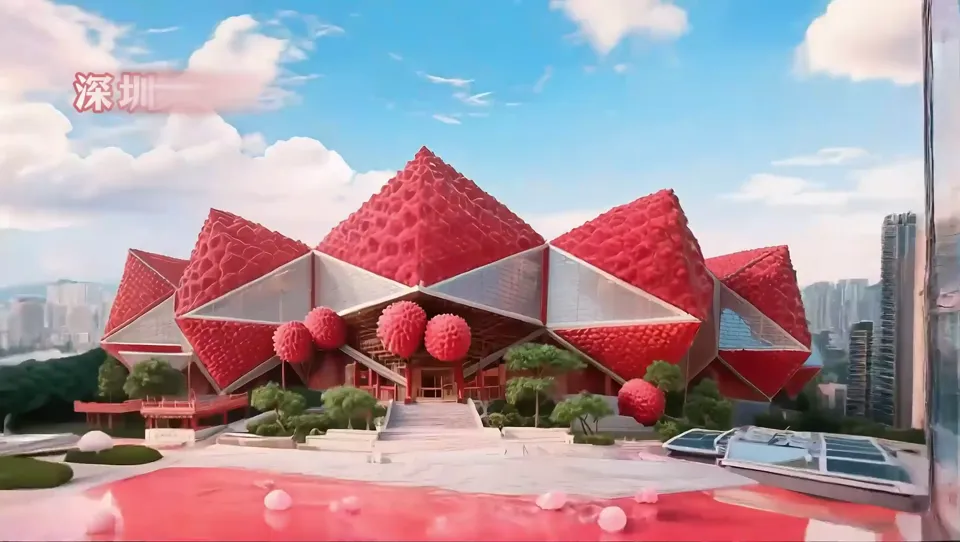
If you just pile a few lychees beside a building, fruit and building tell separate stories. So we let the building itself grow lychee skin, referencing its edges to keep the original structure. In the final film, the surfaces of Huawei headquarters and the twin towers are one continuous lychee skin, while the Universiade Center keeps its white geometric frame and red faceted panels: a bold theme, with the building's structure intact.
03
Color and place names help viewers get it fast
A string of landmarks needs a brisk rhythm, and viewers need to know where they are. The film is cut to a tight 22 seconds. The red lychee texture runs through every image, and place names use consistent wording in a fixed top-left position, so however fast it moves, no one gets lost.
04
Fruit as foreground and transition
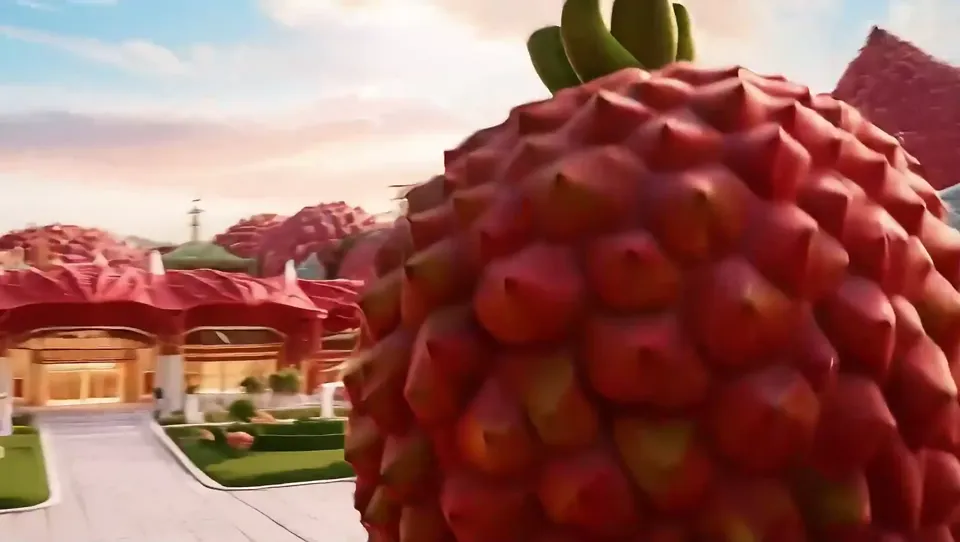
In front of the Universiade Center, a giant lychee moves close to the lens and pulls away to reveal the International Velodrome; then a fruit-laden branch sweeps past, leading into the park buildings. The fruit isn't just decoration; it blocks the lens and then reveals the next place, so the fruit itself makes the transition and every switch keeps telling the same theme.
03 / Scene Breakdown
Nine landmarks, 22 seconds, red all the way.
Film · 00:00–00:06
From Longcheng Square to the Galaxy Twin Towers
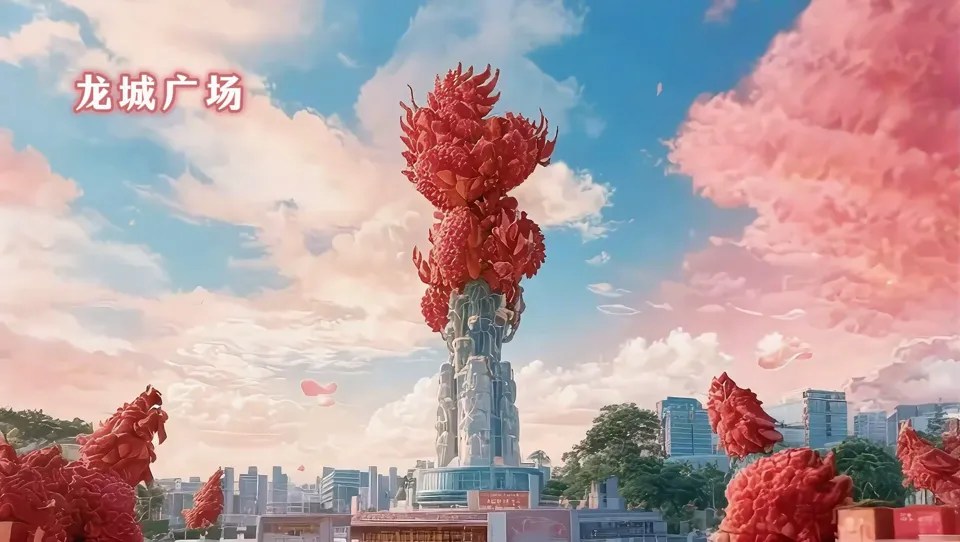
The film opens on the dragon sculpture at Longcheng Square, the dragon and the stone beasts around its base all wrapped in lychee skin; the camera moves right, Huawei's Shenzhen headquarters becomes one square block of lychee, and a piece of skin brushes past up close to switch to the Galaxy Twin Towers.
Clip · 00:00–00:03
Beside the dragon, a lychee building slides in
The Longcheng Square dragon stands in the center of the frame; as the camera moves, Huawei headquarters slides in from the left, its entire facade covered in lychee bumps and the trees out front turned into lychee balls.
Clip · 00:03–00:06
Skin brushes the lens, and the twin towers rise
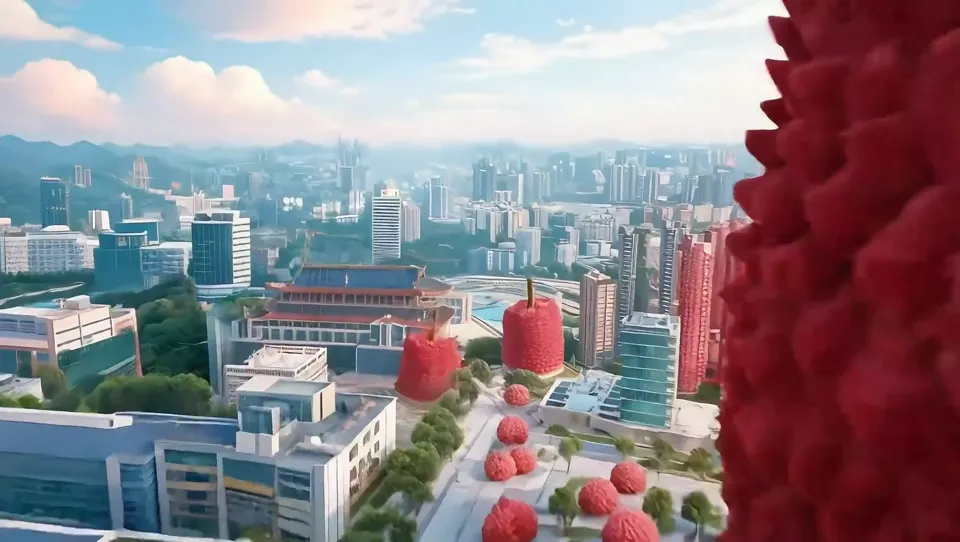
A large piece of lychee skin brushes past the lens, blocks the frame and moves aside: the Galaxy Twin Towers are now two long red lychee columns, and the surrounding residential towers have a red tint too.
Film · 00:06–00:11
From the Universiade Center to the International Velodrome
The Universiade Center keeps its silver triangular frame, with only the faceted panels covered in lychee skin; a giant lychee rolls past the lens to reveal the velodrome, then a leafy lychee branch sweeps across the frame.
Clip · 00:06–00:09
Universiade Center: the frame stays, the panels get a new skin
The Universiade Center's faceted roof is instantly recognizable: the silver triangular frame is untouched, every peak is covered in lychee skin, and the water in front is tinted pink.
Clip · 00:09–00:11
A lychee blocks the lens, switching to the velodrome
A lychee up close fills the frame and moves away, the lychee with its stem and leaves revealing the velodrome behind; then a lychee branch sweeps through the foreground, ready for the next place.
Film · 00:11–00:17
From Longtan Park to Shenzhen MSU-BIT University
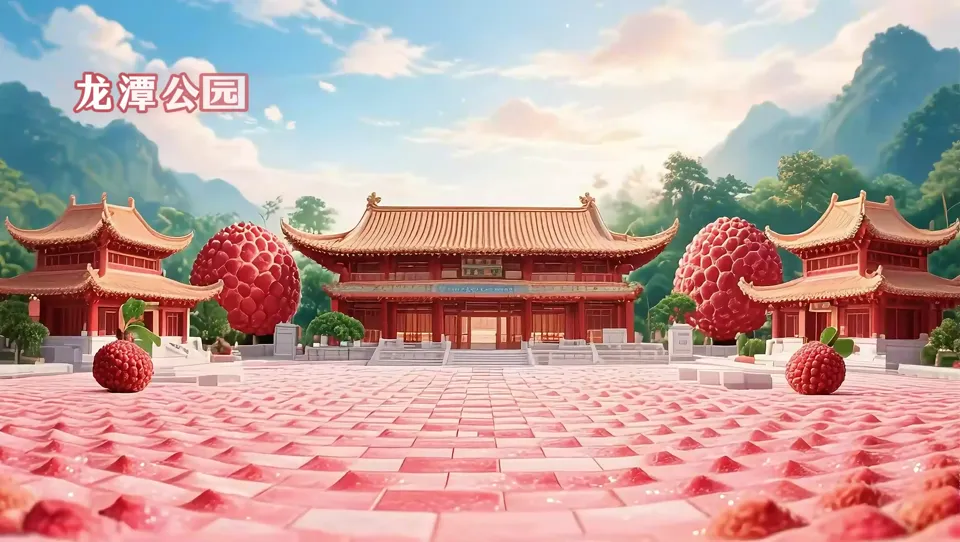
Among the classical halls of Longtan Park, the ground is tiled in a grid of lychee pattern, with a few lychees lying on the plaza; the camera rises over the roofs and leads to the spired main building of MSU-BIT University.
Clip · 00:11–00:14
Lychee pattern covers the park plaza
The golden-roofed halls keep their original look, while the large plaza in front is paved with pink lychee-pattern tiles, flanked by trees shaped like lychee balls.
Clip · 00:14–00:17
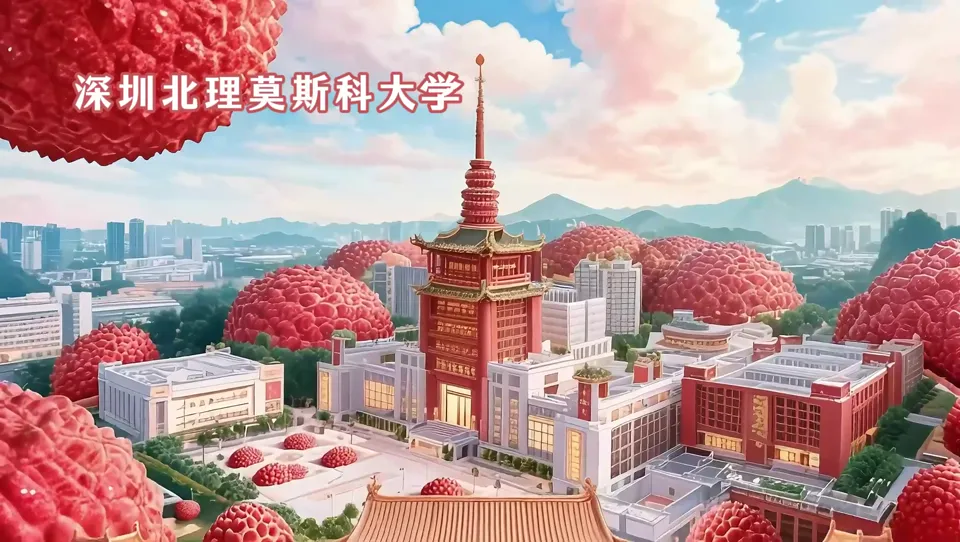
Over the roofs to the campus main building
The camera rises above the park roofs, the spired main building of MSU-BIT University appears in the center, the campus is ringed by lychee trees, and a lychee floats in the sky.
Film · 00:17–00:22
From CUHK-Shenzhen to the Longgang Energy Eco-Park
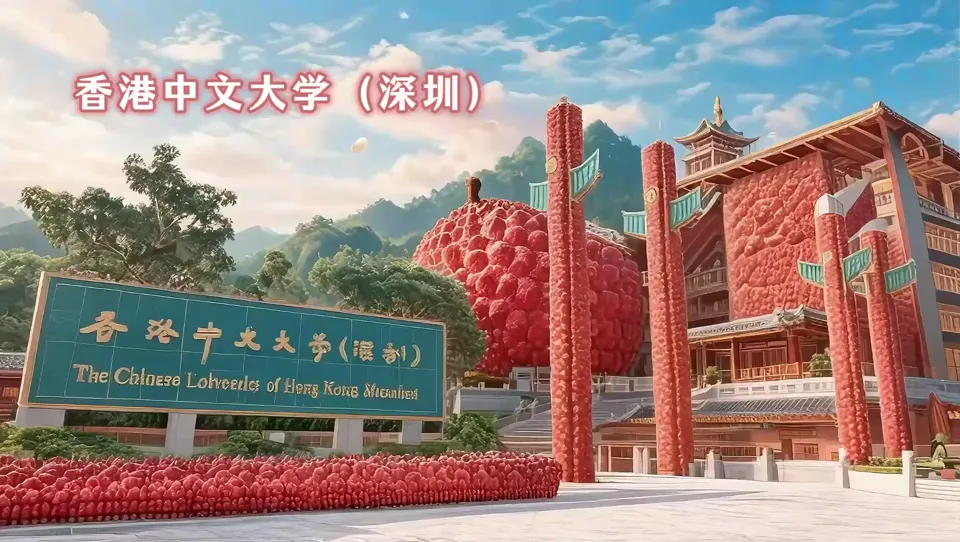
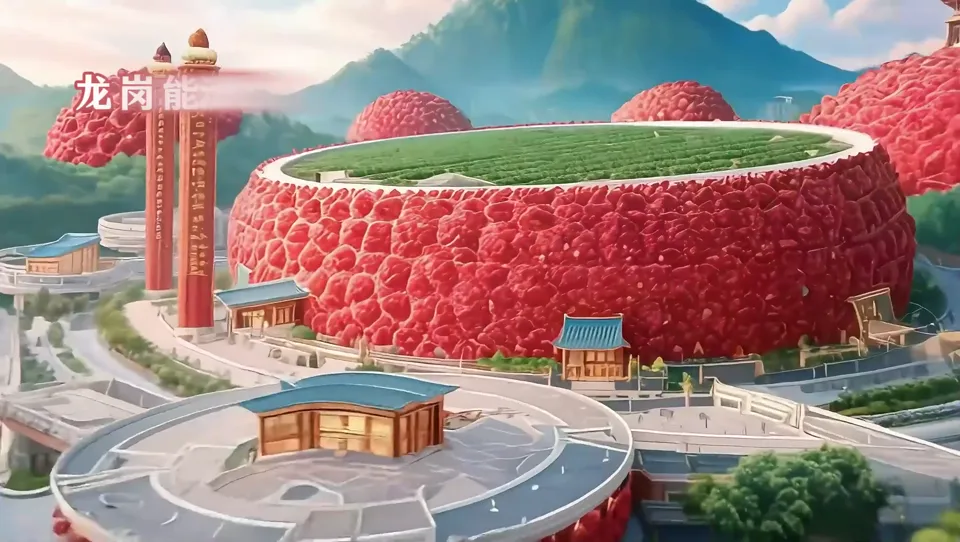
The name sign and pillars of The Chinese University of Hong Kong, Shenzhen are still there, with lychee skin growing on the pillars; the film ends at the energy eco-park, its ring-shaped main building wrapped all the way around in lychee and topped by a green roof.
Clip · 00:17–00:20
The name sign stays, the pillars grow skin
CUHK-Shenzhen's blue-green name sign is kept as is, while the nearby pillars and teaching building walls grow lychee skin, and a lychee bigger than the buildings stands behind them.
Clip · 00:20–00:22
Ending on the ring-shaped eco-park
The camera sweeps past a lychee wall and rises: the ring-shaped main building of the energy eco-park is lychee all the way around, the small round building and two chimneys in front turn red too, and the film ends here.
04 / Storyboards & Final Frames
Nine landmarks, every final frame.
In the order they appear in the film. Each shot describes how the landmark looks in the film, paired with the final image used in the cut.
01
The plaza, the HQ and the twin towers
In the film · 00:00–00:06
Shot 1.1
Longcheng Square
The top of the dragon sculpture is wrapped in lychee skin, the gray-white stone pillar base is left below, and the surrounding stone beasts turn red; it's clearly the dragon sculpture on the plaza.
Longcheng Square · Final 1
Shot 1.2
Huawei Shenzhen Headquarters
The whole building grows a layer of lychee skin while keeping its square shape, and the trees out front become lychee balls.
Huawei Shenzhen Headquarters · Final 1
Shot 1.3
Galaxy Twin Towers
Both towers are wrapped top to bottom in lychee skin, each crowned with a stem; the surrounding residential towers carry a touch of red, blending with the twin towers.
Galaxy Twin Towers · Final 1
02
Venues and the park
In the film · 00:06–00:14
Shot 2.1
Shenzhen Universiade Center
The silver triangular frame is kept as is, with only each peak covered in lychee skin, and the water in front tinted pink.
Shenzhen Universiade Center · Final 1
Shot 2.2
International Velodrome
The ring roof becomes a band of lychee skin, the hills behind are covered with lychee trees, and the distant power pylons stay where they were.
International Velodrome · Final 1
Shot 2.3
Longtan Park
The golden-roofed halls keep their original look, the ground in front is paved with lychee-pattern tiles, and a few lychees lie on the plaza, blending with the halls behind.
Longtan Park · Final 1
03
The campuses and the eco-park
In the film · 00:14–00:22
Shot 3.1
Shenzhen MSU-BIT University
The spired main building keeps its original tiered tower, the campus is ringed with lychee trees, and a few floating lychees are added to the sky.
Shenzhen MSU-BIT University · Final 1
Shot 3.2
The Chinese University of Hong Kong, Shenzhen
The blue-green name sign is kept as is, while the pillars and teaching building walls grow lychee skin; it's instantly recognizable as the CUHK-Shenzhen gate.
The Chinese University of Hong Kong, Shenzhen · Final 1
Shot 3.3
Longgang Energy Eco-Park
The ring-shaped main building is wrapped all the way around in a lychee facade, the green roof on top is kept, and the small round building and chimneys in front turn red too.
Longgang Energy Eco-Park · Final 1
05 / Results
22 seconds, nine landmarks in lychee skin.
This 22-second lychee-themed city short was completed in June 2025 and published on WeChat Channels. Nine landmarks are linked by the same lychee texture, each building still recognizable; the same method was later used for the watermelon and ice cream films.
Case Study
June in Longgang: nine landmarks grow lychee skin
June is lychee season.
This 22-second short gives nine Longgang landmarks lychee skin, one after another: the dragon sculpture at Longcheng Square, Huawei's Shenzhen headquarters, the Galaxy Twin Towers, the Universiade Center, all the way to the Longgang Energy Eco-Park.
The buildings keep their shapes, but their surfaces are all lychee bumps; place names sit in the top-left corner, so however fast it moves, you know where you are.
Client
Longgang everyday city content (supplied for Longgang's everyday publicity; no presenter credited in the film)
Project Type
AI city creative short (fruit theme), the first in Longgang's everyday fruit series, followed by the watermelon and ice cream films
Timeline
June 2025 (finalized June 25)
Runtime & Specs
22 s · 16:9 landscape · 1912×1080
Deliverables
Landscape film with place-name captions and music
Distribution
WeChat Channels
Produced by
Shenzhen Alchemy Technology Co., Ltd. (Liandan AI Studio)
01
Nine images made separately: how do they still look like one city?
The nine landmarks are all different: a sculpture, office towers, a stadium, campuses. If each image started from its own style description, you could easily end up with nine unrelated worlds, and the seams would show as soon as they were cut into a video.
We first wrote an opening shared by all the landmarks: an aerial view of a city sculpture carved from lychees, its buildings dressed in red lychee shells, with green hills dotted with lychee red in the distance. Then we added each landmark's own features, such as a stadium, a campus or a tower.
The word “sculpture” in that opening was key: the AI reads the whole building as carved from lychee, rather than a building with a few fruits placed beside it, and the lychee instantly carries much more weight in the frame.
Longcheng Square · FinalGalaxy Twin Towers · FinalLonggang Energy Eco-Park · Final
02
The lychee skin has to grow on the building, and the building still has to look like itself
In the first round of images, some landmarks just had a ring of lychees piled in front, while the building itself kept its original glass curtain wall; fruit and building told separate stories. We changed the brief to “the building itself grows lychee skin,” and parts that didn't convert were repaired locally.
Huawei Shenzhen Headquarters · First version: lychees piled in front of the buildingHuawei Shenzhen Headquarters · Final: the whole building grows lychee skin
The ground got the same treatment. In front of the hall at Longtan Park, there was at first just a lawn, with lychees scattered on the grass; in the final, the whole plaza is paved with lychee-pattern tiles, so the halls, the ground and the lychees become one.
Longtan Park · First version: still a lawn in front of the hallLongtan Park · Final: the plaza paved with lychee-pattern tiles
While changing the skin, the building also had to stay recognizable. Generation referenced the building edges in the original photos, so the Universiade Center's silver triangular frame, MSU-BIT University's spired main building and CUHK-Shenzhen's blue-green name sign all remained, with only the surfaces replaced. The same went for the Longcheng Square dragon: the first version was red from head to toe, while the final leaves a section of gray-white stone pillar base, looking more like the real sculpture on the plaza.
The Chinese University of Hong Kong, Shenzhen · First version: the name sign changedThe Chinese University of Hong Kong, Shenzhen · Final: the name sign close to the original
03
Lychees block the lens: nine places in one go
Nine places in 22 seconds is just over two seconds each. Hard cuts could make viewers dizzy, so we let the lychees handle the transitions: a piece of skin brushes past the lens up close, or a lychee rolls up and blocks the frame, and when it moves aside, we're at the next stop.
Clip · 00:09–00:11
A lychee blocks the lens, switching to the velodrome
After the Universiade Center, a leafy lychee fills the frame; when it moves away, the International Velodrome is already behind it.
In the edit, place names were unified into one fixed naming style, all in the top-left corner and left-aligned; the overall pace was tightened from about 25 seconds down to 22. Adjacent clips were joined from the last frame of one to the first frame of the next, and each join was checked for color shifts and jumps; captions use a commercially licensed font.
04
What this project achieved
For city publicity, this is a fast way to produce seasonal content: the landmarks are familiar, and a new skin of seasonal fruit makes them feel fresh without people failing to recognize their own city.
This “shared opening + individual features” approach was later used directly for the watermelon and ice cream films in the same series. For people learning AI video, it solves a common problem: how to keep a set of images in one consistent style, so the seams don't show once they're cut into a video.
FAQ
FAQ
When AI turns buildings into fruit textures, how do you make sure they're still recognizable?
Generation follows the edge lines of the building's original photo, changing only the surface material, never the outline. In Lychee Longgang, the Universiade Center's triangular frame, MSU-BIT University's spired main building and CUHK-Shenzhen's name sign were all kept, and every landmark is labeled with its place name in the top-left corner.
How do you keep a set of AI images in one consistent style?
First write a style description shared by every image (viewpoint, material, tone, background), then add each image's own architectural features. All nine landmarks in Lychee Longgang were generated from the same opening, so once cut into a video, they look like one “lychee city.”
Can city landmark creative shorts be made into a series?
Yes. Lychee Longgang was the first, made in June 2025; in July the same method produced Watermelon Longgang and Ice Cream Longgang. The landmarks stay the same while each film swaps in a different summer fruit or dessert, which suits ongoing seasonal updates to city content.
Approach
Unify the generation style first, then make local fixes.
Stills were restyled from the original photos with Duiyou, using a shared style description plus each landmark's features and referencing the building edges in the original to keep each building's form; spots that didn't take on the lychee texture or where the perspective didn't line up were repaired locally. Motion was generated by AI, and the transitions between shots and the pacing in post complete the city tour.
The film first passes the plaza, corporate buildings and twin towers, then moves on to venues, the park and campuses. Wide shots of whole buildings make them recognizable, while the skin and foreground fruit provide close-up detail; in post, place names were unified and text positions fixed, with each landmark on screen for just over two seconds, so material, motion and text each do their own job.