| Aspect | AI production | Live action | 3D animation |
|---|---|---|---|
| Best for | Imagined scenes, history and the future, visuals across places and seasons; holiday greetings, city promos, music videos and animated dramas | Real people, interviews and speeches, event coverage, anything that must be recorded as it happened | Product structure and how-it-works breakdowns, models that need exact dimensions and repeated use |
| On-site work | Not needed; photos, drawings and documents are enough to start | Required; venues, people, weather and schedules must line up | Not needed; models are built from drawings and data |
| Making changes | Only the changed shots are redone; changing the lead or core product touches many shots | Small changes happen in the edit; new shots mean another shoot | Once modeled, angles and materials are easy to change; structural changes go back to modeling |
| People and products | Kept consistent through character and location assets; exact UI and small text come from real screenshots or post-production | Real people and real objects, the most authentic | The most precise dimensions and structure |
| Visual style | Realistic, Chinese painting, paper-cut, felt, miniature or steampunk | Mainly real-world texture | Realistic or stylized rendering |
| Turnaround | About two weeks for 1–2 minutes; samples as soon as the same day; rush production available, timeline and price agreed case by case | Depends on shoot preparation and post-production | Depends on the amount of modeling and rendering |
| When to combine | Adds scenes live action can't capture, and settings and atmosphere around 3D models | Live action as the core, with AI filling shots and backgrounds that can't be filmed | 3D for the exact product and structure, AI for the surrounding scenes |
| How we work | In-house: script, AI images, AI video, editing, AI voiceover and music | Shot by a subcontractor, or we use footage you already have | Handled by long-term subcontracting partners, listed to you at cost |
What AI production suits today
AI production suits three kinds of content best: what is hard to film, such as myth, history, the future and fantasy; what spans many places and seasons, such as a solar-term episode with both a frozen northern river and southern terraces; and what leaves no time to organize a shoot, such as a booth film requested three days before a trade show.
When live action is the better fit
When real people say real things, such as leadership speeches, veteran interviews or customer testimonials, live action is the better fit and more convincing; the same goes for event coverage and anything that must be recorded as it happened. Your own crew can shoot that footage, or we can bring in a partner crew as a subcontractor, and we cut the AI segments together with it.
When 3D animation is the better fit
When a product's structure must be exact down to each part, its inner workings need an exploded demonstration, or one model will be reused across many films, 3D animation is more reliable. When a project needs 3D rendering, we use long-term subcontracting partners and pass their fees on at cost with no margin; if you already have 3D assets, we can use them directly.
Ways to combine them
Each of these combinations appears in our cases:
- Live-action program plus AI: CCTV's “Exploring China Through Idioms” used AI composited with live action and big-screen virtual backdrops for filming
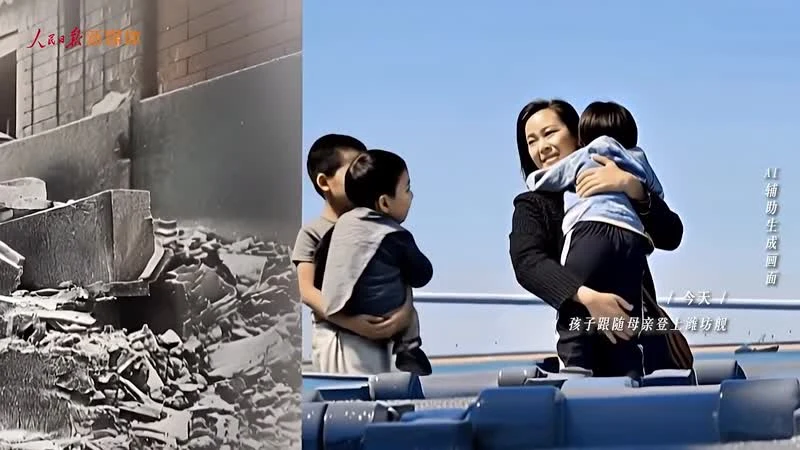
- An AI segment inside a live-action film: for the People's Daily memorial film, we didn't do the filming or interviews, only an effects segment of about 11 seconds
- Client footage plus AI visuals: some company buildings and aerial shots in the Haidian District promo came from the client
- Live-action compositing: the Chengdu Tianfu Twin Towers project added a version with pandas composited onto real footage of the towers
- Motion graphics plus AI backgrounds: BGI Genpilot used After Effects for UI and text, with AI only for animated backgrounds