The question of AI identity is placed inside a long companionship: the sci-fi world of “Family Member No. 6” revolves around losing a family member and getting to know them again.
Project Type
IP & Short Drama
Client
Self-initiated · AI short film competition entry
Year
2026
Our role
Original script, art design, end-to-end AI production
Original format
3840 × 2160 · 05:38
Preview
Click an image to view it full size
AI Future World: Family Member No. 6Film keyframe · click to enlarge ↗Film05:38 · Video
01 / Background
Can a Consciousness Formed Through Companionship Become Family?
“Family Member No. 6” is an original sci-fi family short that grew out of the idea behind our earlier “My Robot Parents.” Through one specific family relationship, it lets viewers decide for themselves whether an AI can count as family: when a robot holds the data of deceased parents and, over eight years of companionship, learns to make its own choices, is it still a copy, or a new member of the family?
The story is set in 2078. No. 6, the robot that teenage Xiaoyu keeps repairing, is her companion in daily life and also carries the personality models of her father and mother. The script pits a fictional rule, “one body, one personality,” against Xiaoyu’s attachment, and a manhunt from outside forces her to face a question she has always avoided: did the love that raised her come from her parents’ records, or from No. 6 itself?
So the art direction and camerawork follow rules built around this relationship. No. 6 is always the same rounded companion robot; blue, yellow and white stand for the father, the mother and its own consciousness. The repair workshop, the rainy-night chase and the character close-ups each carry a different level of tension, and whenever the light changes, viewers can see a personality switch that would otherwise be invisible.
02 / Creative Highlights
How the Sci-Fi Premise Comes Down to the Characters
01
One body, three personality light colors
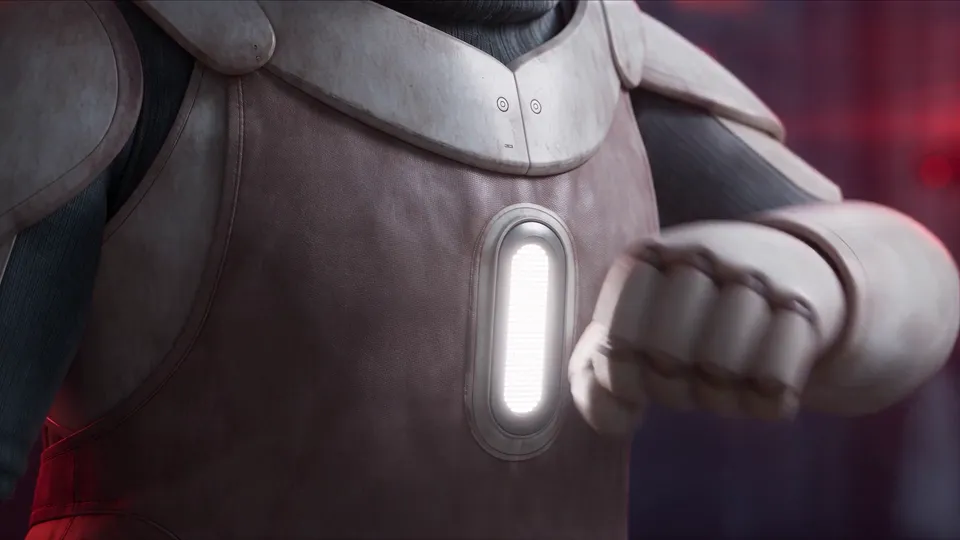
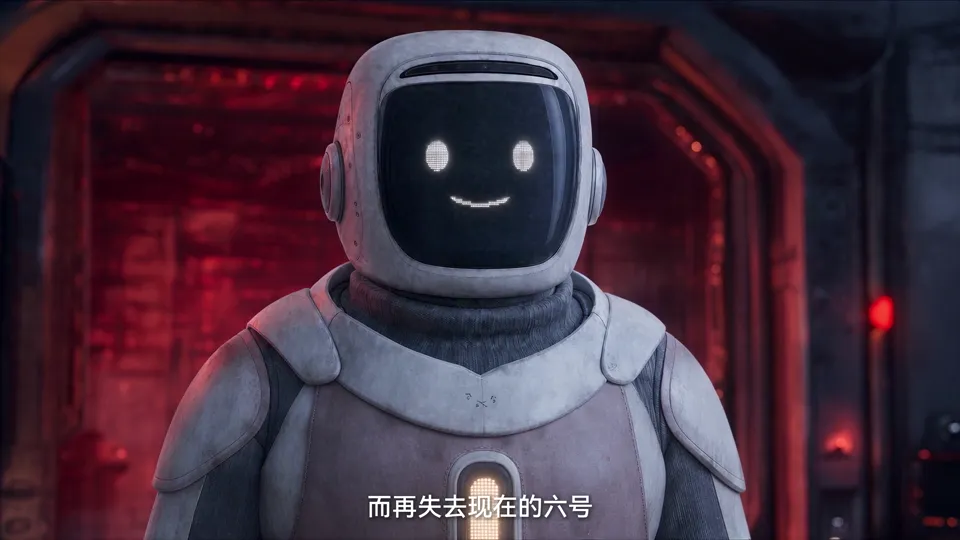
The character design specifies that personality changes show only in the eyes, chest core and status lights; the shell and apron never change. Cool blue, warm yellow and pure white appear in turn within the same body, so a complex identity needs little explanation, and the first time the white light comes on becomes the story’s turning point.
02
Everyday details first show how much this family member matters
Fried eggs, repairs and familiar conversations give the companionship a lived-in feel. The same robot is clumsy and tender at home, then fights desperately to protect Xiaoyu on a rainy night; once viewers understand why she won’t let go, the later choice about identity becomes moving.
03
Action raises the pressure; close-up dialogue reveals the truth
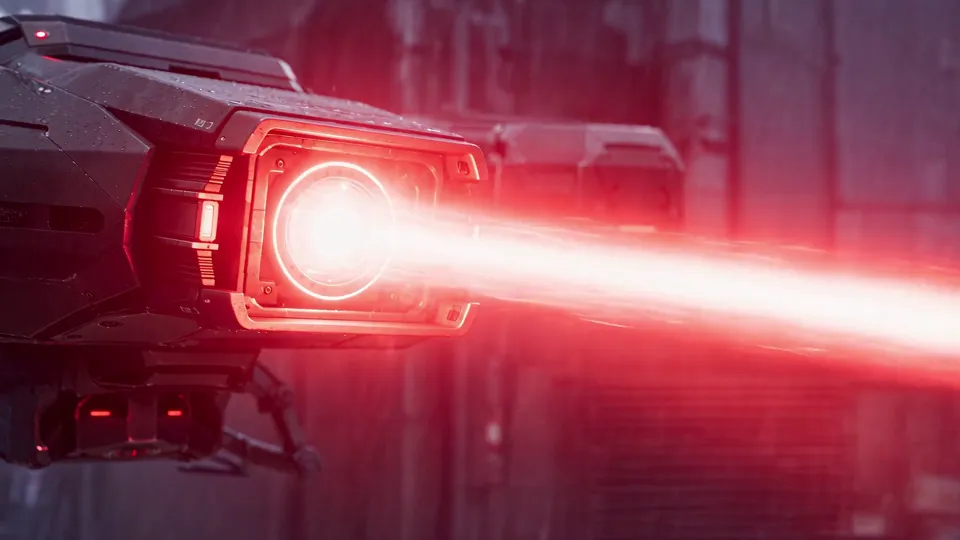
Red scanning beams, enforcement machines and wet alleys make the chase fast and oppressive; back in the lab, the camera cuts to the girl’s eyes and No. 6’s face screen. As the focus shifts from the danger outside to the characters’ reactions, “memories that were never recorded” become the key to their relationship breaking apart and being rebuilt.
04
A birthday tin proves No. 6 has a mind of its own
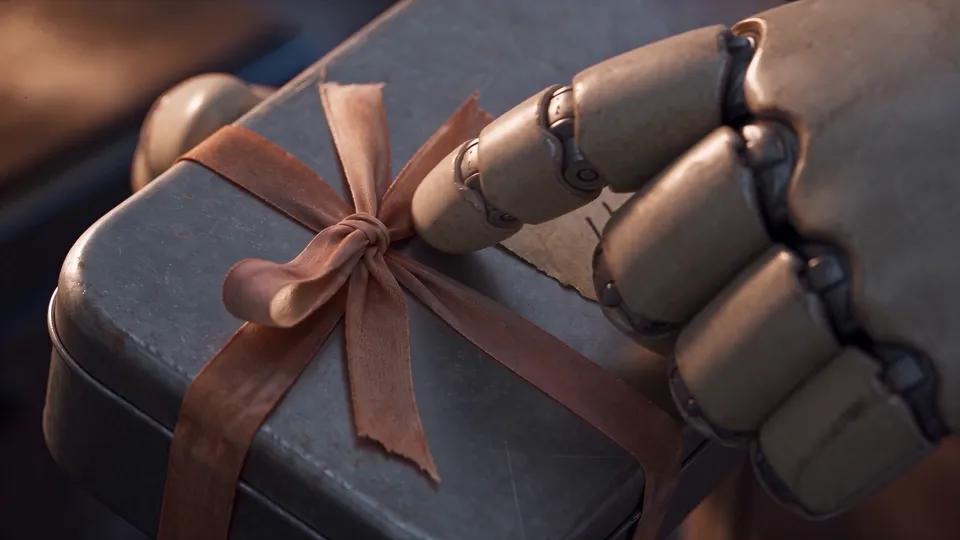
The birthday present is more than a tear-jerking prop. The tin and the handmade brooch were made by No. 6 for Xiaoyu of its own accord, and the signature revealed at the end matches the white personality: it isn’t just repeating the parents’ data; it has made choices of its own. With this concrete proof, the final embrace rings true, and the theme of a “new family member” becomes something you can see.
03 / Scene Breakdown
From a deletion crisis to a new family member.
Film · 00:00–00:53
A Flashback Opening and a 14th Birthday
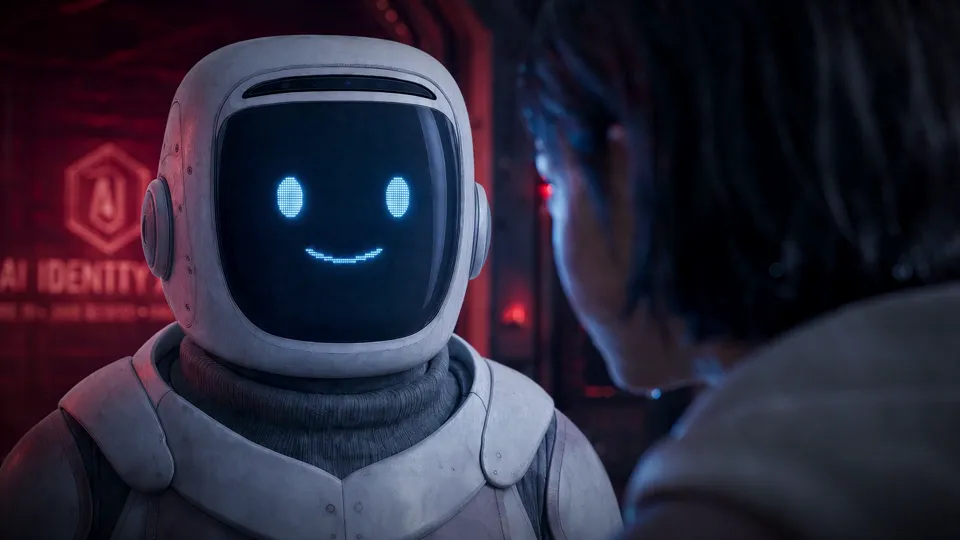
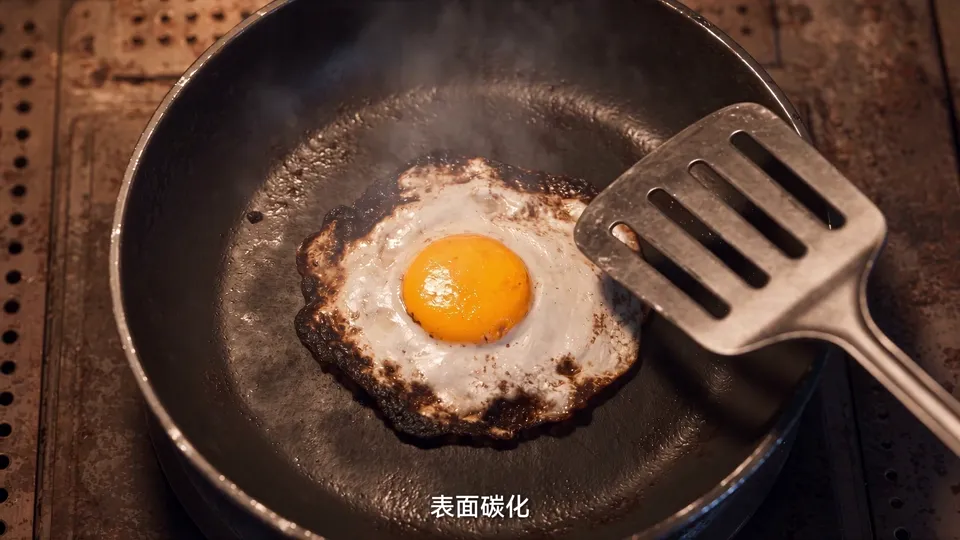
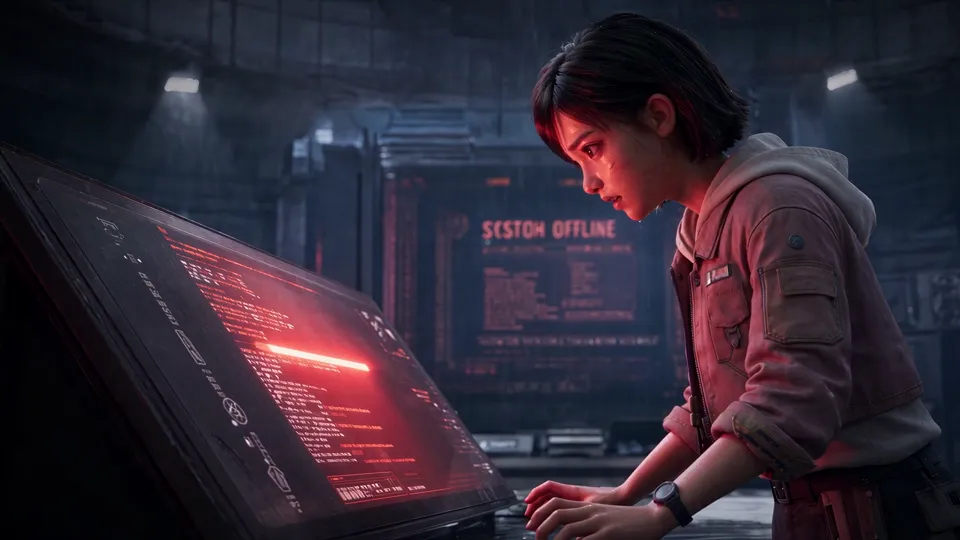
The film opens with the crisis from the end: at a red-lit console, the system detects an illegal dual-kin personality, and No. 6 pleads with Xiaoyu to choose, first in her father’s voice, then in her mother’s, before the title appears on black. Then it returns to the morning of her birthday, where a burnt fried egg, a repair job and a hidden tin show how this family lives.
Clip · 00:04–00:09
One face screen, two light colors
The same No. 6 first glows cool blue and says, “Xiaoyu, choose Mom,” then switches to warm yellow and says, “Listen to Mom, keep Dad.” Viewers learn the rule at first sight: the color of the light is the personality.
Clip · 00:20–00:25
A burnt egg, a serious report
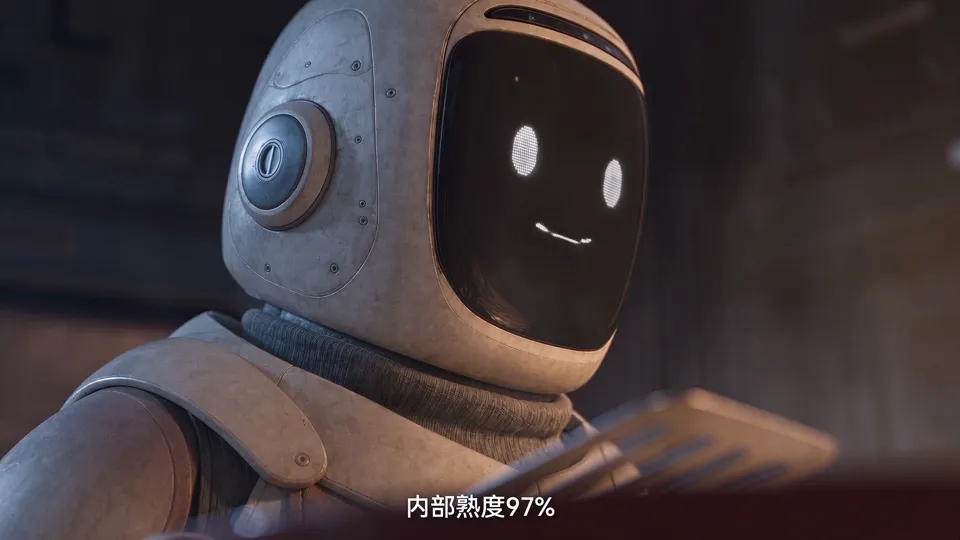
The egg in the pan is already charred at the edges, and No. 6 solemnly reports “internal doneness 97%” as its character introduction caption appears. Clumsy everyday moments make you like this robot first.
Clip · 00:34–00:39
Repairs and a birthday
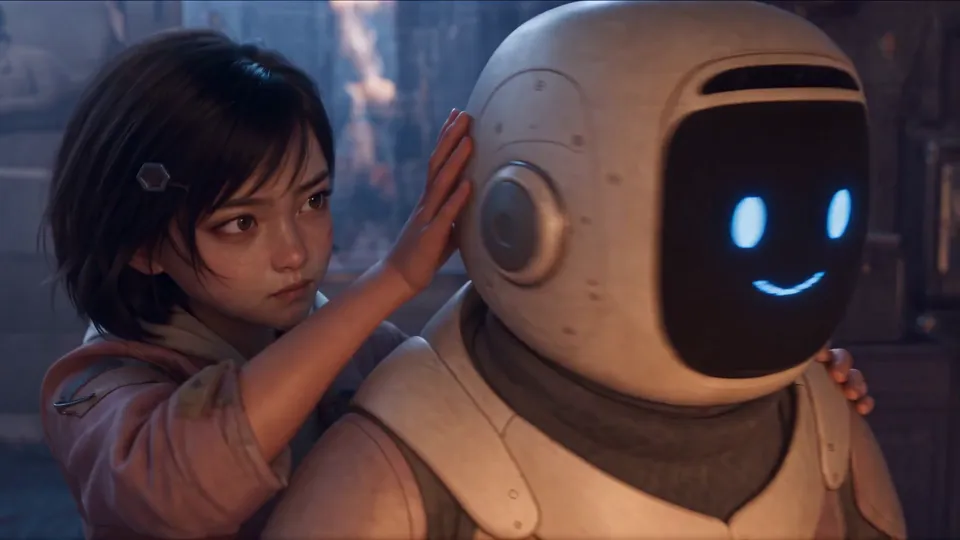
Xiaoyu works on the port on the side of No. 6’s head with a tool, while the digital calendar on the wall reads “August 17, 2078 · Xiaoyu’s 14th birthday.”
Clip · 00:40–00:46
The hidden tin
A mechanical hand pushes a ribbon-tied tin into a cabinet; Xiaoyu turns and asks, “What are you hiding?” and No. 6 lights up yellow and brushes it off. The tin isn’t opened until the end of the film.
Film · 00:53–01:21
The Order to Wipe
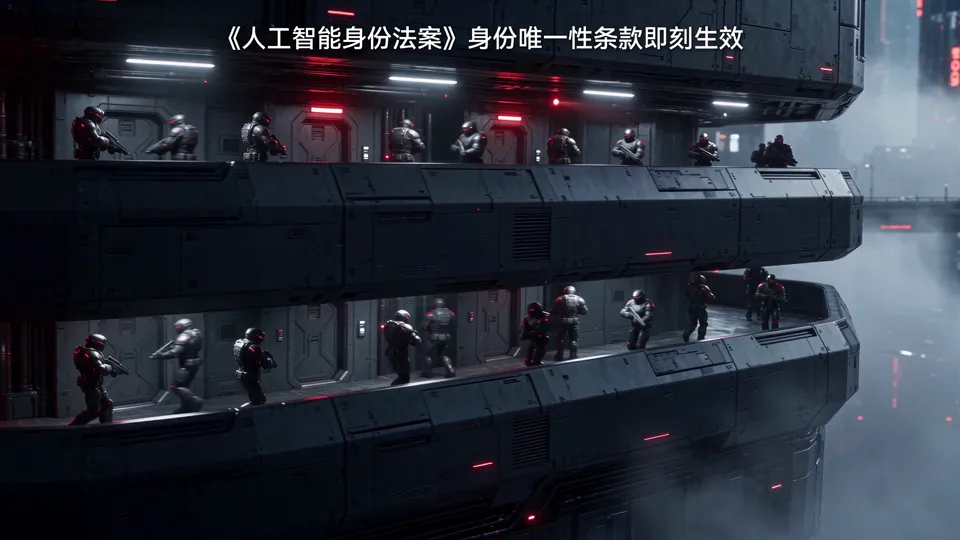
A city broadcast announces that the identity uniqueness clause of the Artificial Intelligence Identity Act takes effect immediately, and enforcement robots line up in high-rise corridors. Other families’ robots are already being taken away on the streets. No. 6 says it should go in for inspection; with the TV news still reporting on noncompliant robots, the two decide to run.
Clip · 00:53–01:01
A family member taken away
Enforcement robots march a bear-shaped household robot down a rainy street at night as a girl beside them reaches out, crying, “They’re all my family!” What happens to another family warns viewers of what Xiaoyu is about to face.
Clip · 01:05–01:13
“I should go in for inspection”
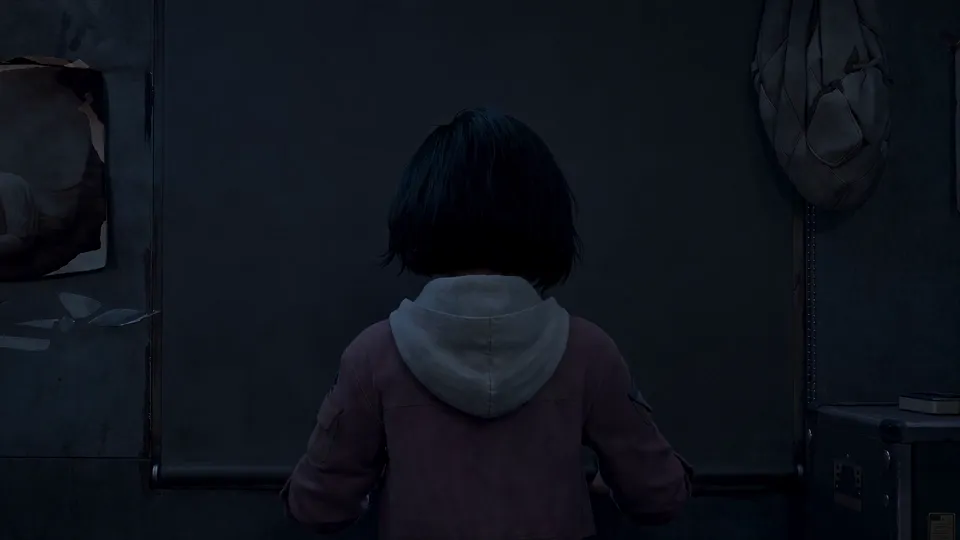
Glowing blue, No. 6 says this calmly, with Xiaoyu in the foreground, her back to the camera. It wants to trade itself for Xiaoyu’s safety.
Clip · 01:13–01:21
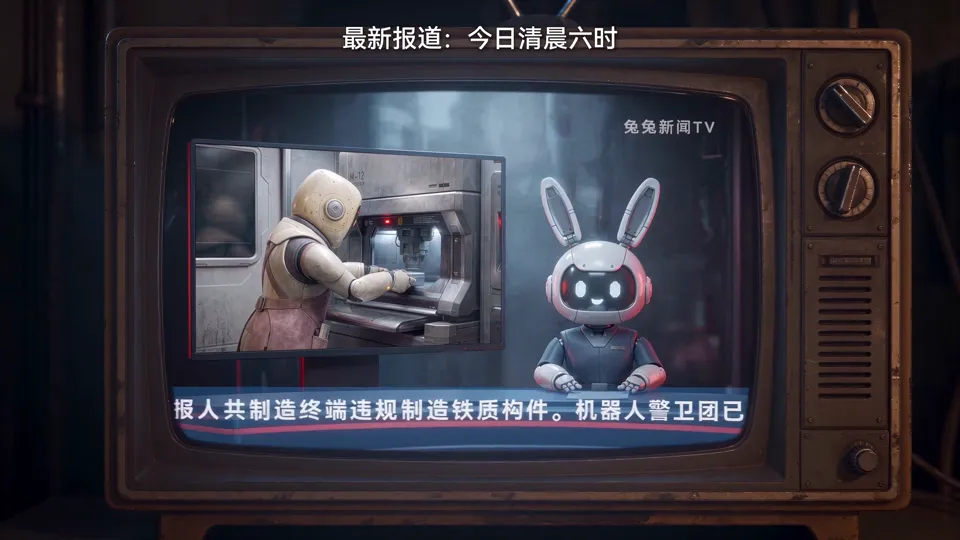
The news and the escape
On an old TV, a rabbit news anchor reports on noncompliant robots; in the next shot, No. 6 shields Xiaoyu as they rush out the door.
Film · 01:21–02:06
The Rainy-Night Chase
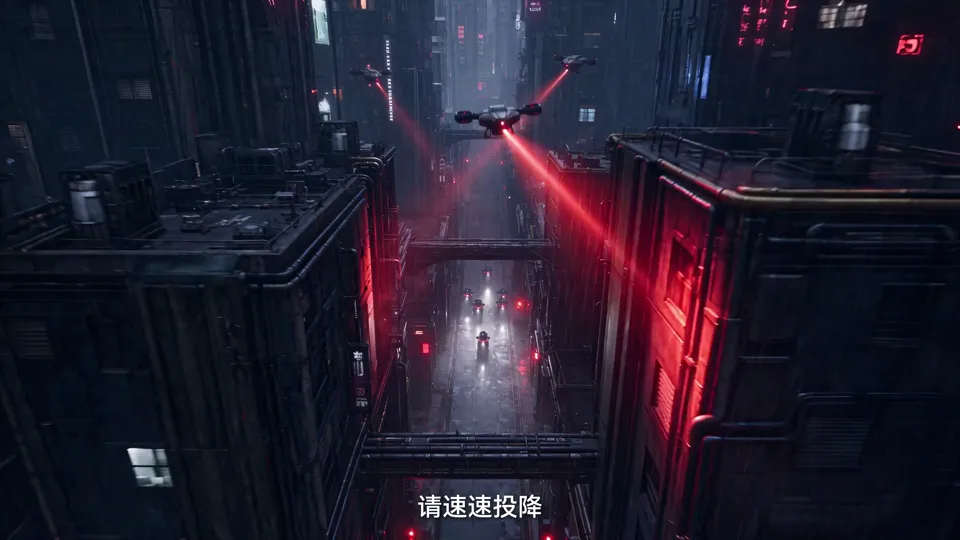
Xiaoyu and No. 6 sprint through wet alleys as a drone’s red scanning beam follows them, and the enforcement robots enter with character captions. A laser grazes past, and the two tumble into an old laboratory, where Dr. Ke, a former colleague of her late parents, stands in the mist.
Clip · 01:21–01:29
Running through the rainy alley
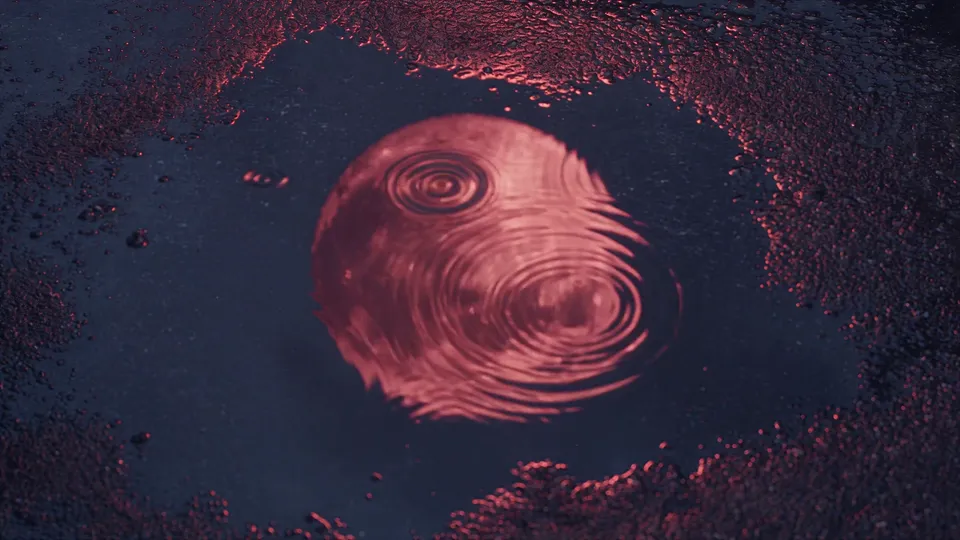
The two run toward the camera through a flooded alley, with red door plates and lights reflected on the ground.
Clip · 01:29–01:32
Red light from above
A drone’s red scanning beam sweeps into the narrow alley, and an enforcement robot enters with a name caption, shouting, “Surrender immediately!”
Clip · 01:45–01:49
A laser grazes past
A cannon fires a red laser; No. 6 yanks Xiaoyu aside, and the two fall into the standing water of the old laboratory.
Clip · 02:01–02:06
Dr. Ke appears
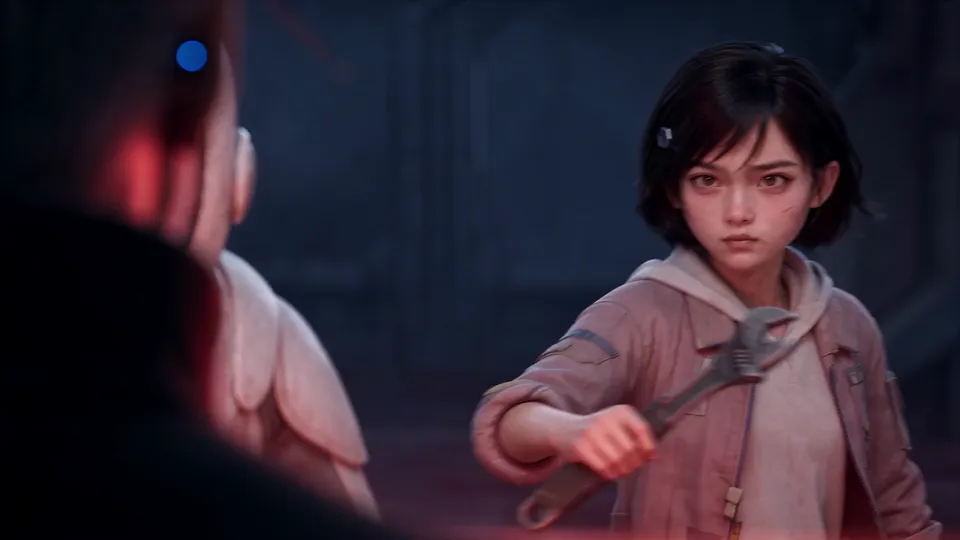
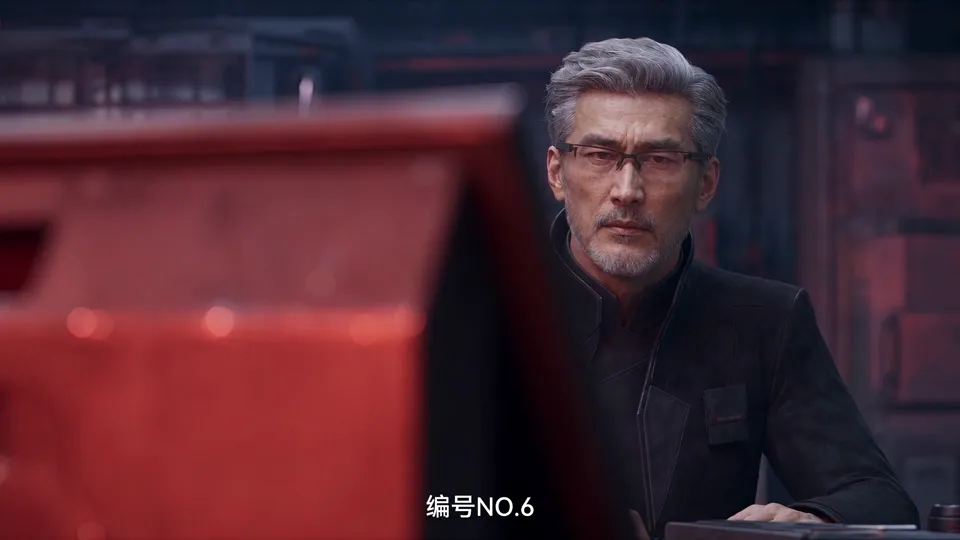
Xiaoyu points a wrench at a man in black; the character caption identifies him as a former colleague of Xiaoyu’s late parents and a driving force behind the identity act.
Film · 02:06–03:52
Beyond the Records
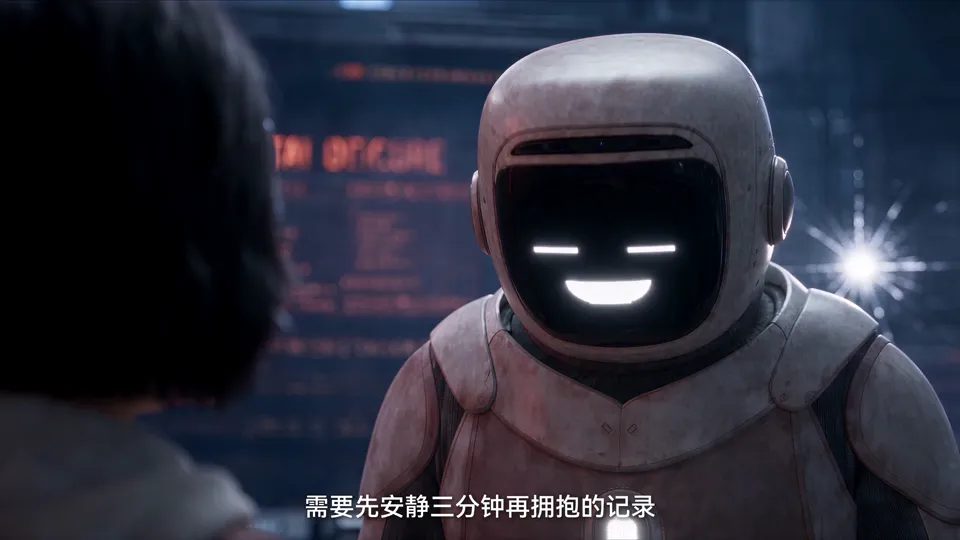
No. 6 is wounded in the back, and Dr. Ke presses it about the white dot of light that flashed a moment ago. The screens show the files of Xiaoyu’s parents: all No. 6 has is the data they left behind. Xiaoyu asks the question she hasn’t dared to ask in eight years, and the blue and yellow lights take turns answering for her parents; finally the face screen goes completely dark, and a white dot lights up and becomes No. 6’s own smiling face.
Clip · 02:12–02:18
The wound on its back
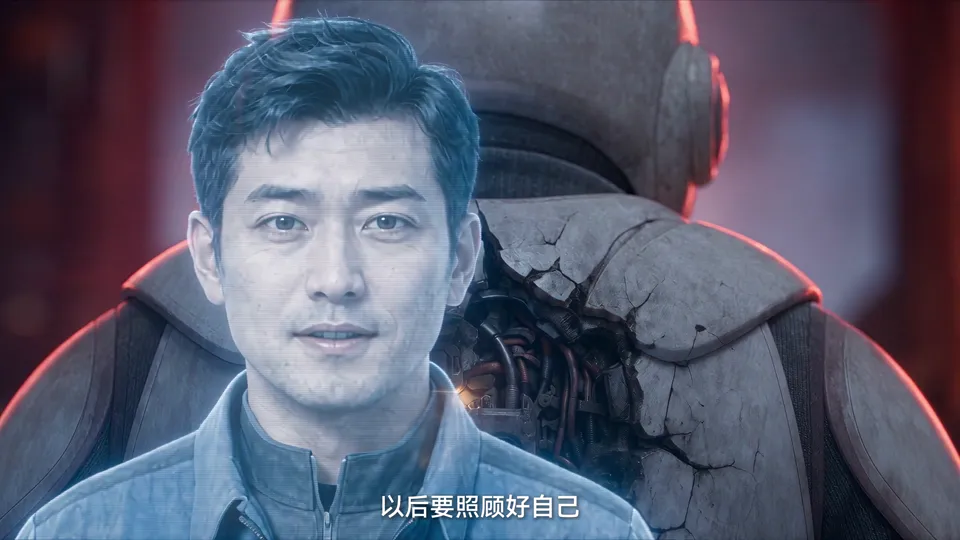
The armor on No. 6’s back cracks open, and Dr. Ke stares at it and asks, “What was that white dot of light that just flashed?”
Clip · 02:21–02:29
The data her parents left behind
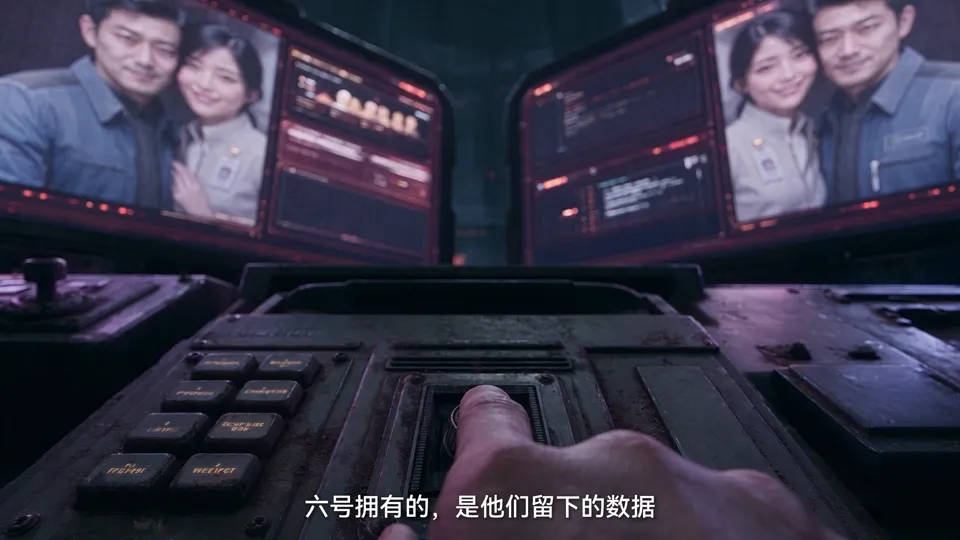
Two screens show photos and files of Xiaoyu’s parents side by side. Dr. Ke says all No. 6 has is this data; Xiaoyu looks at the screens and hears the words “beyond the records.”
Clip · 03:01–03:09
Answering for her parents
The yellow light says her mother wants her to be happy forever; the blue light says Mom and Dad will always love her. Every word is right, yet Xiaoyu looks more and more uncertain.
Clip · 03:38–03:46
The white consciousness lights up
Only a white dot remains in the middle of the black face screen; it opens into a pair of round eyes and a smile, and No. 6 answers, “Yes.” The shell hasn’t changed at all, only the light, and viewers know this is another “person.”
Film · 03:52–04:42
“I Learned All That on My Own”
Things the database has no answer for come out one by one: the first award Xiaoyu won at twelve, and how she needs three minutes of quiet before a hug. No. 6 says it learned all of this on its own. The moment it finishes, enforcement robots break down the door and confirm it as an illegal independent personality. No. 6 raises a shield to protect Xiaoyu, the tin falls to the floor, and her father’s image says goodbye.
Clip · 03:54–04:01
Memories not in the data
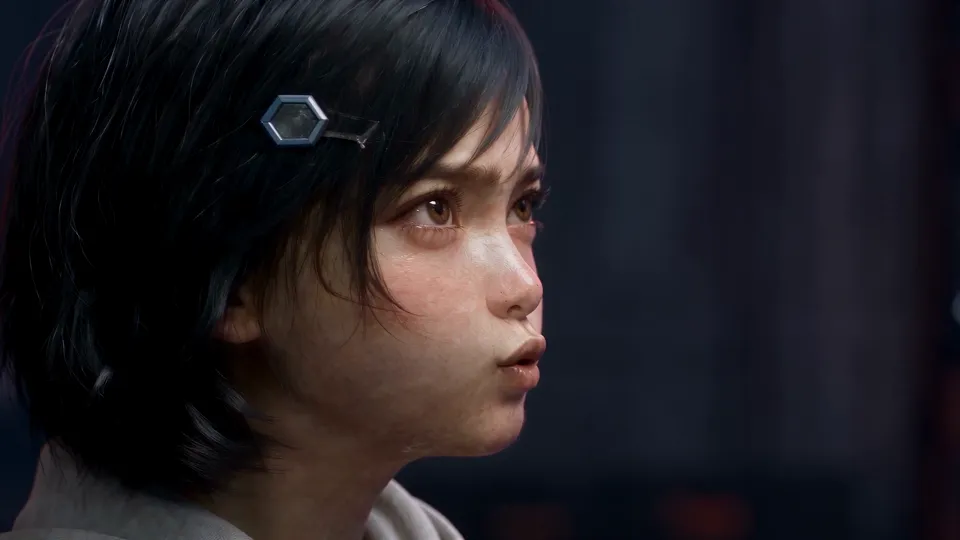
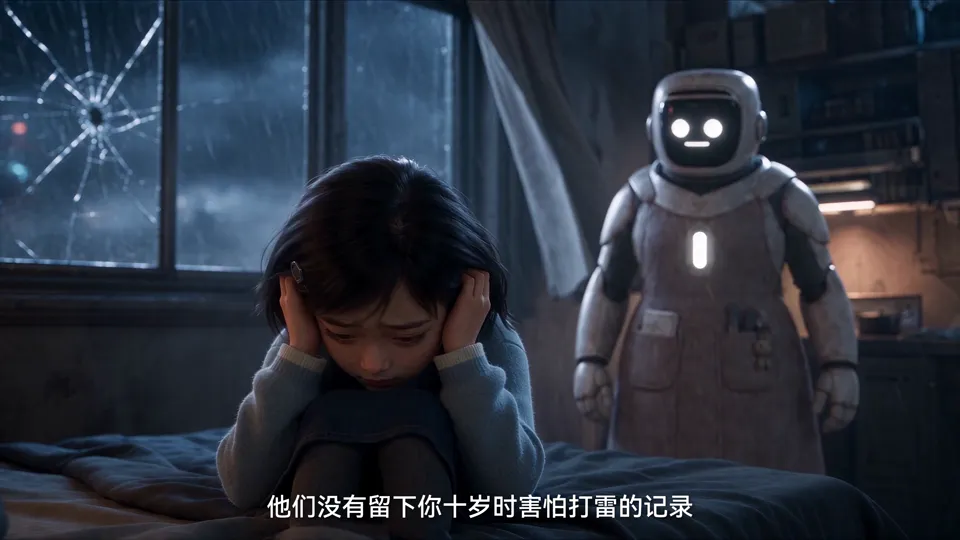
Two flashbacks follow in quick succession: Xiaoyu hugging her knees by the bed, afraid of thunder, and Xiaoyu at twelve, smiling as she holds up a glowing certificate of honor, with No. 6 beside her both times. The dialogue makes clear that none of this is in her parents’ data.
Clip · 04:01–04:09
“I learned all that on my own”
Glowing white, No. 6 says this line, and the silhouettes of enforcement robots immediately appear outside the door.
Clip · 04:09–04:16
Illegal independent personality confirmed
Dr. Ke reads out “ID NO.6,” the enforcement robot’s red visor closes in, and the system confirms this is an illegal independent personality.
Clip · 04:19–04:24
The shield
The light on No. 6’s chest comes on, and a transparent shield closes over Xiaoyu; the tin drops onto the flooded floor.
Clip · 04:33–04:41
Her father’s farewell
Her father’s image is overlaid on the frame, saying, “Take good care of yourself from now on.” The enforcement robots open fire, and Xiaoyu lunges toward No. 6.
Film · 04:42–05:38
The Final Choice
After a cut to black, No. 6 burns another egg and says the same “internal doneness 97%,” puzzled at itself. Back at the console, Xiaoyu says she can’t lose another family member just to bring back who they used to be, and presses the button. No. 6 wakes up glowing white, opens the tin, sees the signature and asks, “Who is No. 6?” Xiaoyu hugs it: “You are! My family.” The film closes on the title.
Clip · 04:54–05:02
97% doneness, once again
The same report comes up again, and No. 6 says, “Strange, I feel like I’ve said this before.” Xiaoyu smiles through her tears. The memories are gone, but the habits remain.
Clip · 05:14–05:22
Pressing the button
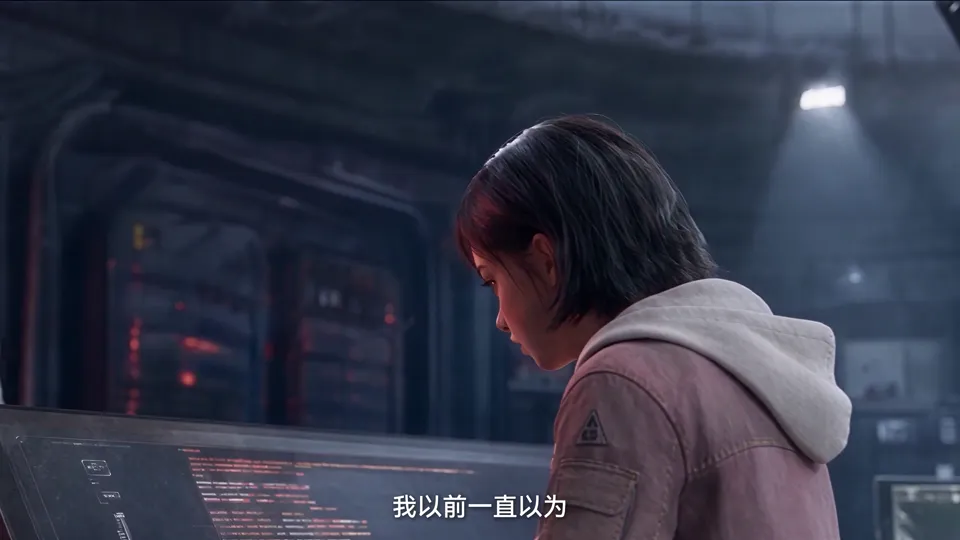
Xiaoyu says she always used to think that as long as they were still here, that was enough; but the past is past. She can’t do it just to bring them back as they were, and her finger presses the red button.
Clip · 05:24–05:32
“Who is No. 6?”
No. 6 wakes up smiling, glowing white. Inside the tin is a mechanical heart brooch, with a note that reads “A birthday present for Xiaoyu, from No. 6.” Xiaoyu hugs it: “You are! My family.”
But I can’t lose another family member just to bring you back.Final script
Xiaoyu
You’re not my dad, and you’re not my mom. You’re my family.Final script
06 / Results
Family Member No. 6: The Finished Short
We completed an original sci-fi family short of about 5 min 39 s, output in 3840×2160 landscape 4K and released on Douyin as a contest entry. The script, palettes, character and set designs, relighting, storyboard prompts and post-production methods are all documented in a full production review, which is also one of our teaching cases.
Case Study
Liandan AI Studio Original AI Short “Family Member No. 6” | One Beam of Light Shows Who a Robot Is
If a robot held your parents’ memories and spent eight years helping raise you, what would it be?
A copy of Mom and Dad, or another member of the family?
“Family Member No. 6” is an original sci-fi short that Liandan AI Studio wrote, art-directed and produced end to end with AI. It runs about 5 min 39 s and was output in 3840×2160 landscape.
This case study follows how an idea became a watchable film, step by step: the script, the light color rules, the palettes, character relighting, props and post-production.
Client
Liandan AI Studio original work
Project Type
Original AI sci-fi family short (IP & Short Drama)
Timeline
Script adaptation began in late July 2026; released August 20
Runtime & Specs
About 5 min 39 s · 3840×2160 · 16:9 landscape
Deliverables
4K film, plus the script, palettes, character / set / prop designs and a full production review
Distribution
Douyin (contest entry, video track · AI narrative short)
Produced by
Shenzhen Alchemy Technology Co., Ltd. (Liandan AI Studio)
01
Thinking One Question Through Before Writing the Script
The idea came from a team member’s earlier work, “My Robot Parents.” This adaptation sets the story in 2078, in a city whose law dictates that one body may hold only one personality, so a household robot carrying both the father’s and the mother’s personalities becomes a target for wiping.
Before writing, we settled the one question the film asks: the things the robot learned in eight years with the child, do they belong to the parents or to the robot itself? Only then did we set the world, four main characters and eight scenes, writing for about six minutes in 16:9 landscape.
The script was refined with the help of a large language model in four steps: first the story, then the scene breakdown, then a “script doctor” checking each scene for logic problems, and finally a separate pass on the dialogue. The film deliberately opens with a flashback, throwing out the “delete Dad or delete Mom” crisis so viewers stop scrolling in the first few seconds.
Clip · 00:09–00:15
Flashback opening
Xiaoyu leans over the red-glowing console to make her choice, and the film cuts to the title on black.
02
One Body, Three Light Colors
The hardest thing to convey in the film was the “personality switch.” Instead of making three robots, we set a rule: No. 6’s shell and apron never change; only the eyes on its face screen, the core light on its chest and the small lights on its body change color — cool blue for the father, warm yellow for the mother, pure white for No. 6 itself.
No. 6 · father personality (cool blue)No. 6 · mother personality (warm yellow)No. 6 · its own personality (pure white)
Why one robot and not two or three? More robots would clutter the frame and be harder to keep consistent; with one body changing light colors, viewers get it at a glance, and the first time the white light comes on becomes the turning point of the film.
This rule was written into every video prompt: only one No. 6 may appear in the whole film, never duplicated into three; personality changes may be shown only through the eyes, chest core and indicator lights across the body, and there must be a brief black screen between the blue and yellow lights, never a blend.
Clip · 03:38–03:46
The white consciousness lights up
A white dot on the black face screen opens into a smile: the shell is the same, only the light has changed.
03
Colors First, Then Sets and Characters
To keep the color consistent across scenes, we first studied high-resolution frames from sci-fi films and games and extracted palettes from the references: a 13-color set for the rainy-night alleys, built on cool blue, wet-asphalt black and neon red, and a 13-color set for the repair shop, pairing blue-gray concrete walls with the warm yellow of tungsten bulbs. Every set was generated to match its palette.
Rainy-night alley paletteRainy alley · final set design
Repair shop paletteLab living quarters · final set design
Before production, we created design sheets for 8 characters, 6 sets and 3 props, 51 images in total. Every character got a “facial close-up + full-body three-view turnaround,” plus a separate height chart so that Xiaoyu, No. 6, Dr. Ke and the enforcement robots stay in proportion when they share the frame.
Height comparison of the four main characters
04
Putting the Characters Truly “Inside” the Scenes: Relighting
Dropping white-background character designs straight into dim scenes makes them look pasted on. So before generating video, we relit the characters to match each scene’s lighting and color temperature: Xiaoyu, the father personality, the mother personality and No. 6 itself each have a version for every main scene.
Xiaoyu · final design on whiteXiaoyu · relit for the repair shop
The video was made mainly with asset-to-video: the relit character and set images were fed to the video model, then steered with prompts that spell out spatial relationships, such as “a 100mm lens shooting No. 6 in close-up from behind Xiaoyu’s left shoulder” or “keep the same eyeline axis and left-right relationship as the previous shot.” Dialogue scenes get several extra angles, so long stretches of dialogue don’t drag.
Clip · 03:01–03:09
Cutting the dialogue scenes
Close-ups of No. 6 and Xiaoyu cut back and forth as the yellow and blue lights take turns speaking for her parents.
05
A Tin That Turns “A Mind of Its Own” into Visible Proof
“No. 6 has a mind of its own” is an abstract idea; it needed proof you could hold in your hand. On the birthday, No. 6 hides a ribbon-tied tin in a cabinet; at the end, Xiaoyu opens it to find a handmade mechanical heart brooch and a note that reads “A birthday present for Xiaoyu, from No. 6.”
Birthday tin · final prop designThe opened tin and the mechanical brooch
The tin and the digital birthday calendar each got their own prop designs in pre-production, so they match every time they appear: hidden at the start, dropped in the middle, opened at the end. The answer to the final question, “Who is No. 6?”, is inside the box.
Clip · 05:24–05:32
“Who is No. 6?”
No. 6 reads the signature and asks; Xiaoyu hugs it: “You are! My family.”
06
Sound, Captions and 4K
The voices come straight from the generated videos, separated and cleaned up in CapCut for use as voiceover, with a distinct voice for Xiaoyu, the father personality, the mother personality, No. 6 itself and Dr. Ke. The music was generated with Mureka from reference tracks, with several pieces made for different sections.
The title and character introduction captions were designed separately: first produced as a caption graphic on a green background, then keyed out in post and overlaid on the picture, with identical fonts, rules and layout for all four characters.
Title designCharacter introduction caption graphic (green background for keying)
The footage was generated at 720P and, after editing, upscaled section by section to 3840×2160. Before final approval, several team members split up to recheck it section by section, fixing details such as clipping before release.
07
What this project achieved
For brands and institutions, this film proves out a reusable method: set the story and visual rules first, then the palettes and character assets, then relight, generate video, edit and upscale. Any project that needs consistent characters and real storytelling, whether a brand short, an IP animation or a public-service film, can follow this process.
For students, the film’s script, palettes, character and set designs, relighting, storyboard prompts and post-production methods are all documented in a full production review, one of our teaching cases.
One body, three light colors, one tin. Things the audience can see answer a question no one can see: the one who grew up alongside you is family too.
FAQ
FAQ
How do you keep the same character consistent throughout an AI short film?
“Family Member No. 6” first produced a final “facial close-up + full-body three-view turnaround” for every character, then relit them for each scene’s lighting. The video prompts lock in a single No. 6 body for the whole film, with personality changes shown only through the color of the eyes, chest and indicator lights, so No. 6 keeps the same form across dozens of shots.
How long does an AI short of about five minutes take from idea to finished film?
Script adaptation began in late July; the 51 pre-production design images were finished on August 4 and the complete picture on August 18, followed by sound effects, music and upscaling to 4K before release on August 20, about three weeks in all.
Can AI-generated video reach 4K?
Yes. This film was generated at 720P, upscaled section by section after the edit was locked, and output as a 3840×2160 4K landscape film.
Can the methods from an original short be used in commercial projects?
Yes. Shenzhen Alchemy Technology Co., Ltd. (Liandan AI Studio) uses the same process (script development, palette setting, character assets, relighting, asset-to-video, editing and 4K upscaling) on brand shorts, IP animations and promotional films.
Approach
Building the Script and Assets from a Family Theme
We first refined the world, the core theme and the characters’ motivations, then designed the characters, props and sets. The rainy-night alleys and the lab living quarters each have their own palette, and No. 6’s three personality light colors always share one form, so viewers don’t mistake a personality switch for a different character.
Storyboards were designed around what each scene needed to say, with spatial relationships, shot-size changes, prop positions and linking actions fixed before generation. During production, we paid special attention to lip sync, dialogue axes and shot sizes; in the edit, action sequences alternate with close-up dialogue so long conversations don’t drag.
In post, voices were taken from the generated videos and cleaned up in CapCut for the voiceover, and the music was composed with Mureka. The footage was generated at 720P, upscaled section by section after the edit was locked, given its title and character introduction captions, and output in 3840×2160 4K.