Wishes Fulfilled in a Prosperous Era: Chasms into Thoroughfares
A question asked on the Long March finds its answer in an encounter today.
Project Type
IP & Short Drama
Client
Self-initiated practice piece
Year
2026
Our role
Adapted script, character design, AI video
Original format
1920 × 1080 · 00:16
Film00:16 · Film
01 / Background
How a Road of Hardship Finds Its Answer Today
Built around the theme “Wishes Fulfilled in a Prosperous Era,” “Chasms into Thoroughfares” recreates and then adapts an existing film. The adaptation turns the forebear's question toward the Long March: the hard road they once forged with their lives, does it lead anywhere today? The answer lands on present-day life, where “chasms have become thoroughfares,” and the forebear's hopes are answered in a single encounter.
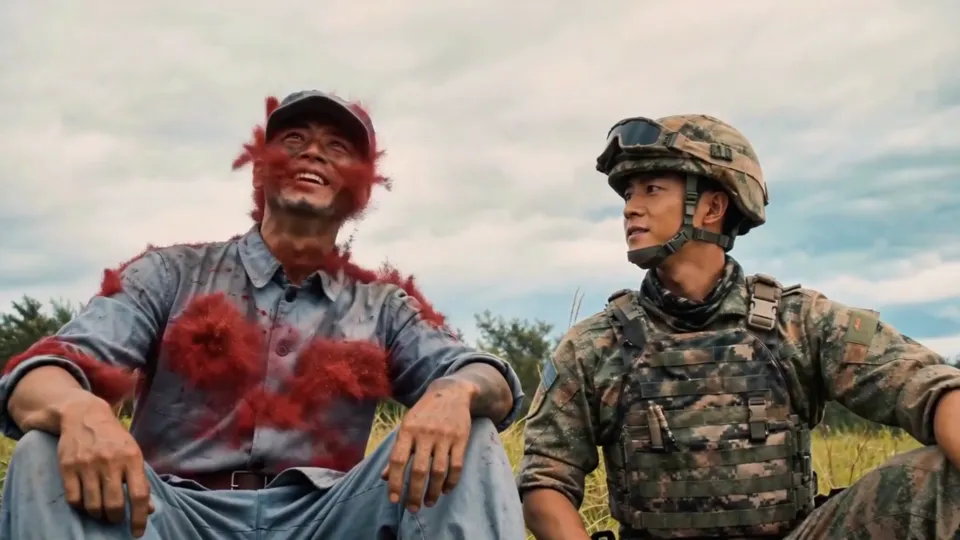
In about 17 seconds, the characters had to move from asking, to listening, to watching, to finding peace. So the short film uses only one tall-grass slope, putting an old gray cotton uniform and modern camouflage in the same frame; the two people from different eras stay in the same place throughout, and the moment the phone comes out and they look at the screen together is the turning point of the story.
02 / Creative Highlights
Fitting a Span of Generations Into One Encounter
01
Using Costume and a Single Setting to Link Two Eras
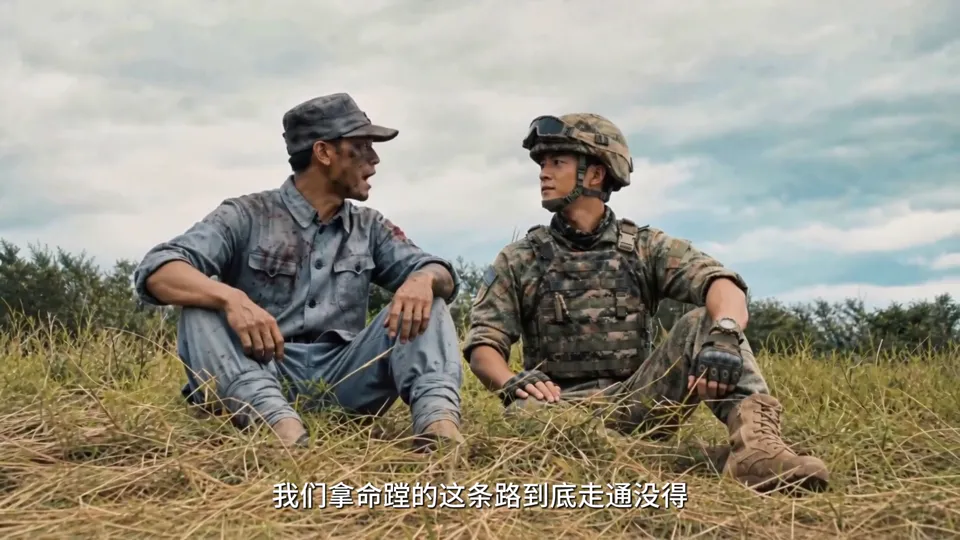
A gray cotton uniform and worn cloth shoes sit side by side with a modern helmet and tactical gear on the grassy slope. A low two-shot keeps the characters in the foreground, while the tall grass, tree line and clouds behind them stay continuous, so when the two turn to answer each other, viewers aren't distracted by a busy setting.
02
Writing the “Answer” Into the Order of Actions
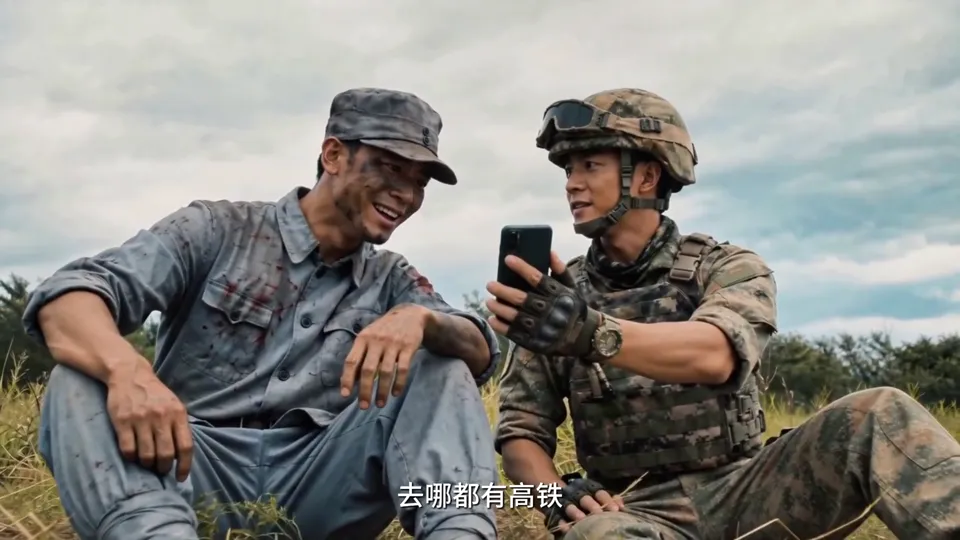
The script broke the characters' actions into a clear sequence: the forebear asks, the modern soldier listens and responds, then takes out his phone to look at it with him. In the final film, the forebear first leans in to look at the screen, then looks up and smiles; one phone links two eras, and the shift in emotion has a concrete cause.
03
Moving From the Characters to a Symbol in One Shot
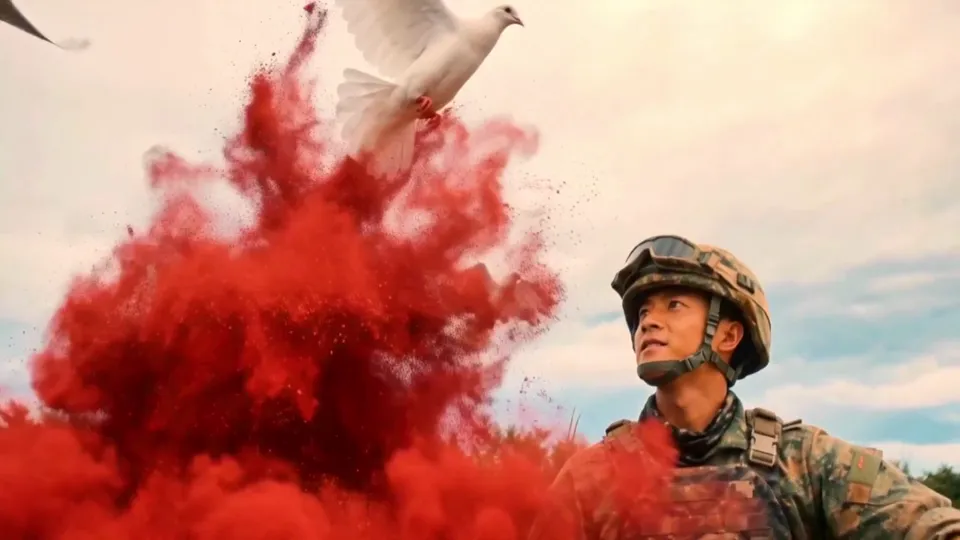
After the forebear's smile, red dust spreads out from where his body was, white doves fly out of it, and the camera gradually turns toward the sky. The first half films the two men talking; the second half switches to slow motion: a heavy cloud of red dust rolls outward while a few light white doves fly upward, so remembrance and peace follow straight after the smile.
04
Character and Scene Designs Carried Into the Final Film
Multi-view character sheets and the slope design unified the gray cotton clothing, the modern gear and the natural earth tones. The video keeps these looks, so the focus of this meeting across time stays on the characters' expressions and actions.
03 / Scene Breakdown
Three Beats, From Question to Peace
Film · 00:00–00:05
A Forebear Questions the Present
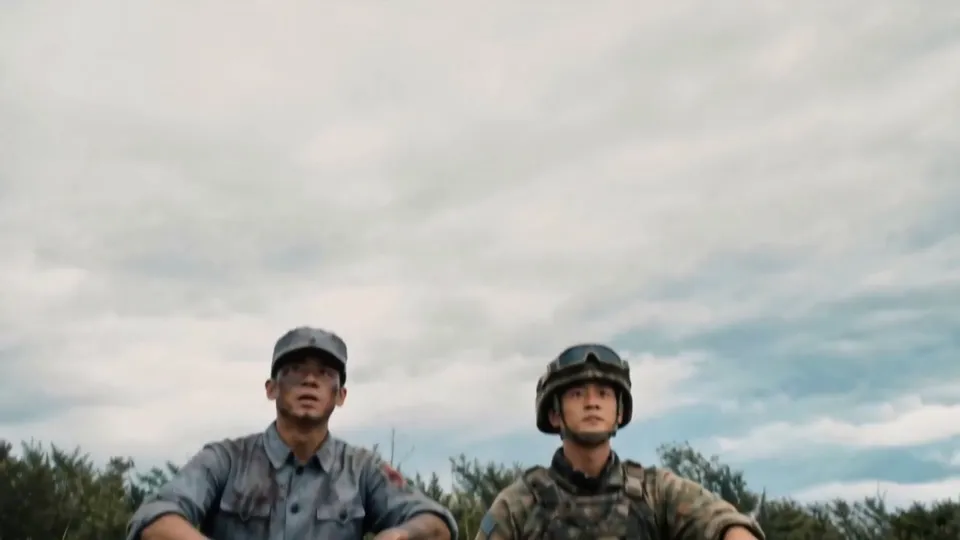
The camera descends from the clouds and settles on the two men on the grassy slope. The forebear turns first to ask, then the modern soldier turns to listen, and the question comes down to “Did this road ever get through?”
Clip · 00:00–00:02
From the Sky Down to the Slope
The film opens on clouds; the camera drops, and the two men rise into frame from the bottom, sitting side by side on the slope, both looking ahead. The gray cotton uniform and the camouflage appear in the same frame for the first time.
Clip · 00:02–00:05
One Question: Did This Road Ever Get Through?
The forebear turns to the young man beside him and asks, “This road we paid for with our lives, did it ever get through?” Only then does the modern soldier turn his head, listening and answering with gestures.
Film · 00:05–00:11
A Phone Gives the Answer
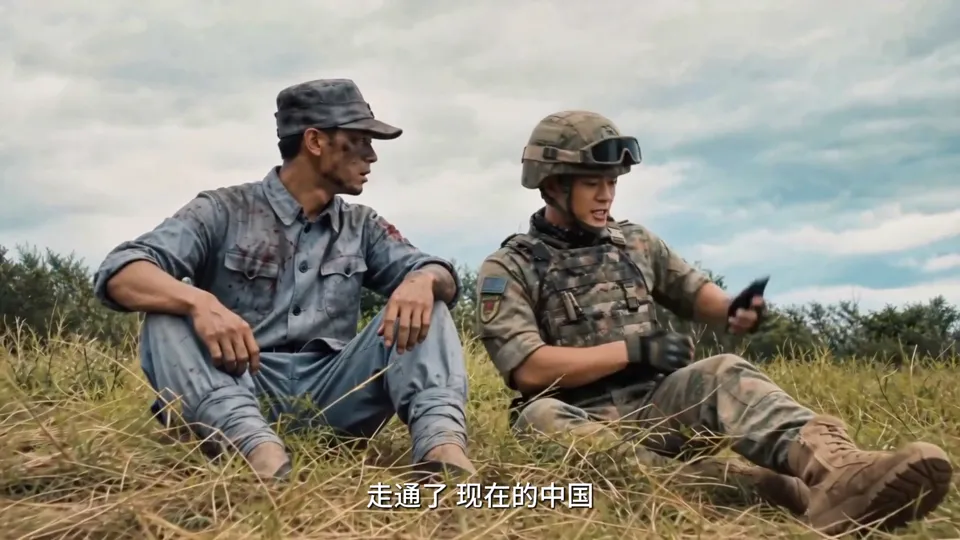
The modern soldier answers that “chasms have become thoroughfares,” stretches out his legs, pulls a phone from his pocket and hands it over; the forebear leans in, looks at the screen, then looks up and laughs out loud.
Clip · 00:05–00:08
Stretching Out, Taking Out the Phone, Handing It Over
“It got through. China today…” As he speaks, he straightens his bent legs, takes the phone out of his pocket, unlocks it and holds it up to the forebear's eyes.
Clip · 00:08–00:11
Looking at the Screen, Then Laughing Skyward
The forebear stares at the screen, the tension in his face easing little by little; he says, “Good. Then the Long March wasn't for nothing,” and throws his head back with a laugh. By now the camera has quietly pushed in a little.
Film · 00:11–00:16
Red Dust Scatters, White Doves Take Flight
As the laughter fades, the film shifts to slow motion: the forebear turns into a cloud of bright red dust, white doves fly out of it, and the camera tilts up after them while the modern soldier stays seated, looking up as they go.
Clip · 00:11–00:13
Turning Into Red Dust Mid-Laugh
Still frozen mid-laugh with his head thrown back, the forebear's face and upper body break apart into red powder first, like a handful of mineral pigment caught by the wind; the dust is heavy and rolls outward.
Clip · 00:13–00:16
White Doves Soar Into the Sky
Several white doves beat their wings and fly out from the center of the red cloud, their feathers clearly visible; the camera rises with the doves, leaving only the upturned profile of the modern soldier at the bottom of the frame.
04 / Gallery
Frames worth a closer look.
Project character design: the forebear in a gray cotton uniform and worn cloth shoes.Project character design: three-view sheet of modern camouflage, helmet and tactical gear.Project scene design: a tall-grass slope, tree line and cloudy sky.
05 / Script Excerpts
Beyond the picture.
Red Army Soldier
Comrade, have you come from the new China? This road we paid for with our lives, did it ever get through?Script
Modern Young Man
It got through! China today has turned chasms into thoroughfares. There's high-speed rail wherever you want to go!Script
Red Army Soldier
Good! Then the Long March wasn't for nothing!Script
06 / Results
A Short Adaptation About “Chasms into Thoroughfares”
This was a creative exercise by Liandan AI Studio: first recreate the original film in full, then rewrite it as a new story, “Chasms into Thoroughfares,” and finally make it into a short film of about 17 seconds at 1920×1080, shot as one continuous take. A question and an answer, looking at a phone together, the forebear turning into red dust and white doves: three beats tell his journey from hope to peace.
Case Study
Liandan AI Studio Creative Exercise | One Phone Answers a Question From the Long March
A Red Army soldier in a gray cotton uniform and a modern soldier in camouflage sit side by side on the same grassy slope.
He asks, “This road we paid for with our lives, did it ever get through?”
The young man takes out his phone to show him. After looking, he throws his head back laughing and turns into a cloud of red dust, as white doves fly from it into the sky.
“Chasms into Thoroughfares” is a creative exercise by Liandan AI Studio: we first recreated, in full, a widely shared short film about a dialogue across time, then rewrote it as our own story. The whole film runs about 17 seconds in one continuous shot.
Client
No commissioning client (Liandan AI Studio creative exercise)
Project Type
AI Cross-Time Dialogue Short (Recreation + Adaptation)
Timeline
Jun 17–18, 2026
Runtime & Specs
About 17 s · 1920×1080 · 16:9 landscape · single continuous shot
Output
1 final film; 2 character three-view sheets and 1 scene design; 3 versions of the adapted script
Produced by
Shenzhen Alchemy Technology Co., Ltd. (Liandan AI Studio)
01
First, Remake the Original to See Where We Fall Short
The original's structure is simple: two soldiers from different eras sit on a grassy slope, trade a question and an answer, the forebear turns into red dust and white doves take flight. The simpler the film, the more the details matter.
Without changing a single word, we first recreated a full version using the original's setting, characters and lines, then compared it with the original section by section: how close could AI get on the characters' movements, expressions and pacing?
The comparison showed that the biggest gap was in the movement. In the first version, the modern soldier stared at the veteran the whole time he spoke, which looked stiff. So we reordered the two men's actions: first both look ahead, then the forebear turns to ask, then the young man turns to listen, and only then comes taking out the phone and handing it over.
The forebear's three-view sheet: gray cotton uniform, Red Army cap, worn cloth shoesThe modern soldier's three-view sheet: camouflage, helmet and tactical gear
02
Three New Stories, and We Chose “Chasms into Thoroughfares”
Once the recreation was good enough, we wrote three adapted scripts in a single day, all using the same setting and the same pair of characters:
The Nameless Monument: the forebear fears that he and his fallen comrades will be forgotten by later generations; the young man takes off his cap in salute and shows him the sea of flowers beneath a memorial.
Chasms into Thoroughfares: a Red Army soldier crossing the grasslands on the Long March wants to know whether the road they forged with their lives ever got through; the young man shows him high-speed trains and sea-crossing bridges.
The Nation's Long Sword: the forebear is still shaken by enemy bombing raids; the young man shows him a formation of China's own fighter jets.
We went with “Chasms into Thoroughfares.” In this version both the question and the answer are about a road: the forebear asks about the Long March, and the young man answers that “chasms have become thoroughfares, there's high-speed rail wherever you want to go,” which viewers understand in a single line.
03
One 17-Second Shot Means Every Action Has Its Place
The film has no cuts; it's a single handheld long take. The camera path was written out precisely: descend from midair → hold on a low upward angle → push in slowly → switch to slow motion and tilt up with the dust. The low upward angle makes the two men look tall and leaves a wide sky for the doves at the end.
With only one shot, there's no editing to carry the plot, so every small action went into the prompt in a set order: both look ahead → the forebear turns to ask → the young man turns to listen → he stretches out his legs and takes the phone from his left pocket → taps the screen twice → hands it over.
Clip · 00:05–00:11
Taking Out the Phone, Handing It Over, the Forebear Laughs
In the final film this section plays out in the scripted order: stretching out, taking out the phone, handing it over, and the forebear going from staring at the screen to laughing with his head thrown back.
Both men speak in the Sichuan dialect. The forebear speaks his home dialect and the young man answers in it too, so two people decades apart sound like fellow villagers the moment they open their mouths.
04
The Red Dust at the End: Weighty, but Also Bright
The ending was the hardest part of the film. In the prompt we spelled out both the requirements and what to avoid: the dust should burst like mineral pigment powder, with weight, falling downward; no glow, nothing liquid, nothing like ink wash; the doves needed real feathers and real light and shadow.
In the recreation, the dust leaned brick red and the sky was washed out, so the whole thing felt heavy. For the adaptation we changed the color requirement to a bright, pure vermilion, so the moment the forebear dissolves reads as peace and hope rather than sorrow.
Recreation ending: brick-red dust, washed-out skyAdaptation ending: the dust becomes a bright vermilion, with white doves flying out of it
Clip · 00:11–00:16
Red Dust Scatters, White Doves Take Flight
As the laughter fades, the film shifts to slow motion: the red dust rolls outward, white doves fly out of the middle, and the camera tilts up after them.
05
What this project achieved
For clients: the structure of “two people from different eras sitting together, one asking and one answering” can be reused for anniversaries, Party-building campaigns, city development, company history and more, just by changing the question and the footage on the phone. At 17 seconds and one shot, it suits fast spread on short-video platforms.
For students: the order of this exercise is worth following. First recreate the original in full and compare it section by section to find the gaps; then write several scripts using the same characters and setting, and pick one to make. When writing prompts, separate the order of actions, the camera path, the sound and what must not appear, so AI can tell the whole story within one shot.
FAQ
FAQ
Can AI-generated video do a single continuous shot?
Yes. “Chasms into Thoroughfares” runs about 17 seconds in one continuous shot: descending from midair, a low upward angle, a slow push-in, and finally slow motion tilting up with the dust. The key is to spell out the camera path and the order of every action in the prompt.
How do you get AI characters to act out the story instead of just sitting there?
Break the movement into a series of small actions in order and write them in. For this film it was: both look ahead → the forebear turns to ask → the young man turns to listen → stretches his legs and takes out the phone → taps the screen twice → hands it over. In the recreation, the characters kept staring at each other and looked stiff; once the actions were ordered like this, the movement became much more natural.
Can this kind of cross-time dialogue short be adapted to our own theme?
Yes. With the same characters and setting, we wrote three scripts in one day: honoring nameless martyrs, the Long March and high-speed rail, and national defense. Just swap the forebear's question and what the phone shows him, and it can fit anniversaries, city development, company history and other themes.
How long does a short film like this take?
From recreating the original to finishing the adaptation took two days: the first day for the recreation and comparison, the second for writing scripts, choosing “Chasms into Thoroughfares” and producing the 1080p final film.
Approach
A Minimal Setting for a Historical Dialogue
The adaptation keeps the original's basic structure of two men meeting, one dissolving and white doves taking flight, chooses “Chasms into Thoroughfares” as its theme, and writes the dialogue as a question and answer about whether the hard road ever got through. The setting stays simple, and the new emotional turn comes from the two men looking at the phone together.
The characters' actions were placed in a set order, and taking out the phone and looking at it together is the key to the shift in emotion. The two men share the same place throughout the film; at the end, the dust, the doves and the rising camera open up the frame, so the symbolic ending follows right after the smile of relief.