The engineering image of “trailblazers” extends to the Moon: barren plains, heavy equipment, a station being built and a train setting off tell an easy-to-follow story of future infrastructure.
Project Type
Science & Tech
Client
Self-initiated concept film
Year
2026
Our role
Script & narration, AI visuals & video, editing
Original format
1920 × 1080 · 01:34
Preview
Click an image to view it full size
China Railway Group: Lunar BaseFilm keyframe · click to enlarge ↗Film01:34 · Video
01 / Background
Extending the trailblazer spirit to an interstellar Silk Road
“Lunar Base Pioneers” is a sci-fi concept film built around China Railway Group's brand image. The idea moves the work of clearing paths, building bridges and laying railways from Earth to the rim of a lunar crater: if infrastructure kept reaching further into space, how would builders turn a wasteland into a world you can travel through? The film answers with an “Interstellar Silk Road.”
The key with this kind of subject is making viewers understand what the equipment is doing, not just watch big machines. So the script is split into four acts: first the silent lunar surface, then tunneling, spanning chasms and laser construction, then the completed transport hub, and finally a train bursting out of a tunnel. Silver-gray lunar soil, white metal and blue energy light run through the whole film, with red lasers and the CREC logo as the visual accents.
02 / Creative Highlights
Visual choices, from wasteland to connection
01
Establish the wasteland first, then let engineering change it
The opening moves from the whole Moon down to a crater, and only then do the cold artificial light and an astronaut appear. The Moon, the surface and the figure appear in turn, letting viewers feel how vast and desolate the place is; later, when the base lights and buildings come on, the contrast is clear.
02
Machine close-ups that show “how it's built”
Glowing blue shield cutterheads, tracks, levitation units and chasm-spanning rails alternate on screen. Close-ups highlight the moving parts, while wide shots show how the machines relate to the terrain; the equipment feels massive, and the tunneling, transport and assembly are easy to follow at a glance.
03
Right after construction, the finished result
After the red laser formation, a silver dome and a ring-shaped hub come into frame. The camera turns from the work site to the whole complex, then to the transport axis, bringing scattered machine actions together into a working lunar base.
04
Ending on the train to land the brand image
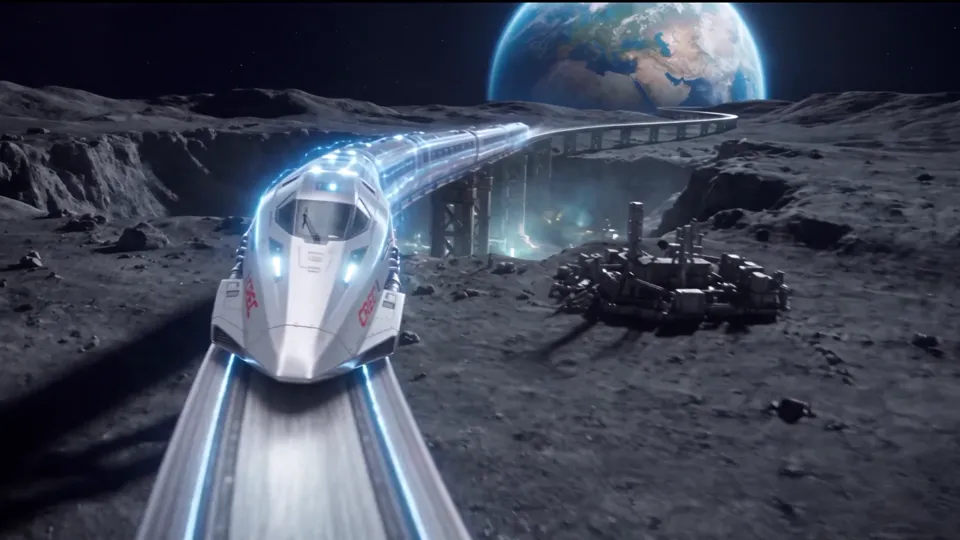
A blue ring tunnel first builds depth and makes viewers wait to see what comes; a silver train charges toward the camera, then runs onto an elevated track on the surface. The red CREC logo on its body stands out against the blue-gray frame; finally the train turns into a horizontal streak of light that leads into the China Railway Group end logo, completing the story from construction to the first train.
03 / Scene Breakdown
Four Stages of Building on the Moon
Film · 00:00–00:23
The Lunar Surface and the First Light
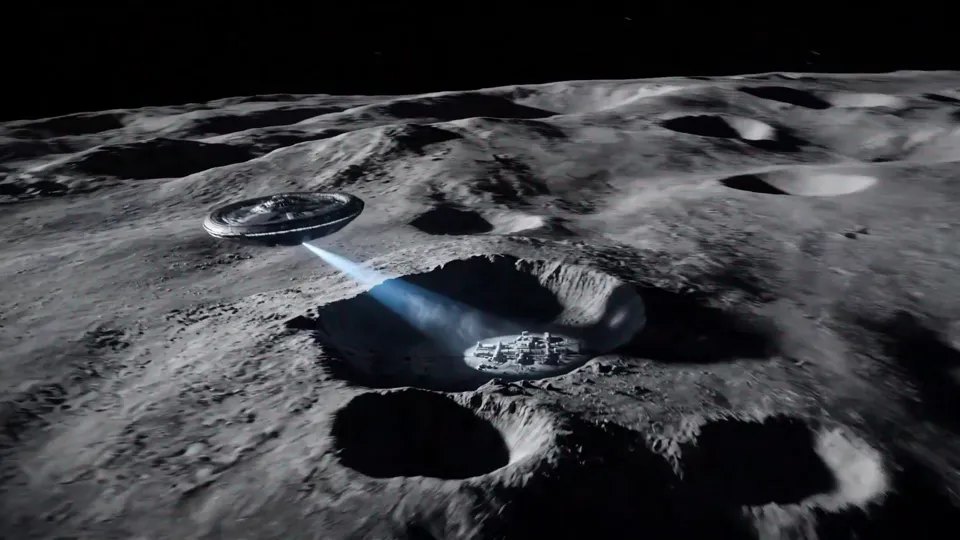
In one continuous shot, the camera pushes from the whole Moon to a crater's edge, where a hovering mothership casts a beam of cold light onto the base in the crater; an astronaut steps onto the surface as the voiceover says, “On a wasteland silent for billions of years.”
Clip · 00:00–00:07
Pushing in from the whole Moon
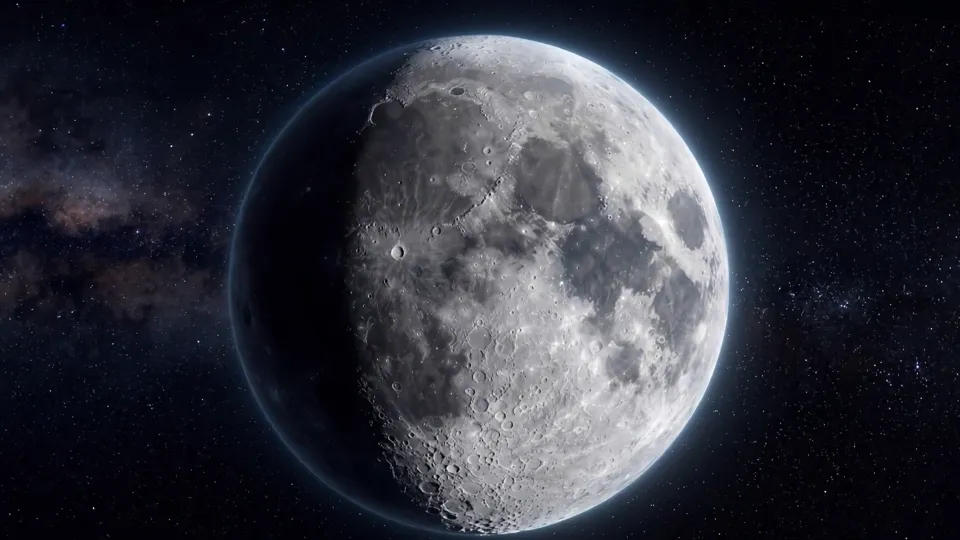
The whole Moon hangs among the stars as the camera keeps pushing in, craters growing one after another until they fill the frame.
Clip · 00:10–00:16
The mothership's beam lights the crater floor
The camera skims to the crater's edge, where a hovering ring-shaped mothership casts a cold blue beam, lighting up the base and scanning coordinates on the crater floor.
Clip · 00:17–00:23
The astronaut and Earth
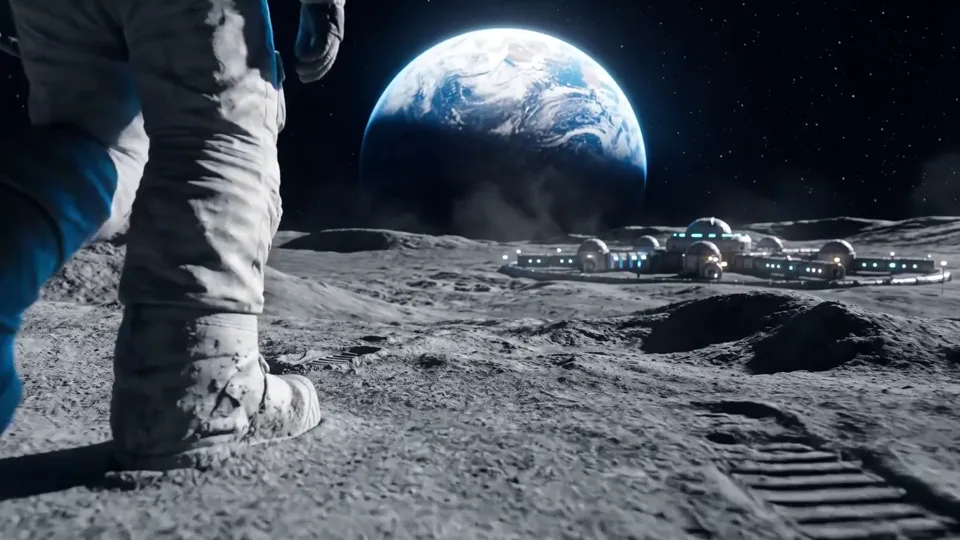
A white boot presses into the lunar dust and leaves a footprint; the camera tilts up as the astronaut walks toward a lit base in the distance, with the blue Earth hanging overhead.
Film · 00:23–00:45
Heavy Machinery Tunnels and Spans the Chasm
As the voiceover speaks of “great national machines,” the picture shows what each machine does, one by one: the shield machine cutting rock, the shield train moving in, the levitating machine landing and the bridge builder spanning a rift.
Clip · 00:23–00:27
The shield machine shows its cutterhead
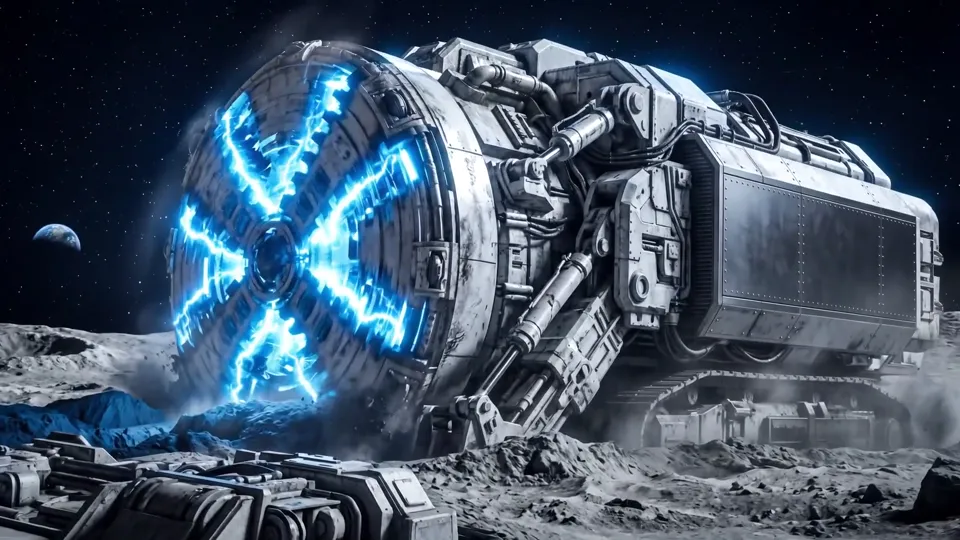
A tracked shield machine bears down head-on; a cross of blue electric arcs lights up on its cutterhead as lunar dust churns to either side.
Clip · 00:28–00:32
The cutterhead bites into lunar rock
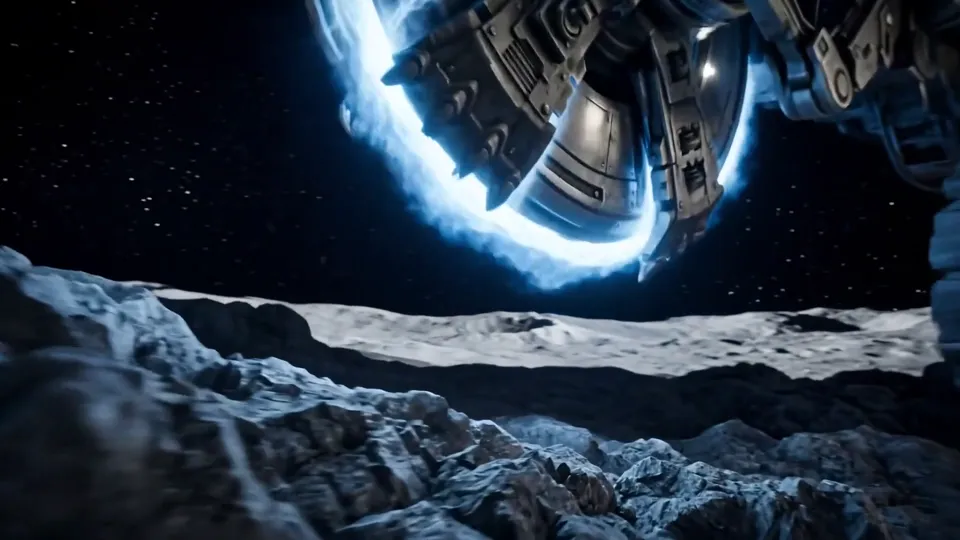
The cutterhead spins against the lunar rock; instead of debris flying, the rock dissolves into a cloud of blue-white light.
Clip · 00:33–00:37
The shield train moves in
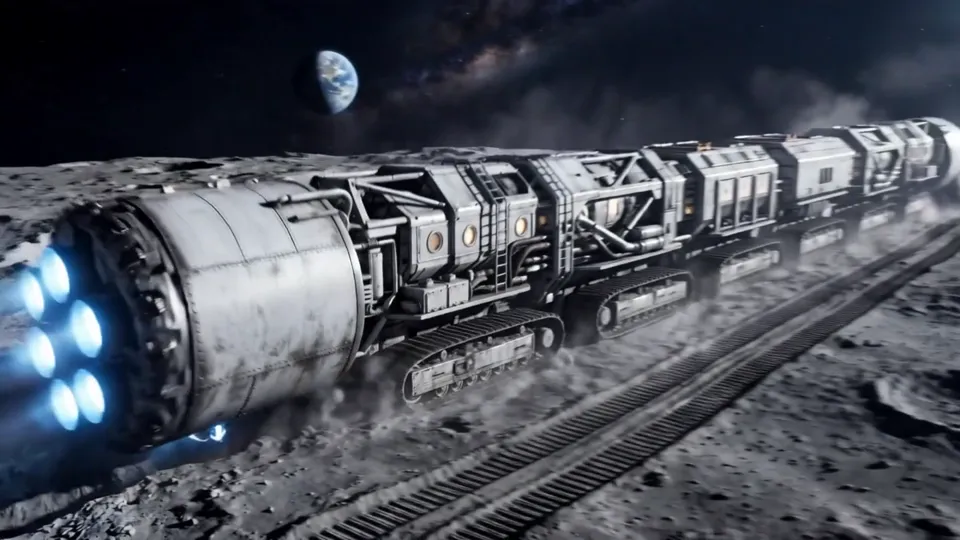
A shield train of linked silver-white segments advances with blue light jetting from its tail, pressing two track marks into the lunar surface.
Clip · 00:37–00:41
The levitating machine lands
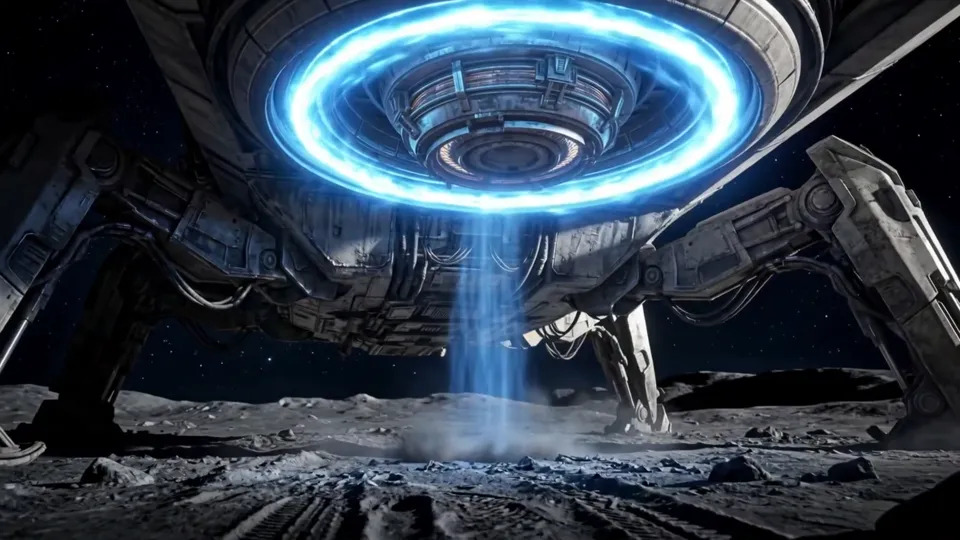
Looking up at the underside of a giant machine, a blue ring of light rotates and a column of light strikes the ground, whipping up lunar dust.
Clip · 00:42–00:45
Laying track across the chasm
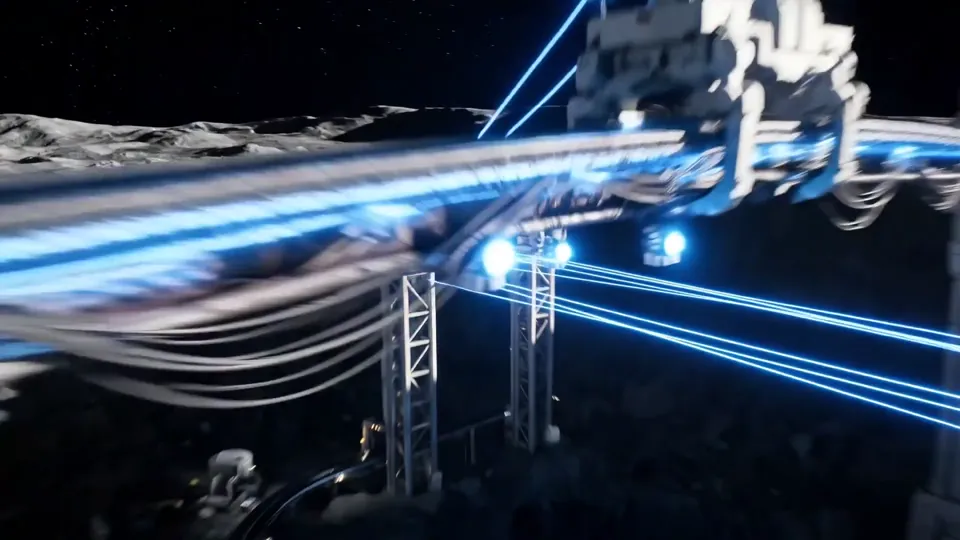
Blue lasers shoot from a tower to the far side, and a white robotic arm hovers over the rift, joining the track section by section.
Film · 00:45–01:04
Laser-Built Station and the Base Takes Shape
The voiceover turns to “clearing paths through mountains, bridging every river,” and the picture pulls back from the work site to the finished hub: drones print a dome, then the ring-shaped hub, the central tower and the solar panels appear in turn.
Clip · 00:45–00:50
Drone laser printing
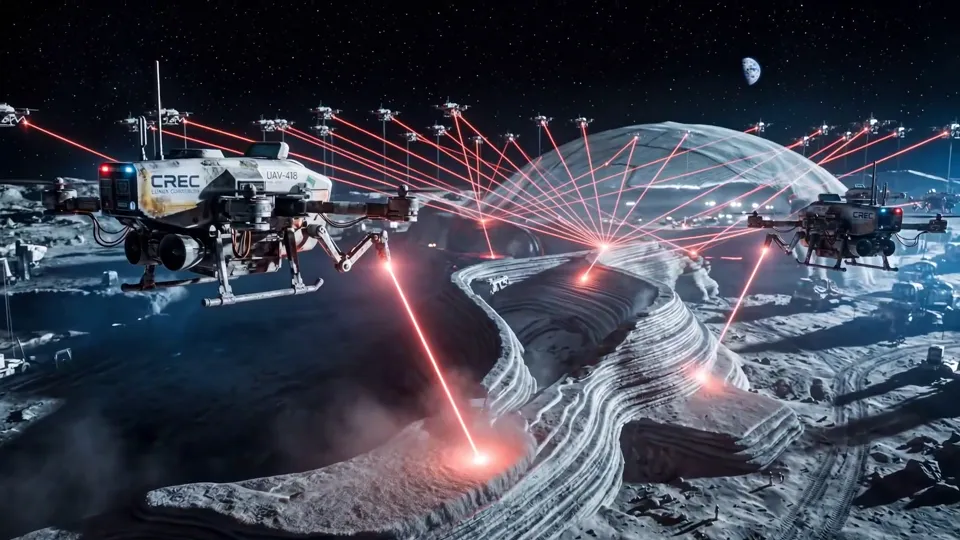
Drones marked CREC hover in midair, their red lasers sintering lunar soil layer by layer as the dome frame behind them slowly takes shape.
Clip · 00:50–00:53
The dome is completed
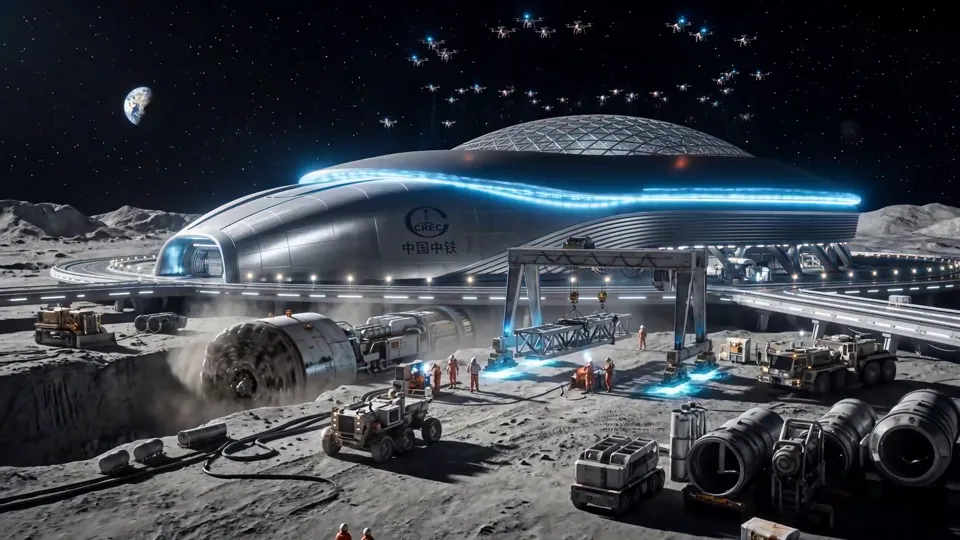
The camera keeps pushing forward: the silver dome is already complete, while workers, shield machines and transport vehicles on the ground finish up.
Clip · 00:54–00:58
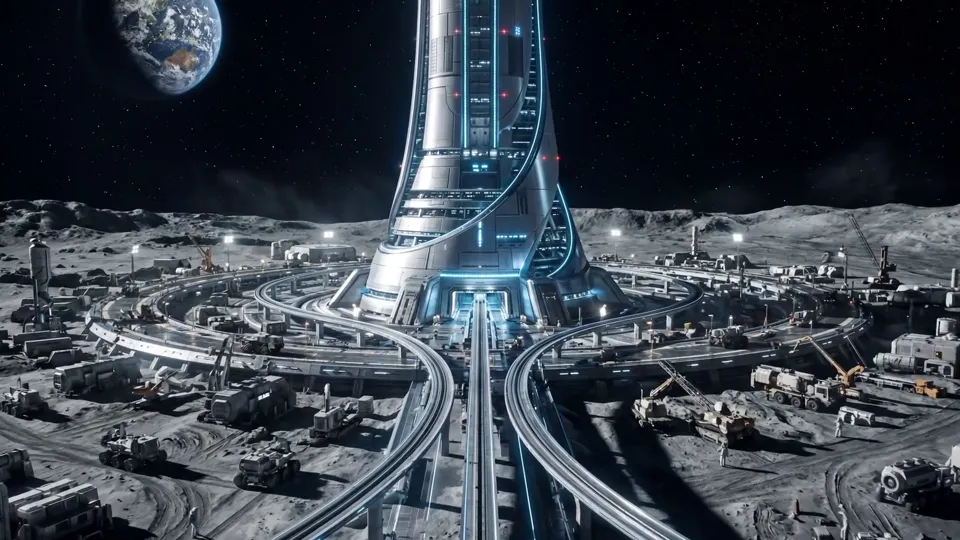
The ring hub in full view
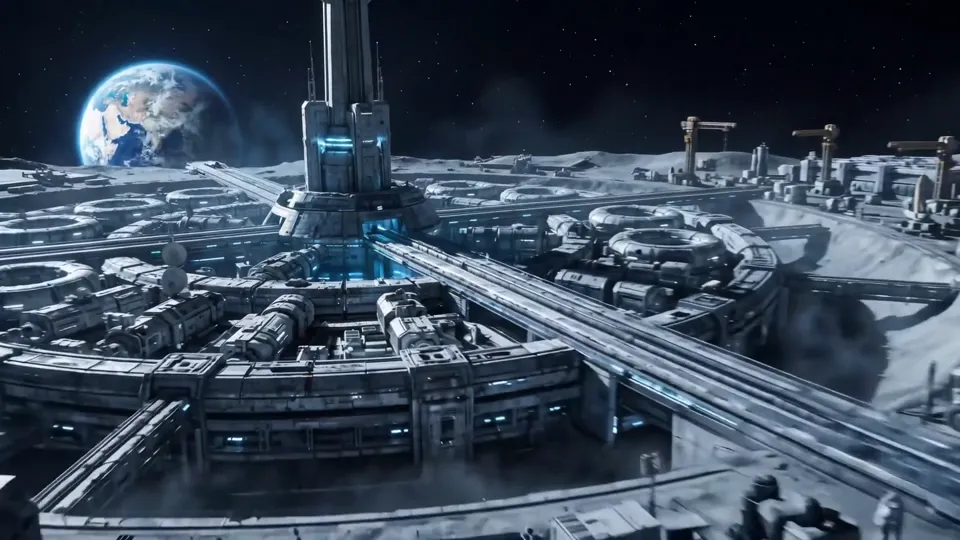
Looking down on the whole hub, ring-shaped buildings and radiating roads are arranged around the central tower, with Earth in the upper left.
Clip · 00:58–01:02
The spire and solar sails
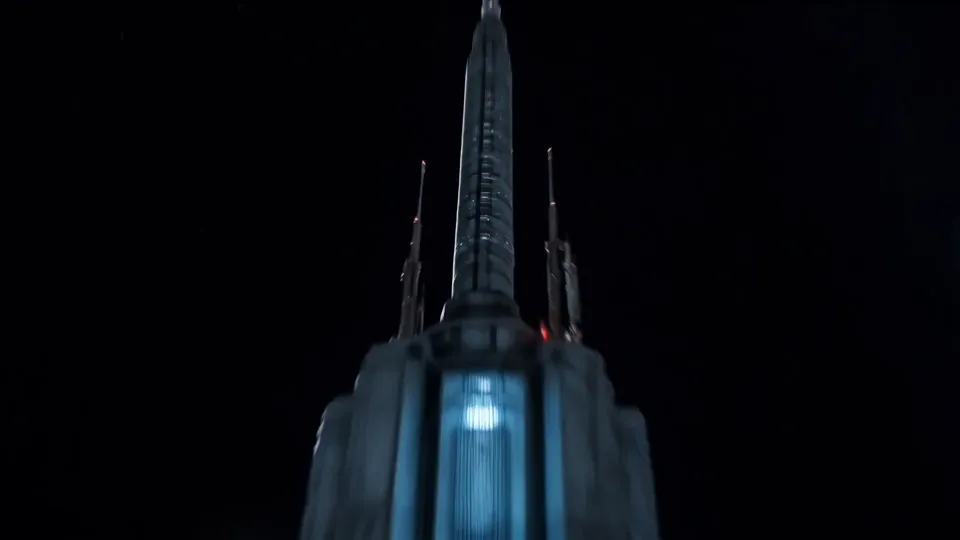
The camera looks up along the central spire, then a set of giant solar panels unfolds above the top of the tower, reflecting the sunlight.
Clip · 01:02–01:04
Tracks converge at the tower base
Several elevated tracks branch out from the tower base and curve across the lunar surface, paving the way for the train in the next section.
Film · 01:04–01:34
The Train Sets Off and the End Logo
“Listen! That is the electromagnetic resonance of the first lunar maglev train.” Headlights glow in the tunnel, the silver train bursts out and crosses a lunar valley, and finally turns into a trail of light that leads into the China Railway Group logo.
Clip · 01:04–01:08
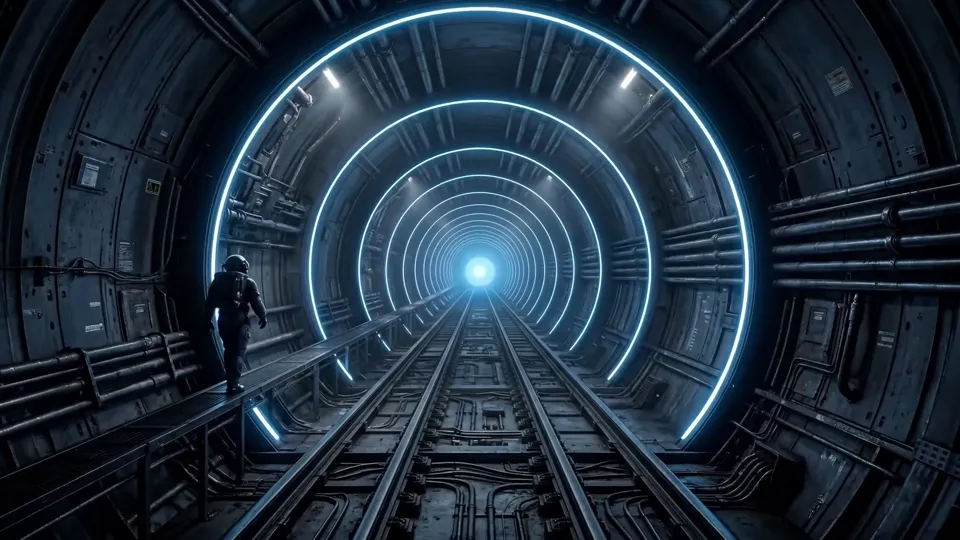
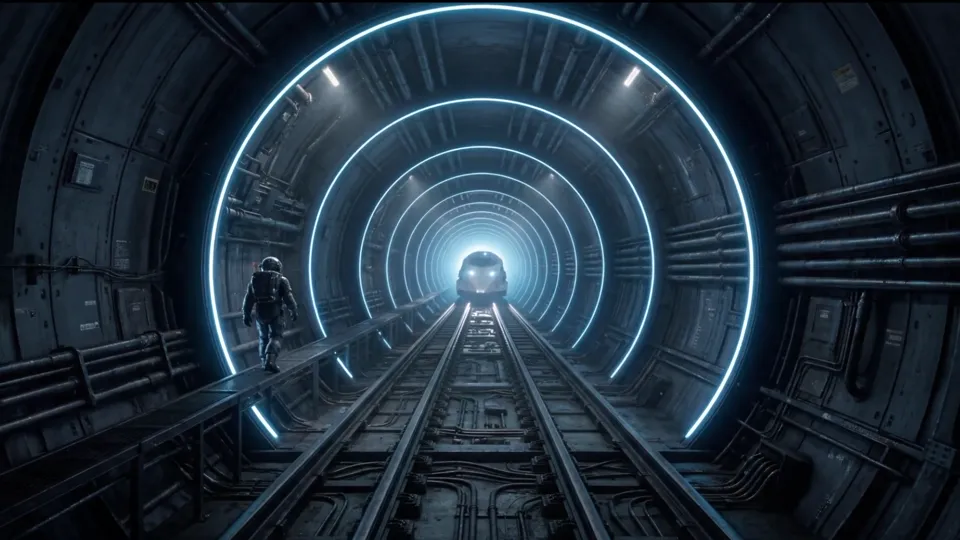
Ring tunnel
Blue rings of light stretch deep into the tunnel as an astronaut stands on the walkway, looking toward the point of light at the far end.
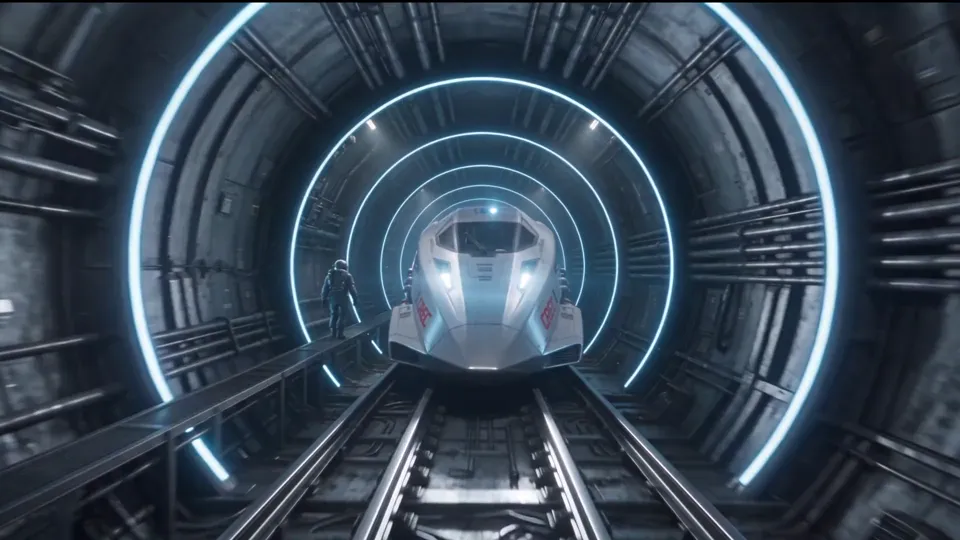
Clip · 01:08–01:14
The train bursts out of the tunnel
The silver train charges toward the camera with two headlights blazing and bursts out of the tunnel mouth; the view opens up, with Earth right behind the train's nose.
Clip · 01:15–01:21
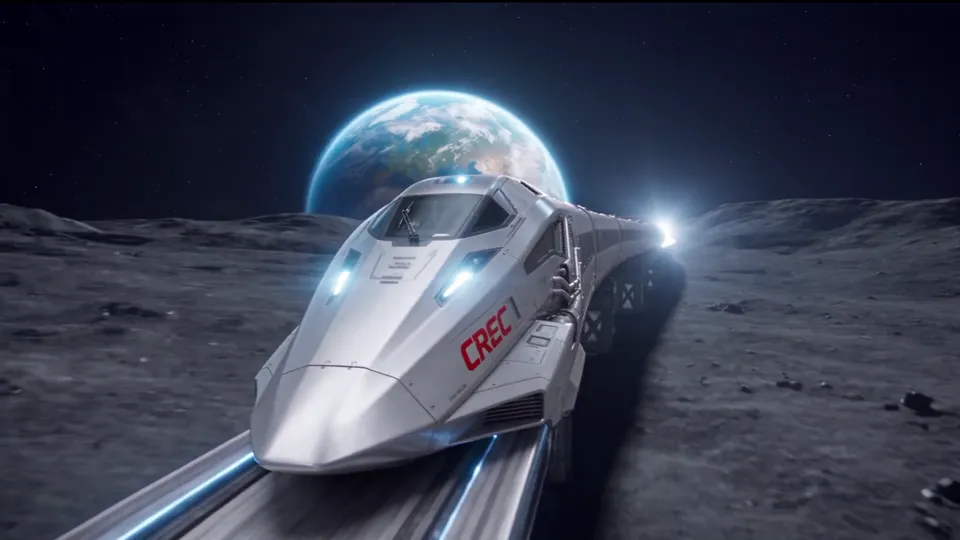
CREC on the valley viaduct
The train crosses a lunar valley on an elevated track, the red CREC on its body standing out as blue arcs stream back along it, with the base lights below the bridge.
Clip · 01:21–01:26
Turning toward deep space
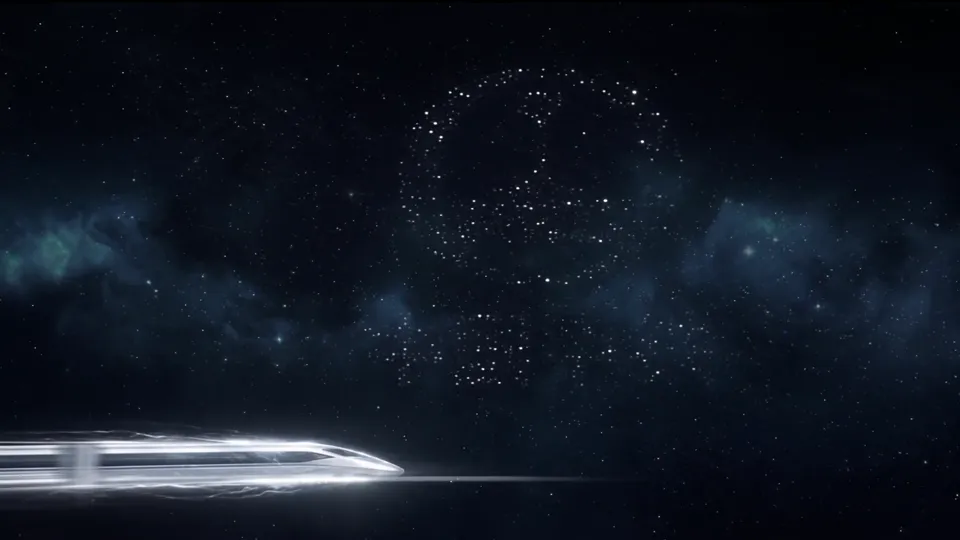
The train rounds a curve into profile and runs along the track into the stars, growing smaller and smaller.
Clip · 01:26–01:32
Light trail and logo
The train becomes a silver trail of light across the bottom of the frame, and stars across the sky gather into the China Railway Group logo.
04 / Storyboards & Final Frames
18 shots, from stills to the finished film.
Shown in the order of the finished film: each shot first notes what it shows, then the final still used to generate the video. A few continuous shots were generated from a first and last still; how they move is as shown in the finished film.
01
The Lunar Surface and the First Light
In the film · 00:00–00:23
Shot 1.1
Pushing toward the Moon
Opening first frame. The whole Moon hangs among the stars, one side lit by cold white sunlight, the other sinking into blue shadow. From here the camera pushes all the way in without a cut, landing at a crater's edge.
Pushing toward the Moon · Final 1
Shot 1.2
The mothership's beam lights the crater floor
Opening last frame. A mothership hovers above the crater, casting a cold blue beam onto the crater floor that reveals man-made structures and scanning coordinates. Paired with the previous still as first and last frames, it generates one continuous push-in.
The mothership's beam lights the crater floor · Final 1
Shot 1.3
The astronaut steps onto the Moon
A white boot presses into lunar dust; the camera tilts up to the astronaut's back, with a lit base in the distance and the blue Earth overhead.
The astronaut steps onto the Moon · Final 1
02
Heavy Machinery Tunnels and Spans the Chasm
In the film · 00:23–00:45
Shot 2.1
Plasma shield machine
A low-angle hero shot: the silver-white machine presses into lunar dust, blue plasma arcs flickering on its cutterhead.
Plasma shield machine · Final 1
Shot 2.2
Cutterhead cutting rock
Close-up of the cutterhead: its teeth cut into lunar rock, which turns into a blue-white haze of light instead of flying grit.
Cutterhead cutting rock · Final 1
Shot 2.3
The shield train moves in
Overhead tracking shot: a shield train of linked segments jets blue light from its tail, its tracks leaving trails on the lunar surface.
The shield train moves in · Final 1
Shot 2.4
Levitation thrusters
An extremely low angle on the underside of a giant machine: a blue ring of light spins and lunar dust is swept up by the energy field.
Levitation thrusters · Final 1
Shot 2.5
Anti-gravity bridge building
A giant white bridge-building arm hovers over the rift as blue beams hold superconducting track sections in place, joining them one by one.
Anti-gravity bridge building · Final 1
03
Laser-Built Station and the Base Takes Shape
In the film · 00:45–01:04
Shot 3.1
Drone laser printing
First frame. A formation of CREC-marked drones hovers in midair, red lasers melting lunar soil into liquid and building up a dome layer by layer.
Drone laser printing · Final 1
Shot 3.2
The dome is complete
Last frame. The silver dome is complete, while shield machines, bridge builders and workers on the ground finish up. Paired with the previous still as first and last frames, it shows the building rising in one continuous shot.
The dome is complete · Final 1
Shot 3.3
The ring hub in full view
A high view of the finished hub: ring-shaped buildings and radiating roads around the central tower, with Earth in the distance.
The ring hub in full view · Final 1
Shot 3.4
Solar panels unfold
Giant triangular panels unfold above the hub, reflecting the sunlight, their base connected to an energy tower.
Solar panels unfold · Final 1
Shot 3.5
Tracks converge at the tower base
The central tower rises from the ground, with several elevated tracks branching out from its base. The train on these tracks is the same model as the one that sets off later.
Tracks converge at the tower base · Final 1
04
The Train Sets Off and the End Logo
In the film · 01:04–01:35
Shot 4.1
Ring tunnel
The ring tunnel inside the base, with blue rings of light stretching deep inside; an astronaut stands on the walkway to give the tunnel a sense of scale.
Ring tunnel · Final 1
Shot 4.2
The train bursts out of the tunnel
Every train in the film has this design: matte silver, a pointed nose, a red CREC on the body and blue arcs wrapping around it.
The train bursts out of the tunnel · Final 1
Shot 4.3
Valley viaduct
The train crosses a lunar valley on an elevated track, with Earth in the distance and the base lights below the bridge. It's still the same CREC train that burst out of the tunnel.
Valley viaduct · Final 1
Shot 4.4
Light trail and logo
The train becomes a silver trail of light across the bottom of the frame, and the China Railway Group logo appears above.
Light trail and logo · Final 1
Shot 4.5
End logo above Earth
Starlight converges at the center, the logo settles above Earth, and the film ends.
End logo above Earth · Final 1
05 / Script Excerpts
Beyond the picture.
Voice-over
Today, we clear paths through mountains and bridge every river, letting the Belt and Road connect mountains and seas; tomorrow, we will make the vacuum our backdrop and lunar soil our bricks.Script
Closing line
Wherever our footsteps reach, there are the stars.Script
06 / Results
The finished concept film
We completed a sci-fi concept film of about 95 seconds, 1920×1080 landscape, with full voiceover: four seamless sections covering the lunar wasteland, heavy machinery at work, the base hub and the train setting off. It is a creative piece built around the brand image, and it now also serves as a demonstration case in our corporate AIGC training for storyboard breakdowns and continuous one-shot techniques.
Case Study
Liandan AI Studio | Taking the “Trailblazer” to the Moon: a 95-second AI sci-fi infrastructure concept film
Clearing paths through mountains and bridging every river: that is many people's first impression of China Railway Group.
What if that road kept going, all the way to the Moon?
“Lunar Base Pioneers” answers in 95 seconds: starting from a wasteland, heavy machines tunnel and lasers build a station, until a train bearing the CREC name bursts out of a tunnel and heads for the stars.
It's an AI sci-fi concept film we made around China Railway Group's brand image, and it later became a demonstration case in our corporate AIGC training.
Nature of Work
A sci-fi concept film built around China Railway Group's “Trailblazer” brand image (not a client commission or paid placement)
Project Type
AI sci-fi concept film · Brand image short
Timeline
Full version remade in June 2026, finalized in August
Runtime & Specs
About 95 seconds · 1920×1080 landscape · Full voiceover
Deliverables
1 finished film, 18 sets of final stills, one per shot
Purpose
Portfolio piece; demonstration case for storyboarding and one-shot techniques in our corporate AIGC training
Produced by
Shenzhen Alchemy Technology Co., Ltd. (Liandan AI Studio)
01
The biggest risk in sci-fi: “all you see is machines”
With future-infrastructure subjects, it's easy to end up with a parade of cool, giant machines.
But afterward, viewers often can't say what those machines were doing.
So the script started with a very simple line: wasteland → heavy machinery → hub → departure. One line of voiceover, one thing on screen.
The shield machine cuts rock, the bridge builder spans the chasm, the drones print lunar soil into a dome, and the train carries the road onward. Each machine does one easy-to-understand thing, and that moves the story forward.
Clip · 00:28–00:32
The cutterhead bites into lunar rock
Instead of debris flying everywhere, the rock dissolves into a blue-white haze of light: at a glance, this is a shield machine of the future.
02
Make the Moon desolate enough, so the lights later really shine
The opening doesn't rush to the machines.
The camera pushes in from the whole Moon, the craters growing larger until it lands at the edge of one. Then the hovering mothership casts the first beam of light.
In the earliest storyboard, this part was three or four separate shots: a wide shot of the Moon, an overhead view of a crater, a beam sweeping across. Put together, it always felt like the same thing repeated.
We turned it into a single continuous shot: using the wide shot of the Moon as the first frame and the beam lighting up the crater floor as the last frame, letting the camera travel all the way from space down to the surface on its own.
First frame: the whole MoonLast frame: the mothership's beam lights the crater floor
Once the wasteland is fully established, the base lights coming on one by one and the buildings rising one after another make the contrast clear.
03
One shot to watch the dome rise
“Swarm manufacturing fuses the lunar soil”: if this voiceover line were paired with just a finished dome, the “making” would be missing.
Again we used first and last frames: the first frame is the drone formation sintering lunar soil with red lasers, the last is the completed silver dome with workers and vehicles still finishing up on the ground. The growth in between is left to video generation as the camera keeps pushing forward.
First frame: drone laser printingLast frame: the dome is complete
What viewers see isn't a cut between two images, but a building growing out of the lunar soil before their eyes.
04
One train, from the tunnel all the way to the stars
The train is the star of the film, and the hardest part to get right.
When each shot is generated separately, the train easily becomes an ordinary white bullet train in one shot and gets a different nose in the next. Viewers would think several trains had shown up.
We first used the “bursting out of the tunnel” still to lock the train design: matte silver, a pointed nose, a red CREC on the body and blue arcs wrapping around it. After that, in every shot with a train, we kept the original terrain, bridges and Earth position and swapped only the train for this model.
First version: an ordinary white bullet trainFinal: unified as the CREC train
The tunnel shot was changed too: in the first version, a train was already parked deep in the tunnel, and its design didn't match the later CREC train. The final version removes it, leaving only the rings of light and the astronaut on the walkway, saving the train's appearance for the next shot, when it bursts out of the tunnel.
First version: a train already deep in the tunnelFinal: the tunnel stays empty, saving the train for the next shot
Direction had to be controlled too. The prompts for the final section spelled it out: the train always faces forward and keeps accelerating, never reversing or turning around. In the finished film it bursts out of the tunnel, crosses the lunar valley, then curves away into the stars, always heading forward.
Clip · 01:15–01:21
CREC on the valley viaduct
The same train crosses the lunar valley, with the base lights below the bridge and Earth in the distance.
05
Voiceover and picture, line for line
The film has full voiceover, and the visuals are paced to it.
“Plasma pierces the rock, anti-gravity spans the rift, swarm manufacturing fuses the lunar soil”: three phrases, matching the three groups of shots for the shield machine, the bridge builder and the drones.
“Listen! That is the electromagnetic resonance of the first lunar maglev train”: the picture holds on the empty ring tunnel as two headlights glow at the far end.
Clip · 01:06–01:13
Headlights in the tunnel
As soon as the voiceover says “listen,” headlights glow at the end of the tunnel and the train bursts out of the tunnel mouth.
What viewers hear is what they see, so they don't have to work to match them, and their emotions build along with the voiceover.
06
What this project achieved
For the brand, this film tested one thing:Can a familiar brand slogan be turned into an entirely new visual world with AI?
“Trailblazer” originally meant tunnels, bridges and railways. On the Moon, it becomes shield machines cutting rock, bridges spanning chasms, laser-built stations and a train setting off, yet viewers still recognize it instantly: this is about the people who build the roads.
For trainees, it lays out the steps of making an AI film clearly: break the storyboard down by voiceover, with one thing per shot; use first and last frames to join scattered shots into a continuous one; lock one design for the main subject first, then bring every shot in line with it.
No live-action shoot, no sets: a 95-second sci-fi infrastructure film, built step by step.
FAQ
FAQ
In an AI promo, how do you keep the same subject (such as a train) looking the same in every shot?
Lock one final image of the subject first. This film used the “bursting out of the tunnel” still to fix the train design: matte silver, a pointed nose, a red CREC and blue arcs. In other shots with the train, the original composition, terrain and Earth position were kept, only the train was swapped for the same model, and those stills were then used to generate video.
How are continuous camera moves through big scenes done in AI video?
With continuous shots generated from first and last frames. In this film, the opening push from the whole Moon to the base in the crater, the drone printing through to the finished dome, and the tunnel to the surface viaduct were all made by first creating a first-frame and last-frame still, then generating the motion in between, with no cuts and no flashes to black.
How long does an AI sci-fi concept film of about 90 seconds take?
For this remake, it took about 3 days from kickoff to the first complete version; after that came several rounds of fine-tuning on shot transitions, the train design and its direction of travel, and it was finalized in August 2026.
Without live-action footage, how does the brand logo appear on screen?
The logo is written into the frame at the storyboard stage: the drones and the train body carry the CREC name, and the ending uses a train's light trail and converging stars to reveal the China Railway Group logo. The finished film is 1920×1080 landscape with full voiceover.
Approach
Future equipment serves the engineering story
The storyboard breaks the film into shots of the Moon from afar, machines at work, the base taking shape and the train in motion, each with its own camera position, subject action, light and color, and shot size. That way every future scene has something to say: the Moon shows scale, the machines show what's being done, the hub shows the finished result, and the train points the way forward.
Visually, continuity matters most: the opening push from the Moon to the crater floor is one continuous shot, every train in the film is the same silver train, and it always faces forward. Checking the train design, direction and scenes together lets viewers follow this journey from start to finish without being thrown by changes between shots.