3rd AI Visual Creativity Competition (VACAT Awards) Concept Film
We created the ending and cover visuals for the VACAT Awards concept film, using deep space, spacecraft and streams of light to push the imagination of AI creation further.
Project Type
Science & Tech
Client
VACAT Award (3rd AI Visual Creativity Contest)
Year
2026
Our role
23-second closing sequence & cover for promo
Original format
1920 × 1080 · 01:50
Preview
Click an image to view it full size
3rd AI Visual Creativity ContestFilm keyframe · click to enlarge ↗Film01:50 · Film
01 / Background
Adding a Deep-Space Vision to the Competition Film
The full film for the 3rd AI Visual Creativity Competition (VACAT Awards) covers a recap of the competition, creator introductions, and partnerships with platforms and universities. Our part was the ending sequence and the video cover: once the event information has been delivered, the film needs a final run of images that suddenly opens up the imagination and carries the theme “Defining the Next Wave of AIGC Creation” further forward.
For the ending we chose space travel. The spacecraft, giant planets, black-hole-like rings and orange-and-blue streams of light share one visual style, and a single spacecraft links the scenes into one continuous landscape. This page shows the full film of about 1 minute 50 seconds so you can see the context; the space ending we made starts at around 87 seconds.
02 / Creative Highlights
How the Ending Carries the Creative Theme Forward
01
A spacecraft takes viewers out of the everyday
After the theme card, the spacecraft skims over a frozen surface and a ring-shaped megastructure, then enters radiating streams of light. Following the ship through one space landscape after another, viewers go from reading event information to feeling a voyage.
02
A small ship against giant celestial bodies shows scale
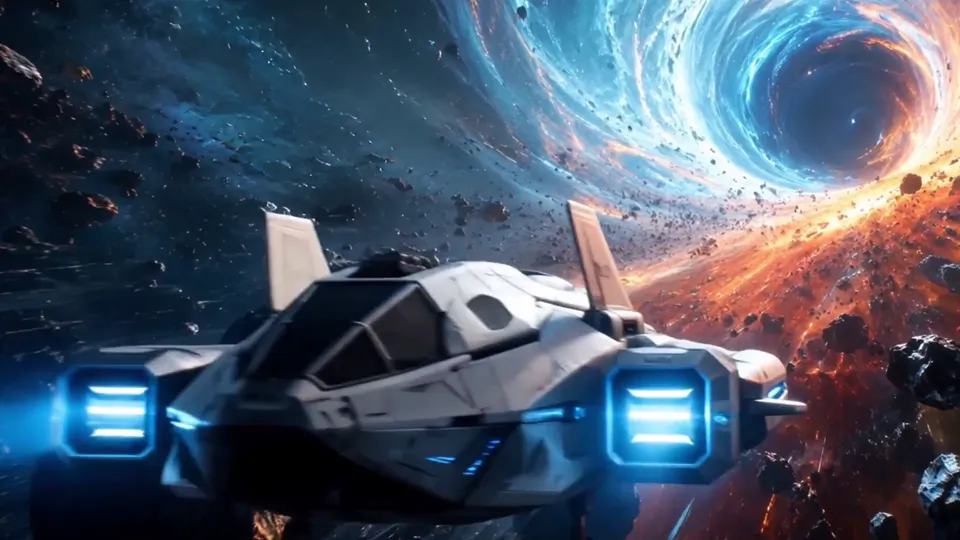
In close-ups you can see the ship's hull and blue engine glow; beside planets and vortexes it becomes tiny. The size contrast lets viewers feel how vast the universe is, rather than relying on words like “grand” to describe the future.
03
Orange and blue light pulls every scene the same way
The ending keeps returning to cool blue light, bright orange bands and arcing rings, which appear along the voyage, at the edges of planets and in the closing background. The light guides the eye, ties the colors of each segment together, and finally frames the competition name.
03 / Scene Breakdown
Focus on the last 23 seconds: the space ending we made.
Film · 00:00–01:26
First 86 seconds: event recap (the organizer's full film, not made by us)
The first part of the full film was made by the organizer: quick cuts of past winning works, a recap of the previous edition, and the new edition's tracks and partnerships with universities and overseas partners. We keep only two clips here for context; our part is the space ending from 86 seconds on.
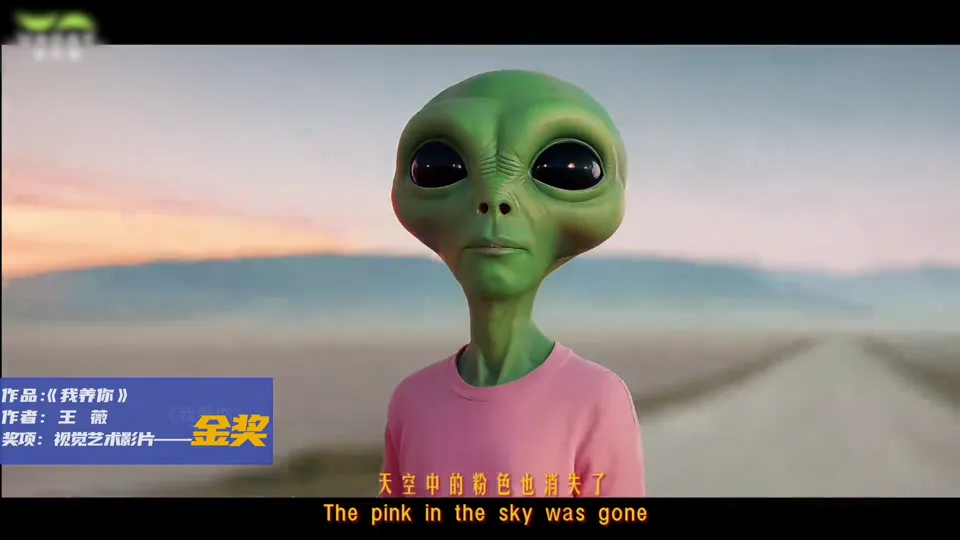
Clip · 00:15–00:21
From the works to the VACAT title
After an alien-themed work, the title “AI Visual Creativity Competition · VACAT Awards” pops up, and the film shifts from showcasing works to recapping the competition.
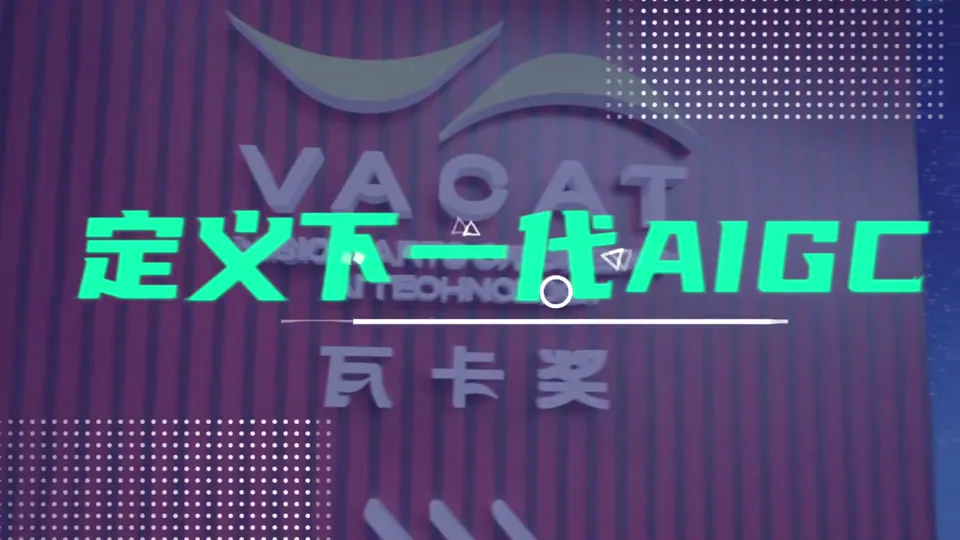
Clip · 01:23–01:26
The theme card leading into the ending
Large green type reads “Defining the Next Wave of AIGC Creation.” In the next shot, the screen hands over to the space ending we made.
Film · 01:26–01:38
Departure and Deep-Space Crossing (Made by Us)
The ending starts here: the spacecraft first appears over an ice field, then plunges into blue-orange streams of light and flies past planets and through an asteroid belt. The whole way, we follow the same ship.
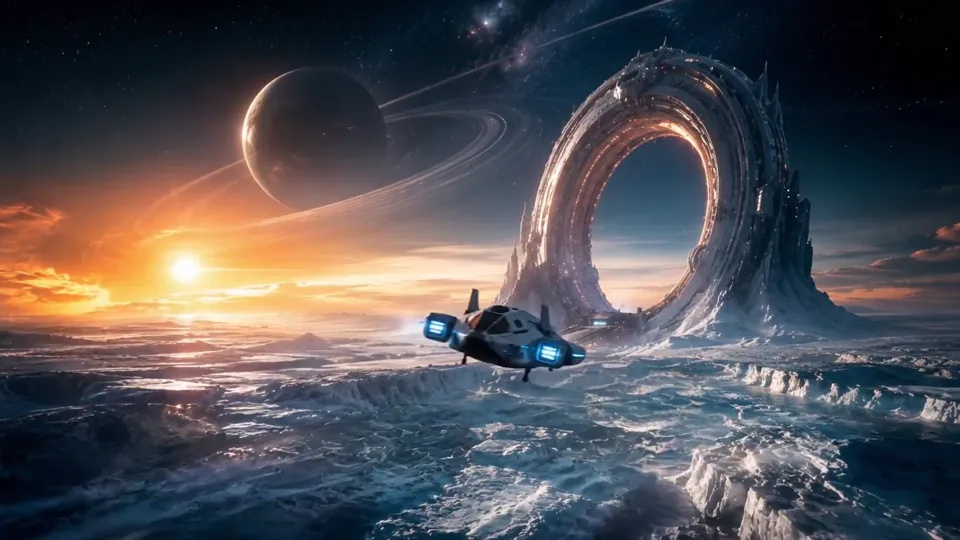
Clip · 01:26–01:29
Leaving the ice field, into the light
The ship flies past a frozen surface and a ring-shaped megastructure, and in the next shot plunges into radiating blue-orange streams of light. This frame also became the video cover.
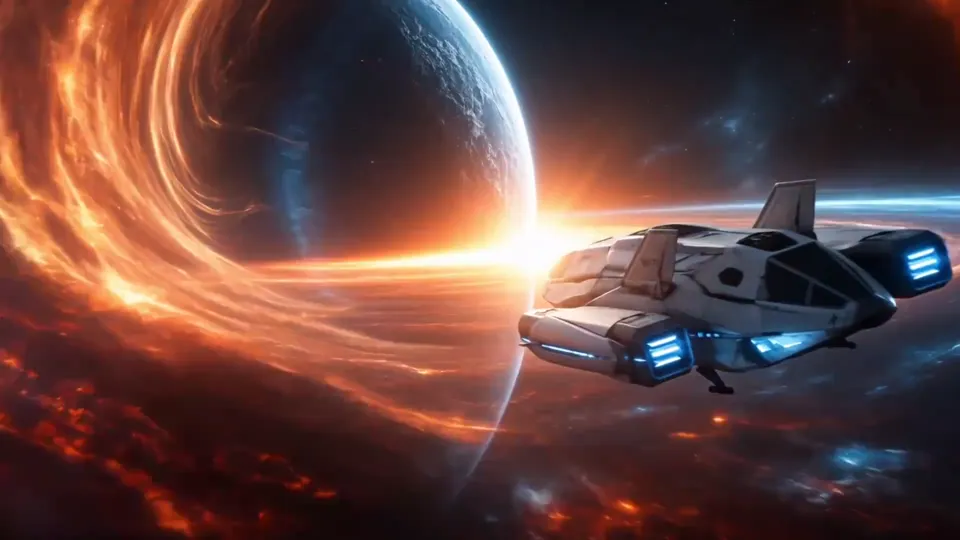
Clip · 01:29–01:34
Skimming a planet along a band of light
The ship follows an orange band of light past a giant planet and a black-hole ring. When the camera pulls back, the ship is just a dot, and the scale of the universe hits at once.
Clip · 01:34–01:38
Through an asteroid belt toward a vortex
In close-up you can see the hull and blue thrusters, with debris streaking past on both sides and a blue-and-orange vortex in the distance.
Film · 01:38–01:50
Planetary Rings and the End Card (Made by Us)
The ship flies farther and farther away, planets and rings fill the frame, and a final band of light remains to hold up the competition name.
Clip · 01:38–01:42
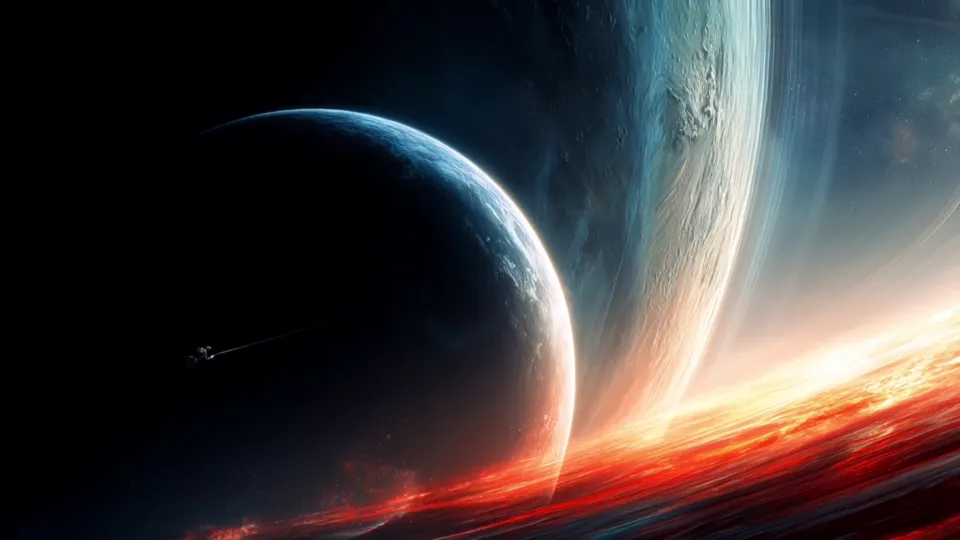
A tiny ship before a dark planet
A dark planet fills the frame and the ship streaks across it, almost too small to see; then rings and orange light spread across the lower half of the screen.
Clip · 01:42–01:46
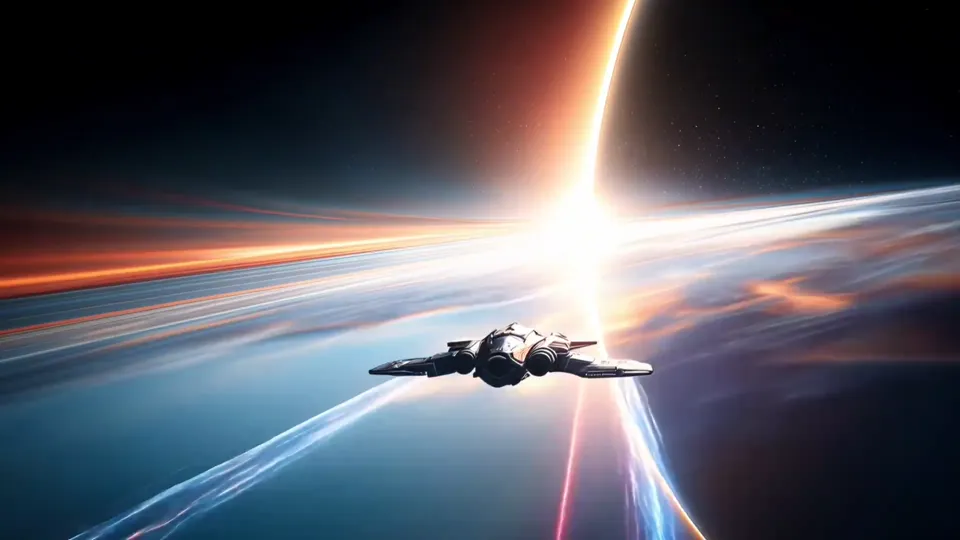
Flying into the bright light
The ship flies toward the bright light at the center of the ring as gold and blue bands stretch out on either side.
Clip · 01:46–01:50
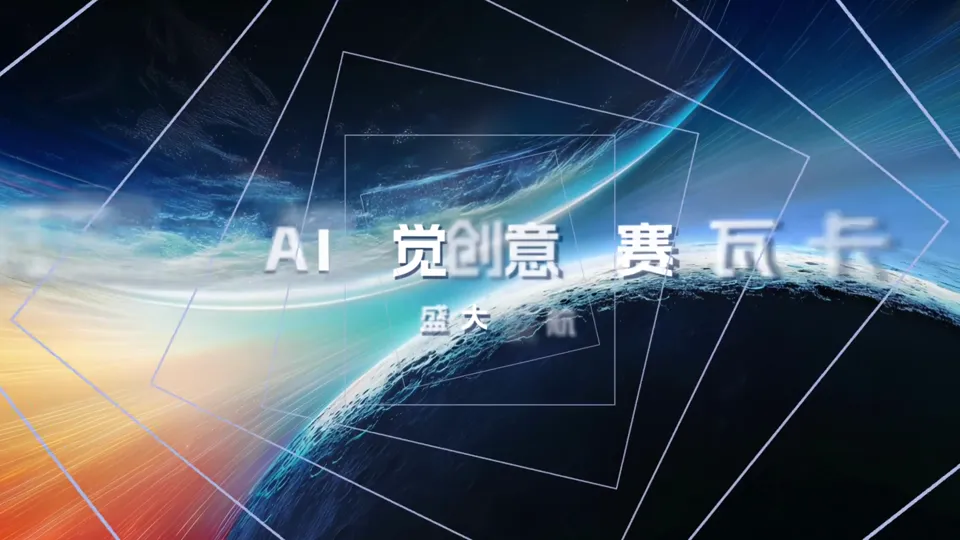
End card: The VACAT Awards set sail
The planet's arc and the band of light stay in the background as “3rd AI Visual Creativity Competition · VACAT Awards · Now Setting Sail” appears, and the film closes.
04 / Gallery
Frames worth a closer look.
Ending and cover visual: the spacecraft skims past a frozen surface and a ring-shaped megastructure.
05 / Results
Our Scope: The Ending and the Cover
We produced the space ending and the video cover for the competition's concept film. This page shows the full film; the roughly 23-second ending is ours, including the spacecraft's voyage, the celestial landscapes and the end card.
Case Study
Liandan AI Studio × VACAT Awards | A 23-Second Space Ending for an AI Visual Competition Promo
The 3rd AI Visual Creativity Competition (VACAT Awards) was releasing a promo film.
The first 80-odd seconds were packed: winning works, judges, platform partnerships, and campus and overseas exchanges.
After all that, the film still needed an ending that would hold the viewer's eye.
We made the last 23 seconds and the video cover: a spacecraft sets off from an ice field, passes through streams of light and planets, and finally brings the competition name onto the screen.
Client
3rd AI Visual Creativity Competition (VACAT Awards)
Project Type
AI promo segment support: space ending + video cover
Timeline
May 2026
Specs
Full promo 1920×1080, about 1 min 50 s; we produced the ending, about 23 seconds
Distribution
Full promo released on Douyin
Results
The ending sequence and video cover were used in the officially released promo
Produced by
Shenzhen Alchemy Technology Co., Ltd. (Liandan AI Studio)
01
Once All the Information Is Out, What Holds the Ending?
The first half of the promo is almost entirely text cards and event photos, one after another, laying out the competition's achievements and new features.
The last card reads “Defining the Next Wave of AIGC Creation.” If more text followed, viewers would just be reading information.
The ending had a different job: make people feel where this competition is headed, then land on the competition name.
We chose space travel. One spacecraft, from departure through the crossing to arrival, in one unbroken line.
Clip · 01:23–01:29
From the theme card to the ship's departure
As the green theme card closes, the picture cuts to the ship over the ice field, which then plunges into the streams of light.
02
First, Break the References Down into a Reusable Prompt Set
Before starting, we were given a set of space images showing the look we wanted: black holes, planets, and orange and blue streams of light.
We had GPT analyze these references and reverse-engineer prompts in Chinese and English, then organized them into a template:keep the base style fixed, change only the subject and composition.
The base style: a deep-space background, cool blue light interwoven with orange-red streams, an ultra-wide angle, motion blur, and a very small spacecraft in frame as a scale reference. The subject rotates among a black hole's accretion disk, giant planets, interstellar portals, space stations and wormholes.
Style exploration: a black hole head-on, the ship charging up toward the ringStyle exploration: a ship skimming past a black hole's accretion diskStyle exploration: high-speed light streams beneath a planet's rings
The images this produced all share the same color and light, like one family, while the scenes differ, so nothing jumps when they are cut into one continuous voyage.
We also compared several image models: some were more realistic, others more fantastical. This ending called for a dreamlike universe, so we went with the more fantastical direction.
03
How the Ship Enters: Show Where First, Then Accelerate
Open on a close-up of thrusters firing, and viewers don't yet know where the ship is or where it's going.
So the first shot is wide: a frozen surface, a ring-shaped megastructure and a ringed planet in the distance, with the ship skimming past in front. Viewers see this world clearly first, and in the next shot the ship plunges into the light.
First shot of the ending, also the video cover: the ship skims past the ice field and a ring-shaped megastructure
This shot also became the video cover. It needs no text; on its own, it reads as a film about imagination and the future.
In the shots that follow, changes in the ship's size carry the sense of scale: in close-ups you can see the hull and blue thrusters; beside a planet, the ship is just a dot.
Clip · 01:29–01:34
The ship skims a planet along a band of light
The camera pulls back and the ship becomes a dot on the band of light.
04
Linking Stills into a Voyage with First and Last Frames
Once the stills were locked, we generated video from first and last frames: given the opening and closing image of a shot, the model fills in the motion between them.
In the generation prompts we specified sound effects only, no background music. That way the footage could go straight into the edit without stripping out music and re-adding effects, saving a step.
In the final film, every shot moves forward: the ship flies deeper into the frame and the light streams pull the same way, so the scenes join into one unbroken voyage.
The ship doesn't appear in the last shot. The planet's arc and the band of light remain on screen as the background for the competition name.
Clip · 01:42–01:50
Into the bright light, landing on the competition name
The ship disappears into the light, and the band of light stays to hold up “3rd AI Visual Creativity Competition · VACAT Awards · Now Setting Sail”.
05
What this project achieved
For the organizer, the promo gained an ending people remember after watching, plus a cover that works without any text.
For us, it was a fast segment job: about 3 hours from receiving the reference images to delivering the ending.
The speed came from a fixed workflow: break down the references and set a prompt template; batch-generate stills and pick the ones that connect; then join them into continuous motion with first and last frames.
The same approach works for event openers, brand film endings, launch-event big screens and other occasions that need a stretch of high-quality visuals on a tight schedule.
FAQ
FAQ
How were the space visuals in this AI promo made?
We first used GPT to analyze the reference images and reverse-engineer prompts in Chinese and English, organized them into a template with a fixed base style and interchangeable subjects and compositions, and batch-generated 16:9 stills. We then turned the stills into video from first and last frames and cut them into one continuous voyage.
If you make only one segment of a promo, will it connect with what comes before?
Yes. In this film, our ending follows right after the theme card “Defining the Next Wave of AIGC Creation,” uses the ship's voyage to push the theme forward, and leaves the band of light as the background for the competition name, “VACAT Awards · Now Setting Sail.”
How long does an AI visual segment like this take from brief to delivery?
For this project, it took about 3 hours from receiving the reference images to delivering the roughly 23-second ending. Timing depends on the number of shots and whether the style already has references.
Can you deliver a video cover as well?
Yes. The video cover for this project came from the first shot of the ending: the ship skimming past the ice field and a ring-shaped megastructure, in 1920×1080 landscape.
Approach
Preparing Visual Assets for the Space Sequence
Our approach to the space scenes: analyze the reference images, distill prompts in Chinese and English, then generate images with different subjects and compositions. Every image keeps the deep space, orange-blue light streams, wide angle and a small ship for scale, while the subject shifts among black holes, planets and interstellar portals, so the visuals stay coherent while the landscapes vary.
With the stills locked, we tested first-and-last-frame video and the motion of the ending, checking the aspect ratio, the ship's size and how the light streams connect. What makes the ending work is continuous motion and size contrast: however striking a single image is, it has to become a voyage viewers can follow.
In the final film, the ship carries through high-speed travel and celestial landscapes, and the band of energy light is left as the background for the competition's end card. The shot breakdown on this page is timed to the full film; the earlier event recap is there only for context, and our part was just the ending and the cover.