Solar streetlights, vehicle-grid interaction, mobile charging and AI dispatching are linked into one line, carrying green energy from city facilities all the way to residents.
Project Type
Science & Tech
Client
Publicity Department of CPC Longgang District Committee, Shenzhen
Year
2025
Our role
AI visuals & final film (music, subtitles)
Original format
1920 × 1080 · 00:43
Film00:43 · Video
01 / Background
Linking scattered pieces of equipment into an energy chain anyone can follow.
This green energy short of about 44 seconds uses city facilities and residents' own experiences to show how AI works with low-carbon scenarios. The problem to solve: when several devices each do their own job, how do you help viewers see the connections between them in a very short time?
The film moves from the city setting and a multi-scene split screen to solar streetlights, then bidirectional charging, a mobile charging vehicle, a dispatch center and a phone. Equipment, back end and the user's phone appear in turn, turning an abstract energy system into a thread viewers can follow.
02 / Creative Highlights
From city facilities to the back end to residents.
01
Using a split screen to show many uses at once
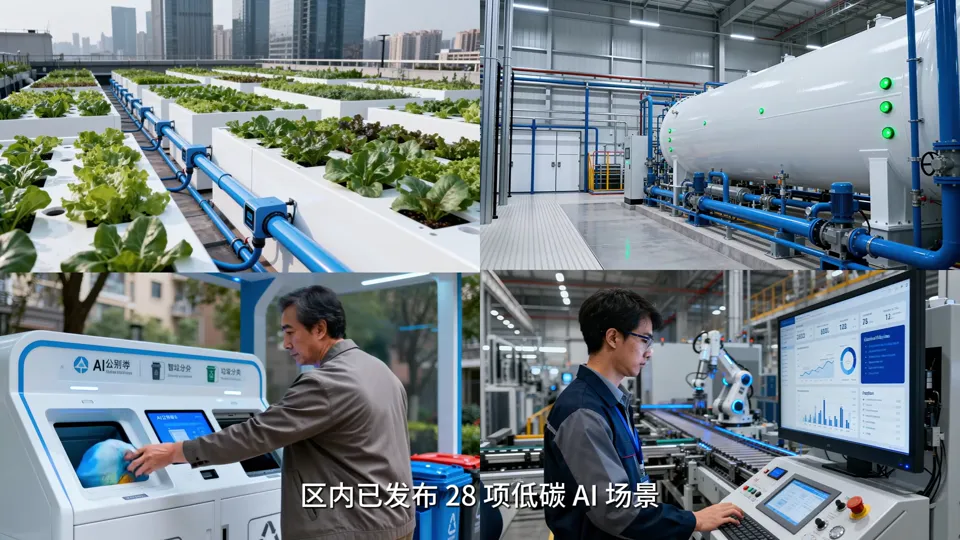
Rooftop farming, industrial equipment, sorting facilities and workers appear side by side in a four-panel frame. Viewers see several scenarios first and then move into the working details of individual devices, so a long list doesn't slow down the opening.
02
Explaining vehicle-grid interaction by comparing screens
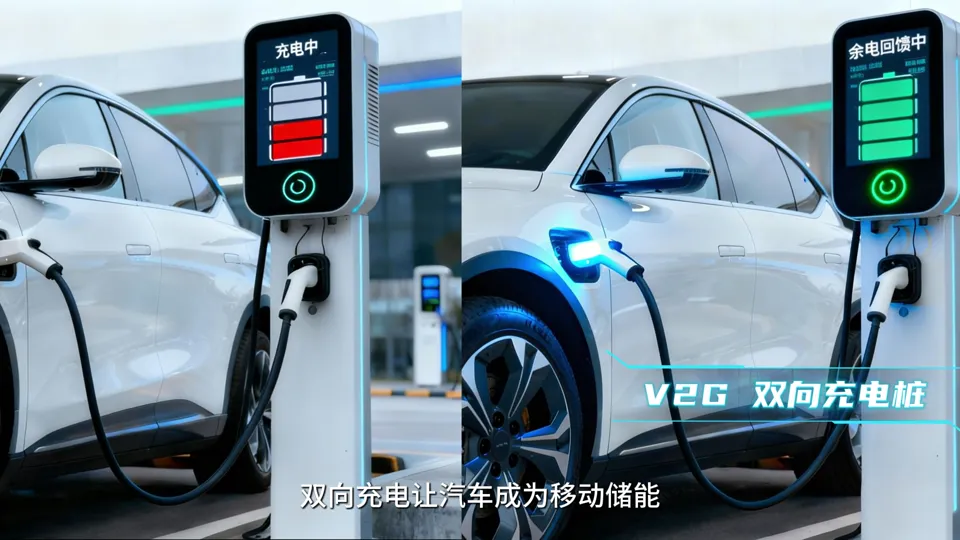
After the car pulls in, two charger screens appear side by side, with blue light effects highlighting the connection between car and charger. Putting the two states next to each other makes “bidirectional charging” easy to understand.
03
Grounding the energy system in concrete services
A mobile charging vehicle shares the frame with a parked car, followed by the dispatch screen and a resident's phone. The images move from “where the equipment is” to “how it's scheduled and used,” so the whole system has real people it serves.
04
Unifying a cool tech look with city life
White equipment, blue information interfaces and green surroundings recur throughout, and the light stays bright and clear. The futuristic feel comes from the facilities and interfaces, while the people and city surroundings keep the look of everyday life.
03 / Scene Breakdown
From an action plan to a phone in a resident's hand.
Film · 00:00–00:12
One plan, twenty-eight scenarios
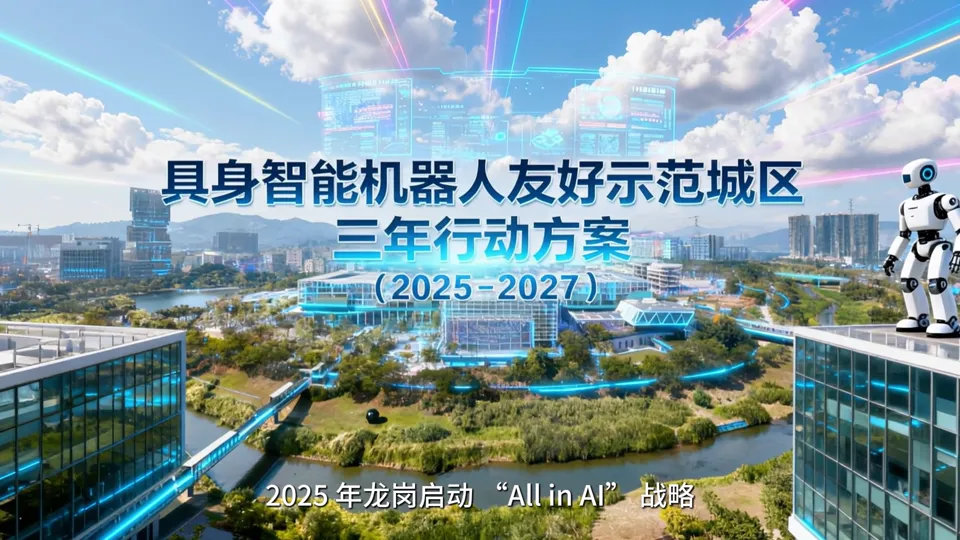
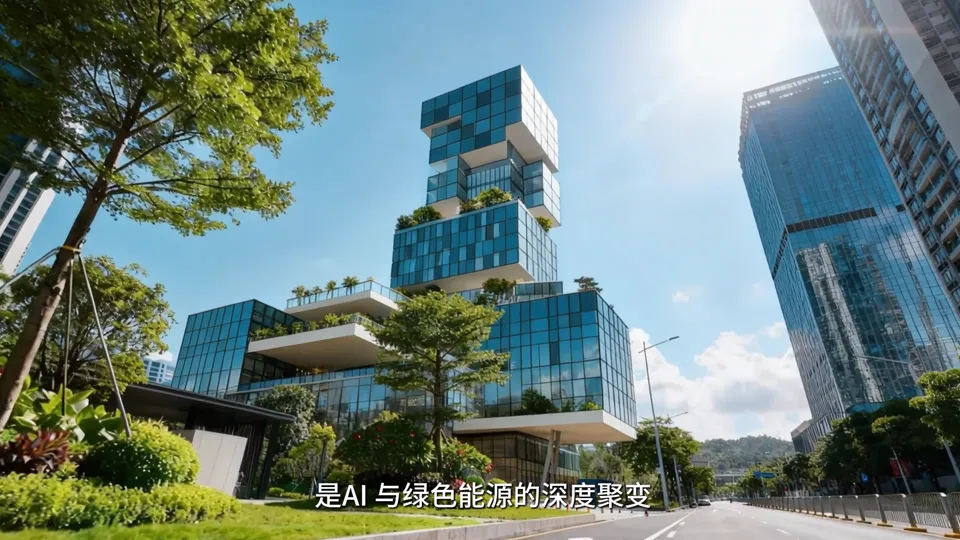
A holographic title, “Three-Year Action Plan for an Embodied-AI-Robot-Friendly Demonstration District,” rises above the city, followed by a low-angle shot of a boxy glass building, then a four-panel split screen that covers Longgang's published low-carbon AI scenarios in one go.
Clip · 00:00–00:03
The action plan in the sky
A glowing plan title hangs above the river and buildings, with a humanoid robot standing on a rooftop and the caption “In 2025, Longgang launched its ‘All in AI’ strategy.”
Clip · 00:03–00:06
Low-angle shot of the boxy glass building
Looking up from beneath the trees, a glass building with staggered levels rises against the blue sky, and the caption calls this “the deep fusion of AI and green energy.”
Clip · 00:06–00:12
Low-carbon scenarios in four panels
A rooftop farm, CO₂ energy storage tanks, a smart waste-sorting machine and engineers in a factory appear at once, with captions reading “28 low-carbon AI scenarios” and “covering 21 sectors.”
Film · 00:12–00:21
Streetlights generate power, and cars can send it back
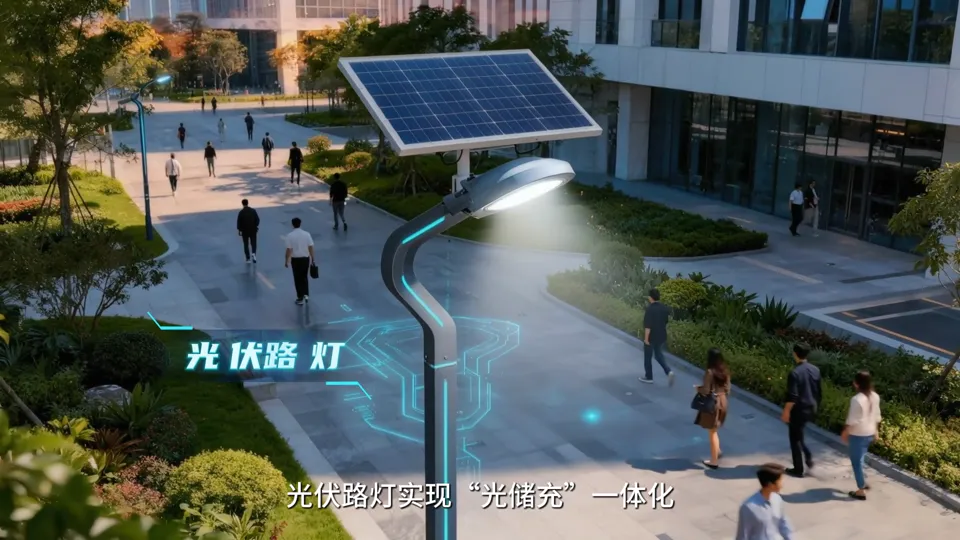
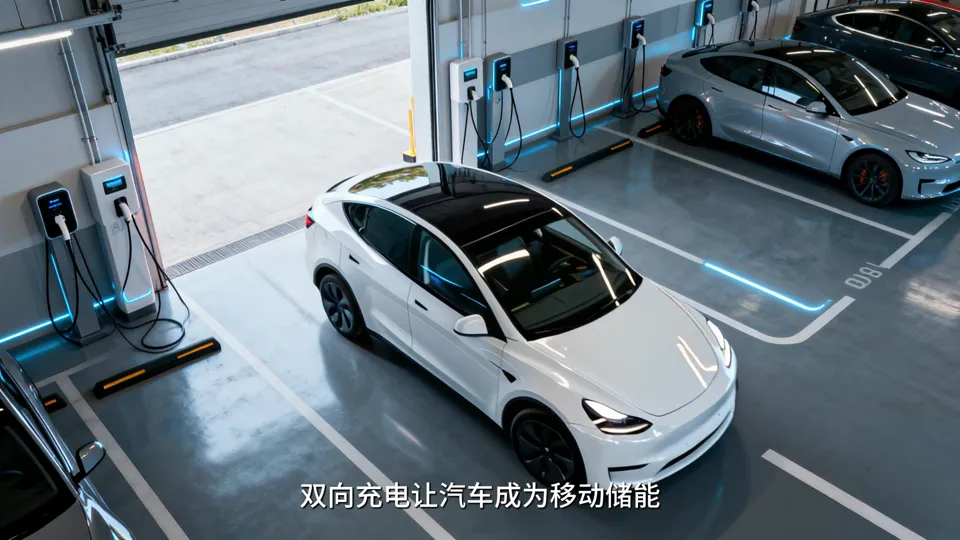
First a streetlight topped with a solar panel lights up among passersby; then a white car pulls into a charging space and two chargers appear side by side, one charging the car and the other sending power from the car back to the grid.
Clip · 00:12–00:17
A solar streetlight among passersby
Pedestrians walk under the light as blue lines on the pole light up, with captions reading “Solar streetlights integrate generation, storage and charging” and “near-zero carbon emissions.”
Clip · 00:17–00:18
Pulling into a charging space
An overhead shot of a white electric car turning into a space lit by blue light strips, with the caption “Bidirectional charging turns cars into mobile energy storage.”
Clip · 00:18–00:21
Charging, and feeding power back
The battery bars on the left charger are red for “Charging,” while the right one shows green for “Feeding Surplus Power Back,” comparing the two states in one frame.
Film · 00:21–00:35
A charging vehicle comes to you, the dispatch center allocates, and a phone charges with one tap
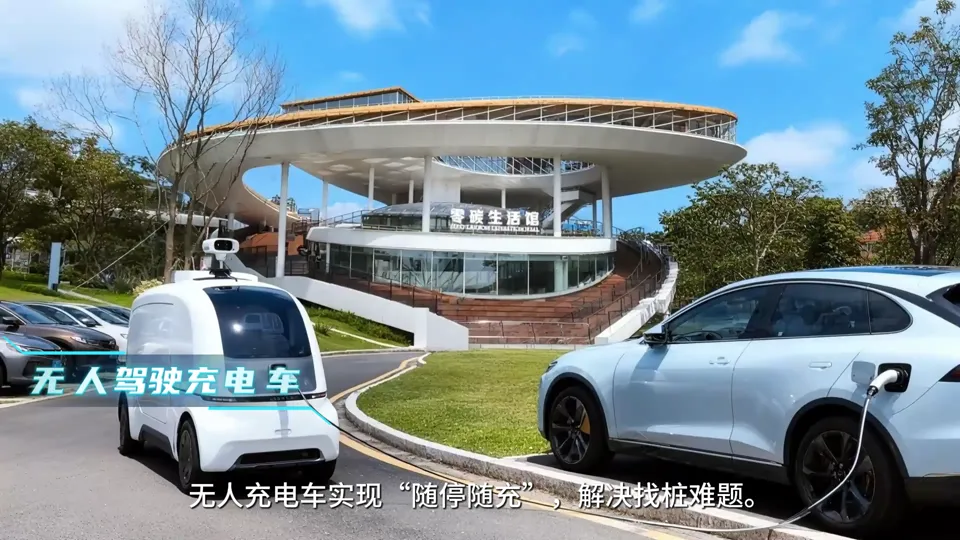
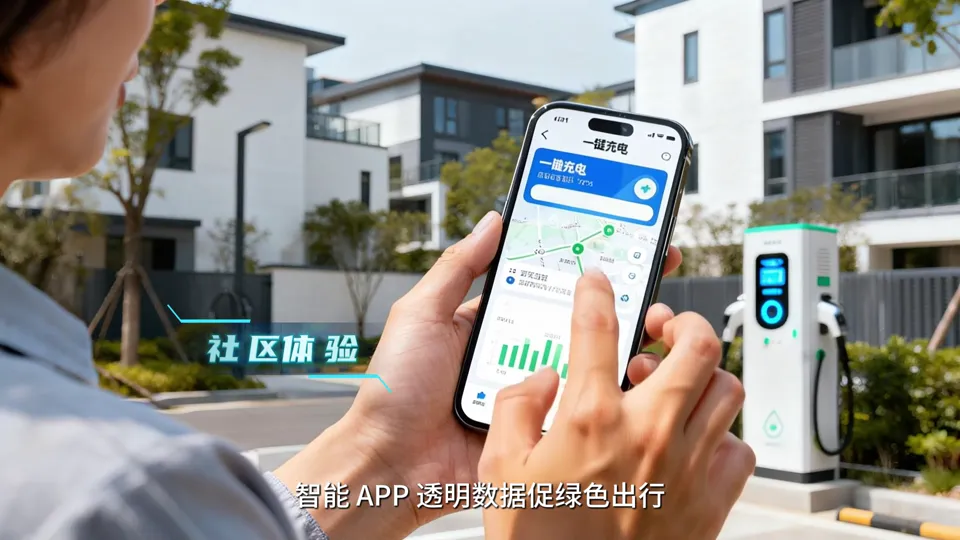
A driverless charging vehicle stops in front of the Zero-Carbon Living Pavilion to top up a car; the camera moves to the big screen in the dispatch center; and it finally lands on the “One-Tap Charging” interface in a resident's hand.
Clip · 00:21–00:26
A driverless charging vehicle pulls up beside a car
In front of the domed Zero-Carbon Living Pavilion, a white driverless charging vehicle pulls out a cable and plugs into a car at the roadside, with the caption “Driverless charging vehicles enable ‘charge wherever you park,’ ending the hunt for chargers.”
Clip · 00:26–00:31
AI charging dispatch center
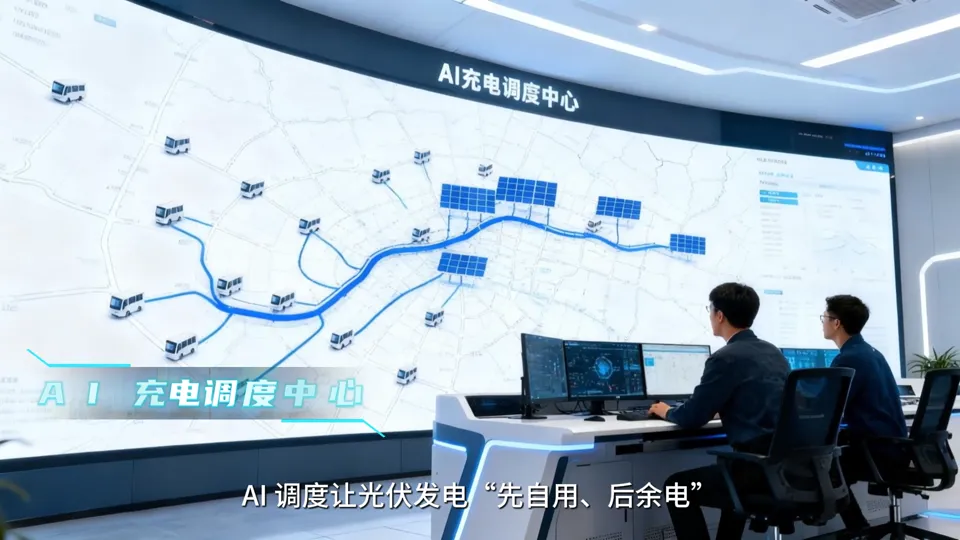
A wall-sized screen shows the district's entire charging network, with blue lines connecting solar points, and two staff members at the console, with the caption “AI dispatching puts solar power to ‘self-use first, surplus second.’”
Clip · 00:31–00:35
One tap on the phone
A resident stands beside a charger in a residential community and taps “One-Tap Charging,” the screen showing charging progress and data, with the caption “A smart app with transparent data encourages green travel.”
Film · 00:35–00:41
Cars on the road, a city among mountains
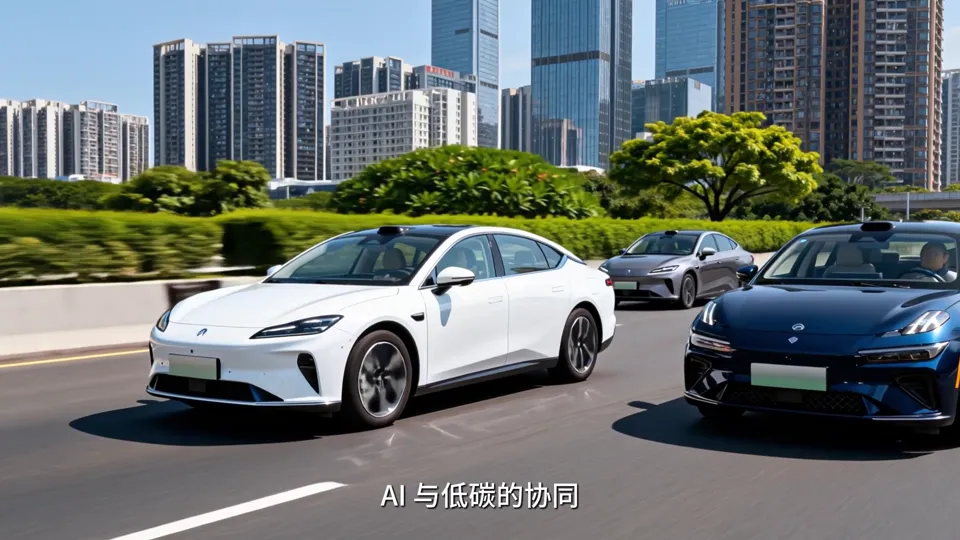
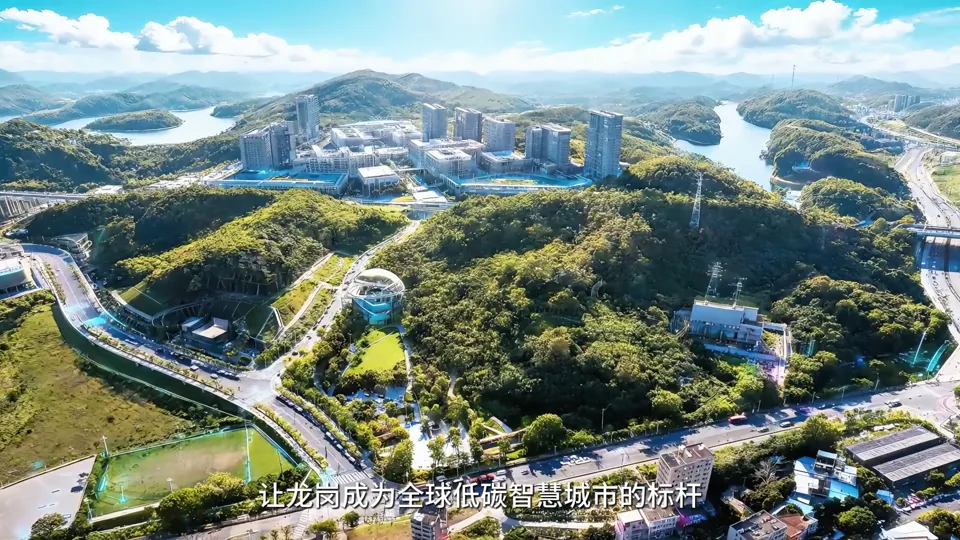
Several electric cars drive side by side on a wide road beneath high-rises, then the camera cuts to aerial shots of Longgang's mountains and water, and the image slowly fades to white into the end card.
Clip · 00:35–00:37
Electric cars driving through the city
White and dark-blue electric cars pass in front of the camera, with Longgang's high-rises and green belts behind them, and the caption “AI and low carbon working together.”
Clip · 00:37–00:41
Panorama of Longgang's mountains and water
Forests, a reservoir, roads and buildings fill the frame, with the caption “Making Longgang a global benchmark for low-carbon smart cities,” before the whole image flashes white to close.
04 / Storyboards & Final Frames
One energy chain: the final frame for every shot.
In the order of the final film: each shot first describes what it shows, followed by the final image used in the film.
01
Opening: The Plan and the Scenarios
In the film · 00:00–00:12
Shot 1.1
Holographic plan title
Longgang's cityscape serves as the background, and the plan title's text, color and position are kept exactly as they were, floating above the city.
Holographic plan title · Final 1
Shot 1.2
Boxy glass building
A low-angle shot of a boxy glass building with staggered levels; the building is clean, with no extra text left in the frame.
Boxy glass building · Final 1
Shot 1.3
Four-panel split screen
Four scenes, a rooftop farm, CO₂ energy storage, waste-sorting supervision and energy-saving upgrades in a factory, combine into one screen to represent the 28 low-carbon scenarios.
Four-panel split screen · Final 1
02
Streetlights and Bidirectional Charging
In the film · 00:12–00:21
Shot 2.1
Solar streetlight
The pole is topped with a solar panel, pedestrians pass beneath it, and glowing tech patterns are added to the lamp body.
Solar streetlight · Final 1
Shot 2.2
Pulling into a charging space
An overhead shot of a white electric car pulling into a futuristic indoor car park, where cars in other spaces are charging.
Pulling into a charging space · Final 1
Shot 2.3
Two charging states
The same car and the same charger, with the screen showing red “Charging” in one and green “Feeding Surplus Power Back” in the other; in the film they appear side by side.
Two charging states · Final 1Two charging states · Final 2
03
Charging Vehicle, Dispatch Center and Phone
In the film · 00:21–00:35
Shot 3.1
Driverless charging vehicle
With the Zero-Carbon Living Pavilion in the background, a streamlined driverless charging vehicle stops at the roadside to top up a car, with lidar and cameras on its roof.
Driverless charging vehicle · Final 1
Shot 3.2
AI charging dispatch center
A wall-sized screen shows the distribution of chargers, blue lines trace where the solar power goes, and two staff members monitor it.
AI charging dispatch center · Final 1
Shot 3.3
One-tap charging
A resident's phone shows the “One-Tap Charging” interface, with the residential community and chargers behind.
One-tap charging · Final 1
04
Closing
In the film · 00:35–00:42
Shot 4.1
Electric cars driving past
White, grey and dark-blue electric cars drive along a wide road beneath Longgang's high-rises, in a tracking shot.
Electric cars driving past · Final 1
Shot 4.2
Aerial view of Longgang's mountains and water
An aerial shot of Longgang's mountains and water under blue sky and white clouds, with the forests, reservoir and buildings all clearly visible.
Aerial view of Longgang's mountains and water · Final 1
05 / Script Excerpts
Beyond the picture.
Copy
Bidirectional charging turns cars into mobile energy storageProject Script and Film Captions
Copy
Driverless charging vehicles enable “charge wherever you park,” ending the hunt for chargersProject Script and Film Captions
Copy
A smart app with transparent data encourages green travelProject Script and Film Captions
06 / Results
Giving a technical system scenarios people can see and use.
In about 44 seconds, the short uses facilities, dispatching and a user's phone to build a clear picture of energy services, so viewers both see the tech scenarios and understand how they relate to city life.
Shorts like this work well in the order “spread out across scenarios, key equipment, service actions, city vision,” letting viewers follow even complex technical themes all the way through.
Case Study
From a streetlight to a phone: explaining an AI energy chain in 43 seconds
The script we received was packed with information: a three-year action plan, 28 low-carbon AI scenarios, 21 sectors, plus a whole string of equipment including solar streetlights, bidirectional chargers, driverless charging vehicles, a dispatch center and a phone app.
The required length was 30 to 60 seconds. There was no way to cover everything, so we did just one thing: let viewers follow the electricity on one full loop.
This is our work for the Publicity Department of the CPC Longgang District Committee, Shenzhen, the fifth film in the Longgang series: 43 seconds on how AI and green energy work together in the city.
Client
The Publicity Department of the CPC Longgang District Committee, Shenzhen (credited at the end as “Presented by the Publicity Department of the CPC Longgang District Committee, Shenzhen”)
Project Type
AI city promo short (green energy theme), No. 5 in the Longgang AI Video Series
Timeline
October 2025 (finalized in the same batch as two other low-carbon shorts)
Runtime & Specs
43 sec · 16:9 · 1920×1080
Deliverables
Landscape final film with subtitles, music and end card
Produced by
Shenzhen Alchemy Technology Co., Ltd. (Liandan AI Studio), credited at the end as “AI technical support by Liandan AI Studio”
01
28 scenarios are too many to cover, so we follow the electricity on one loop
The script came with a list of 28 low-carbon AI scenarios, from smart streetlights and building energy monitoring to cold-chain temperature control and carbon accounting. Even at one second each, that's half a minute, and viewers would remember nothing.
We handed the opening to two “overview” shots: an action plan title rising above the city, then a four-panel split screen showing a rooftop farm, storage tanks, a waste-sorting machine and a factory floor at once, with captions stating “28 scenarios” and “21 sectors.” In five or six seconds, the full scope is laid out.
The rest of the time follows only the charging line: streetlights generate power → cars charge and also send power back → a charging vehicle comes to the car → the dispatch center allocates → residents charge with one tap on their phones. Equipment, back end and users appear in turn, and viewers follow a unit of electricity from the roadside into the palm of a hand.
Clip · 00:06–00:12
Low-carbon scenarios in four panels
Four scenarios on one screen instead of reading out a list.
02
Setting the color first, then generating individual shots
Films like this easily end up with the screen-filling dark blue and neon glow of a “tech look,” where every scene starts to look the same. Before generating the actual shots, we ran all 28 scenarios through several rounds of tests specifically to compare color and texture.
The first round was blue-toned with saturation too high; after that we set a color ratio: 40% white, 20% blue, 10% green, 30% other colors, then lowered the saturation and added detail and a light filter. White equipment, blue interfaces and green plants became the base palette of the whole film, and every shot was generated to this ratio.
First test round: blue-toned, saturation too highAfter setting the look: mainly white, low saturation, with texture
03
For “bidirectional charging,” let two screens speak side by side
The V2G bidirectional charger is the hardest link in the chain to grasp: a car can both charge and send power back to the grid. Just filming a car with a charging gun plugged in doesn't show “bidirectional.”
We made two images of the same car and the same charger, changing only the screen: one shows red battery bars for “Charging,” the other green battery bars for “Feeding Surplus Power Back.” In the film they appear side by side with the screen lights blinking, so viewers don't need an explanation: comparing left and right, they see the power flows both ways.
The screen changed to “Charging,” with red battery barsThe screen changed to “Feeding Surplus Power Back,” with all-green battery bars
Clip · 00:18–00:21
Charging, and feeding power back
The two states side by side, labeled “V2G Bidirectional Charger.”
04
However futuristic the equipment, the background has to be Longgang
Things not yet in widespread use, like driverless charging vehicles and dispatch screens, easily look like sci-fi. We placed them in real Longgang locations: the driverless charging vehicle is parked in front of the Zero-Carbon Living Pavilion, a domed building recognizable at a glance; the ending is built on aerial footage of Longgang, dehazed, brightened and given blue sky and white clouds, with real forests, reservoirs and buildings. The glass building in the opening low-angle shot works the same way: it's a specified boxy modern building, with all extra text in the original image removed.
This film belongs to the same set of low-carbon shorts as “My Light, Low-Carbon Everyday” and “Green Wonders of an Eco-City”; all three were checked and finalized together: subtitles got the same black drop shadow at a fixed height, and each ends with a 0.5-second white flash into the presenter's logo.
The driverless charging vehicle parked in front of the Zero-Carbon Living Pavilion
05
What this project achieved
A script crammed with policy names, scenario counts and equipment terms became an energy chain you can watch in 43 seconds: streetlight, charger, charging vehicle, dispatch center, phone, one shot per link, each connected to the next.
For the client, none of the key figures in the policy were lost; they're all in the captions. For viewers, what sticks is two chargers side by side and that one tap of “One-Tap Charging” in someone's hand.
FAQ
FAQ
The script has lots of policy names and data. How does an AI short fit them in?
Use images for the big-picture information and captions for the smaller numbers. This film opens with the action plan title floating above the city, then a four-panel split screen to represent the 28 low-carbon scenarios, with “28 scenarios” and “21 sectors” written right in the captions. That takes five or six seconds, and the rest of the film focuses on one charging line.
How do you keep color and texture consistent across a set of AI images?
Test in batches before generating the actual shots. We ran the 28 scenarios through several rounds, adjusting from bluish, overly vivid versions to a color ratio of “40% white, 20% blue, 10% green, 30% other,” lowering saturation and adding detail; after that, every shot was generated to this ratio.
With several films in the same series, how do you keep the style consistent?
Check and finalize the films together. This film was delivered on the same day as the other two low-carbon shorts: subtitles got the same black drop shadow at a fixed height, and each ends with a 0.5-second white flash into the presenter's logo, so viewed together they look like one set of work.
Approach
Layer the message first, then unify the visuals and information details.
We first split the information into layers: the city and split screen show where it can be used, the light poles and charging facilities show the specific equipment, and the dispatch center and phone show how the back end and users work together. The story is told through the order of the shots rather than long lists of concepts.
During image generation, we compared color and texture in batches, unifying the film's style with lower saturation, white facilities, blue interfaces and green surroundings; we then wrote clear motion instructions for each action, such as a car pulling in, a streetlight switching on, equipment moving and a finger tapping a phone.
We checked the whole series together, unifying subtitle position and shadow, music and the end-card treatment, and leaving no text carried over from source images or generated clips. Information on the dispatch screen was given a clear hierarchy so the equipment and routes are the focus of the image.